
Trump’s Mandatory Abraham Accords are dangerous; Why he pushes it still
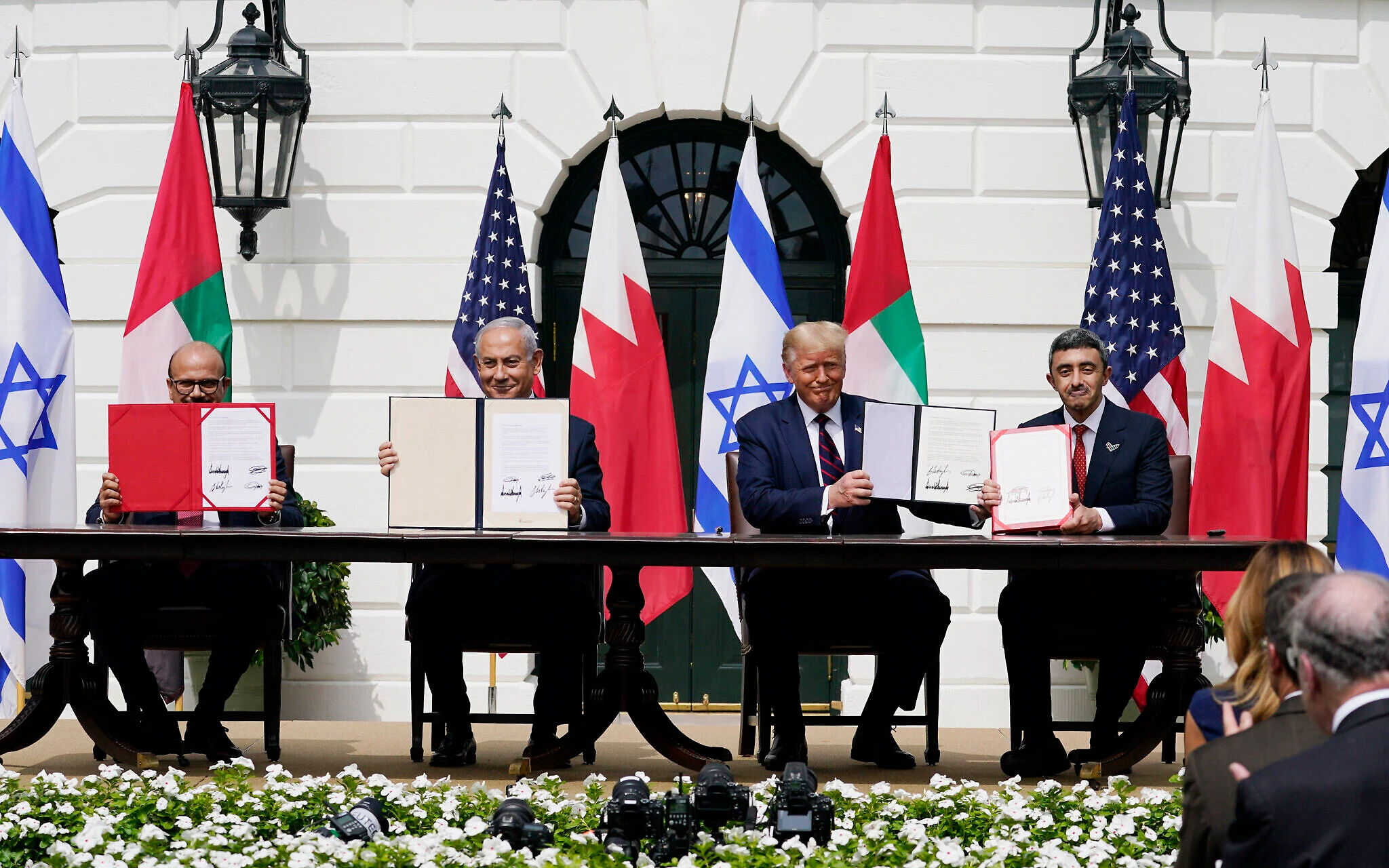
President Trump announced on May 25 that joining the Abraham Accords should be treated as mandatory for Saudi Arabia, Qatar, Pakistan, Turkey, Egypt, and Jordan and linked it directly to any agreement with Iran. The Abraham Accords are rightly regarded as a landmark achievement and expansion at first glance might sound good for Israel. It may not be. The distinction between which elements of Trump’s push genuinely serve Israeli interests and which elements threaten them is the crucial question to ask and the answer requires understanding not just what Trump is proposing, but why.
Why Trump is pushing this now
Reports across multiple international outlets on the draft Iran agreement are frequently contradictory, likely reflecting spin and the ongoing dynamic nature of the talks by the parties to the negotiations. What matters is their convergent pattern: no credible account has suggested the deal would fully dismantle Iran’s nuclear infrastructure, end its ballistic missile program, sever its regional proxy network, or establish unrestricted freedom of navigation through the Strait of Hormuz, leaving the architecture of Iranian regional power largely intact.
In Middle Eastern political culture, compromise by the stronger party on issues it defined as non-negotiable is seen as weakness and weakness emboldens enemies.Iran’s leadership would almost certainly portray surviving the confrontation with the United States as a historic victory, and that narrative would carry regional weight regardless of any agreement’s technical details.
The mandatory Abraham Accords expansion push is most plausibly understood as partly compensatory: by trying to force a sweeping regional diplomatic achievement, the administration attempts to reframe the narrative from a partial Iran deal to a historic transformation of the Middle East. Trump is also deploying the Iran negotiations as active leverage , countries seeking US engagement on Iran are being told they must simultaneously deliver on normalization with Israel. But there is a second motivation, less visible in public commentary, that is arguably more significant for Israel.
On September 17, 2025, Saudi Arabia and Pakistan signed the Strategic Mutual Defense Agreement (SMDA), it is a formal mutual defense pact treating aggression against one signatory as aggression against both. Pakistani Defense Minister Khawaja Asif stated two days after signing that the agreement extended Pakistan’s nuclear umbrella to Saudi Arabia, a characterization Saudi officials reinforced by describing the pact as encompassing all available military capabilities. Some subsequent reporting has introduced nuance around the precise scope of that nuclear dimension, and the strategic ambiguity that remains may itself serve the interests of SMDA members regardless of what is formally operative. By January 2026 Turkey was in advanced talks to join thought it hasn’t yet and on April 17, 2026 the foreign ministers of Saudi Arabia, Turkey, Egypt, and Pakistan met at the Antalya Diplomacy Forum to explore combining their strengths on security matters. Qatar’s association was reported in parallel.
Some international media dubbed this formation an Islamic NATO in the making. It captured something real: a mutual defense structure with an implicit nuclear dimension, several members with deep ties to China and Russia, whose consolidation would shift regional influence meaningfully away from US and Israeli interests.
Five of the six countries Trump named are the countries moving toward this formation, a pattern too striking to be coincidental, even if the precise strategic calculation behind it cannot be confirmed. By singling out Qatar and Saudi Arabia for immediate action, Trump’s push plausibly functions, at least in part, as an deliberate attempt to fracture the SMDA grouping before it consolidates, creating pressure that could split key members by pulling them into a Us-Israeli framewrok rather than allowing a competing formation to solidify. If it succeeds on even one key member, particularly Saudi Arabia, it weakens the group in the making, a clear gain for Israeli and US strategic interests alike, including in the context of great power competition with China and Russia, whose influence runs through of these countries
The danger: what mandatory normalization could mean for Israel
The immediate danger concerns Turkey, Qatar, and Pakistan. Turkey has provided active political support to Hamas and its hostility toward Israel has deepened steadily under Erdogan, who stated in March 2024 that Netanyahu’s name would be remembered alongside Hitler, Mussolini, and Stalin, and whose government this year secured an Istanbul court indictment of Netanyahu and 34 other Israeli officials on genocide charges. Jerusalem Center for Security and Foreign Affairs researcher Yoni Ben Menachem, writing in the Jerusalem Post in April 2026, described this as making Turkey Israel’s emerging strategic threat: ‘Turkey is the new Iran.’ Qatar has hosted and protected Hamas’s political leadership for years which is confirmed by multiple US and Israeli government statements while Qatar’s Al Jazeera consistent hostile coverage of Israel is well documented. Pakistan is a nuclear-armed state that has never recognized Israel, maintains deep institutional opposition at both elite and public levels, and whose military has longstanding ties to anti-Israel actors across the region.
Forcing these three governments into the Abraham Accords framework changes none of their underlying attitude. What it does is grant them expanded access through business, travel, and diplomatic channels that Turkey, Qatar and Pakistan can exploit to increase support for Hamas or conduct intelligence operations against Israel.
The Arab Opinion Index 2025, covering 40,130 respondents across 15 Arab countries, found 87 percent oppose their countries recognizing Israel, with only 6 percent in favor. Arab Barometer surveys in 2023-2024, published in Foreign Affairs, found support for normalization did not exceed 13 percent in any surveyed country. These figures represent the domestic political constraint within which every government on Trump’s list must operate, and explain why forced agreements rather than genuine strategic interest are likely to remain shallow and reversible.
And here the contrast with the UAE is telling. The UAE model worked because it was not forced , it reflected a genuine strategic choice by Emirati leadership to invest in the relationship with Israel, they wanted to make it work, and that led to the UAE working on deep reforms in the education system and media to reshape public opinion which allowed cooperation to deepen gradually and organically. That depth is now visible in concrete operational terms: in 2026.
Israel deployed Iron Dome batteries, Spectro systems, Iron beam system and personnel to the UAE to help intercept Iranian missiles and drones, with IDF soldiers operating air defense systems on Arab soil , something previously unthinkable in the region (Reuters, Times of Israel, May 2026). Any normalization with Turkey, Qatar, or Pakistan would be imposed from above in environments of deep and institutionalized hostility, with both governments and populations overwhelmingly opposed. The contrast makes clear what genuine Abraham Accords normalization produces versus coerced ones and why the two cannot be equated.
Egypt and Jordan sit in a different category but are not viable candidates for the upgrade to Abraham accord style relations. Both maintain formal peace treaties with Israel that have produced real value over the years, from security cooperation and counter-terrorism coordination to Israeli gas exports to Egypt, water agreements with Jordan, and decades without major war. But both relationships remain deeply strained , with high anti-Israel sentiment among the populations and Islamist opposition ready to mobilize against any visible deepening of ties. Pushing either toward Abraham Accords-level normalization risks destabilizing the very governments that have sustained these arrangements, a far costlier setback than the absence of warmer ties.
The structural danger is less immediate but potentially more consequential. Israel’s deterrence has historically rested on a regional monopoly of assumption around its internationally alleged nuclear capabilities, neither confirmed nor denied by Jerusalem, while its conventional military superiority has deterred at least the massive multi country wars of the past. The SMDA’s extension of Pakistan’s nuclear umbrella risks eroding both pillars simultaneously as it introduces Mutually Assured Destruction deterrence (Mad doctrine) dynamics. The India-Pakistan relationship since 1998 illustrates how this dynamic operates in practice: since both became declared nuclear powers, they have clashed militarily multiple times like Kargil in 1999, Pulwama in 2019, and the May 2025 confrontation that itself accelerated the SMDA’s signing. Each confrontation was real and lethal, and each stopped below the nuclear threshold because both sides understood where that ceiling was. That ceiling did not prevent conflict, it created a space of conventional hostilities both parties felt comfortable occupying, calculating the other would not cross existential responses over sub-threshold provocation.
If SMDA members come to feel protected by Pakistani extended deterrence, even imperfectly, as any such arrangement is not yet formed, they may make a similar calculation toward Israel. States shielded by a third party’s nuclear umbrella may calculate they can sustain sub-threshold pressure, proxy support, economic coercion, low-intensity military activity, without triggering a nuclear response neither side wants. That calculation would fundamentally alter the risk tolerance of actors who currently moderate their behavior partly out of respect for Israel’s ability to dominate and control how far any conflict escalates.
This is why the broad mandatory push risks being counterproductive for Israel. Forcing Turkey, Qatar, and Pakistan into Abraham Accords membership while they move to join SMDA grants them the benefits of both frameworks simultaneously, Abraham Accords access alongside SMDA protection. The only instrument capable of achieving genuine disruption of this is breaking up that emerging group by a targeted offer to Saudi Arabia attractive enough to pull it toward US-Israeli orbit rather than toward the emerging bloc.
The opportunity: Saudi Arabia and why it matters
Saudi Arabia is the exception in Trump’s list, it the one country where genuine strategic realignment is conceivable, and whose realignment would deliver the most. Saudi normalization has been a strategic objective of multiple Israeli governments across the political spectrum because of its unmatched weight: Riyadh’s recognition of Israel would transform the regional landscape in ways no other normalization could replicate, given its religious, financial, and political position in the Arab world and wider global muslim community. As the SMDA’s anchor, Saudi Arabia’s genuine reorientation would simultaneously disrupt consolidation of the nuclear umbrella dynamic before it matures further. Iranian attacks on Gulf energy infrastructure in 2026 have raised Saudi threat perceptions in ways that may create genuine openness to both US security guarantees and Israeli security cooperation. As they also saw the current pact with Pakistan didn’t help them much when they were under fire from Iran.
The obstacles are real though. Crown Prince Mohammed bin Salman has consistently identified a credible pathway toward Palestinian statehood as a prerequisite, a condition reflecting genuine domestic political constraints, not merely a negotiating position. The kingdom’s conservative religious establishment, the social contract underpinning Vision 2030’s reforms, and deep public sentiment opposing normalization with Israel all mean any realistic normalization must be carefully staged at Saudi pace. The UAE model of a deep, multi-level normalization that reshaped public attitudes and created room for Abu Dhabi to steadily deepen the relationship is the right destination on the horizon. But it must be reached through Saudi domestic reality and likely requires a slower more incremental path. Not compressed through external pressure that risks triggering the backlash it is designed to avoid.
What Israel should want from this
Israel’s strategic interest in this is not aiming for the broadest possible expansion of the Abraham Accords regardless of who signs. It is a targeted, serious, properly incentivized Saudi normalization process, that takes into consideration the domestic constraints MBS has to deal with, built on genuine mutual interests, and decoupled from the coercive pressure on hostile actors that risks undermining it.
The SMDA disruption goal embedded in Trump’s push is valuable for Israel but it only succeeds if Saudi Arabia is offered something genuinely attractive enough to choose the US-Israeli orbit over the emerging regional bloc. Saudi Arabia genuinely on a path toward the normalization the UAE has achieved, at Saudi pace and on terms that respect its domestic realities, is the most strategically significant gain available to Israel in the current regional moment.
The Abraham Accords label does not make every agreement automatically good for Israel. A hollow broad push that gives hostile actors extra access they can exploit would damage Israeli security and the genuine legacy the original Accords represent. Israel has every reason to make that distinction clearly and to push its American partner toward the focused, serious Saudi track before the current window closes