
Boaz’s grainpile and Ruth’s vulnerability
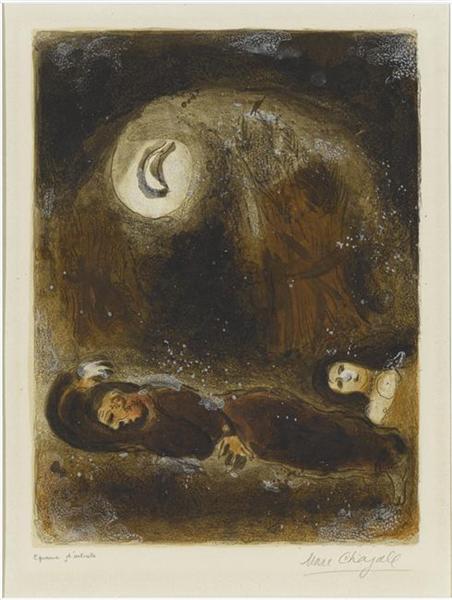
Ruth 3:7-9 is charged with the tension inherent in being poor and vulnerable—and yet full of worth. Ruth the Moabite had devotedly followed her mother-in-law Naomi back to Bethlehem, where Ruth is hard at work in the fields owned by Boaz to glean and make ends meet for herself and Naomi. Naomi then instructs Ruth to seduce Boaz as he sleeps by his grainpile after winnowing barley to guard his pile until the grain is sold:
“Boaz ate and drank, and in a cheerful mood went to lie down beside the grainpile. Then she went over stealthily and uncovered his feet and lay down. In the middle of the night, the man gave a start and pulled back— there was a woman lying at his feet! ‘Who are you?’ he asked. And she replied, ‘I am your handmaid Ruth. Spread your robe over your handmaid, for you are a redeeming kinsman’” (Ruth 3: 7-9).
Boaz acts honorably and “redeems” Ruth by marrying her. Ruth and Boaz thus become the ancestors of King David—and in the Christian tradition of Jesus. But when we take into account what is known about the real world, Ruth and Boaz’s providential “fairy tale” ending seems far from guaranteed. Ruth is vulnerable by being poor and by being a woman and by being a Moabite, a daughter of a nation who were enemies of the Israelites. As I think about Ruth essentially demanding a marriage from the rich farmer Boaz, I hear echoing in my ears Cassio in Shakespeare’s Othello mocking the idea of marrying his lover Bianca:
IAGO
She gives it out that you shall marry her.
Do you intend it?
CASSIO Ha, ha, ha!
OTHELLO
Do you triumph, Roman? Do you triumph?
CASSIO 140I marry ⟨her?⟩ What, a customer? Prithee bear
some charity to my wit! Do not think it so unwholesome.
Ha, ha, ha! (4.1.136-142)
Clearly, some women are marriage material and others are not. A “present-day” Boaz guarding his grainpile could have easily exploited Ruth and then given her the “Ha, ha, ha!” message about the idea of long-term commitment.
In Marc Chagall’s painting “Ruth at the Feet of Boaz,” Boaz seems to be sleeping, but Ruth seems to be awake—perhaps testifying to the predicament of the more vulnerable person who has everything to lose and therefore cannot relax. Ruth’s breasts are exposed in the painting—reminding us that just as Boaz could take her as a wife, he could also choose to exploit her as a sexual object to then be discarded.
That Boaz does not succumb to an exploitative mentality is to be attributed partly to the fact that he regards Ruth not only as physically attractive but also as morally worthy. Shortly after Boaz meets Ruth and before she seduces him, he tells her:
“I have been told of all that you did for your mother-in-law after the death of your husband, how you left your father and mother and the land of your birth and came to a people you had not known before. May the Lord reward your deeds. May you have a full recompense from the Lord, the God of Israel, under whose wings you have sought refuge!” (2.11-12).
Another value that guards Boaz against the vice of exploiting his privilege is that he holds the biblical worldview that his wealth comes from God and that he is merely the steward of that earthly treasure.
In “The Earth Is the LORD’s and the Fulness Thereof,” the British theologian Morris Joseph (1848-1930) writes about the purpose of Shavuot, the holiday during which the book of Ruth is read and that in the times of the Bible involved bringing offerings of first fruit to the temple:
“The religious purpose served by the command ordaining the offering of firstfruits is easily perceived. The precept admonished the Israelite that all good things came from the divine Hand, even the products of the soil, though he himself might have labored for them. He had ploughed, and sown, and reaped; he had delved, and pruned, and gathered; but success had crowned his toil only because God had blessed it. He was reminded, moreover, that God is the real Master of all, that ‘‘the earth is the LORD’s and the fulness thereof’ (Psalms 24.1), and that men are but stewards of their wealth. Even when he laid his gifts upon the altar he in reality only restored to God that which belonged to Him.”
Today, during times of rising antisemitism, many of us seem to be waiting for a protector to wake up and take a principled approach to protecting Jewish people. But how many of our leaders genuinely regard themselves as stewards of the grainpile—as opposed to believing that it is THEIR grain pile and counting each vote as a grain of barley, thus pandering to antisemitism if they believe that doing so would make the pile bigger?
In a culture of antisemitism that thrives on the sentiment of “I am not an antisemite,” two manifestations of antisemitism will possibly be informal social exclusion (“I am busy”), as well as more negative outcomes in job markets for Jews (“we had many other excellent candidates”). What this means is that more Jewish people might find themselves poorer, with a smaller “grainpile” than they would have had in a less antisemitic society.
Jewishness and poverty is a coupling that we tend to associate with the Biblical or diasporic past. In the present day, we like to imagine Jewishness in terms of success.
Describing Purim in pre-Holocaust Poland, Mendele Moker Sefarim writes:
“That winter was very hard for Reb Hayyim, very hard and very bad indeed. On Purim eve, Reb Hayyim sat at the table, at the head of his family, and strained his powers to their utmost in order to keep the Purim feast in the traditional manner, joyously and by sending gifts to the poor, as was his yearly custom. The poor entered and Reb Hayyim gave. He gave with a friendly eye and a good word. The sons of householders were wont to come with kerchiefs to ask charity for others — for the secretly poor who had lost their money and whose families were in want of bread; for a teacher whose strength had failed in the course of time, leaving him naked and penniless; and for So-and-So, a righteous man, the husband of a wife, and father of five children, who had no income all year round and had not a penny to provide for the coming Passover — and Reb Hayyim would hear and give, give with great compassion, and honor them meanwhile with Purim delicacies. The ‘holy servants’ would come in a band: the caretakers of the synagogues and the caretakers of the bathhouses, the society of the musicians and the professional clowns, the ne’er-do-wells and the nasty fellows. Reb Hayyim would give to all of them with a generous spirit and a friendly face” (78).
The description of the reasons for poverty, including being “secretly poor” after losing one’s money or being a teacher who has lost the strength to do one’s job, may seem like a part of the quaint, storied past. However, the powerful and moving documentary J£w$ Got Mon€¥ by Sasha Andreas is well worth watching to remind us that, for many of the same reasons, Jewish poverty remains a challenge today:
Through interviews with Jewish American people living in poverty in the United States and with people who work in organizations that offer assistance, Andreas’s documentary debunks the potentially dehumanizing stereotype that Jews have a privileged relationship with money. Like any other people, Jews are vulnerable to poverty—and often for reasons beyond one’s control such as declining health or for noble reasons such as caregiving for a family member. Malcolm Hoenlein, CEO, Conference of Presidents of Major Jewish Organizations, shares that he has heard of people who leave their home every day with a briefcase for shame of telling their children and others that they had not worked for 1-2 years.
This shame in the face of poverty is not unique to Jewish culture, but in the context of Jewish culture, the erasure of poverty may produce the additional effect of inflaming the antisemitic myth that Jews are rich. Perhaps one reason that we do not want to think about Jewish poverty is because we indeed wish to forget that with rising antisemitism, Jewish poverty might also be on the rise as well. The tension that animates Ruth 3: 7-9 is also in the air today: if society’s material wealth and social richness may be metaphorically imagined as a grainpile, will we have principled stewards over it?
References
Berlin, Adele and Marc Zvi Brettler. The Jewish Study Bible. Oxford University Press. Kindle Edition.
The Morris Joseph quote is from Goodman, Philip. The Shavuot Anthology (The JPS Holiday Anthologies). The Jewish Publication Society. Kindle Edition.
Goodman, Philip. The Purim Anthology (The JPS Holiday Anthologies). The Jewish Publication Society. Kindle Edition.
Shakespeare, William. Othello. Folger edition.
https://www.folger.edu/explore/shakespeares-works/othello/read/4/1/
Source for Marc Chagall’s Ruth at the Feet of Boaz:
https://www.wikiart.org/en/marc-chagall/ruth-at-the-feet-of-boaz-1960