
Book review – Foundations and Concepts in Lomdus
For many students of Gemara, there comes a moment when the discussion on the page begins to reveal something deeper. The give-and-take of the Talmudic sugya, the unit of discussion, yields an underlying conceptual architecture in which legal principles, definitions, and categories interact with remarkable precision. This is the world of lomdus, the analytical methodology that has shaped generations of Torah scholarship but often remains inaccessible without years of advanced yeshiva study.
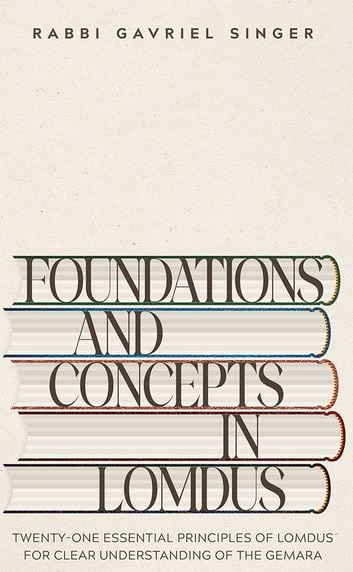
In Foundations and Concepts in Lomdus (Mosaica Press), Rabbi Gavriel Singer of Yeshivat Orayta in Jerusalem opens that world to a much broader audience. Rather than reducing profound ideas to simplistic explanations, Singer equips readers with the conceptual tools needed to approach them thoughtfully. His objective is not merely to explain individual sugyos, but to cultivate the habits of analysis that lie at the heart of serious Torah learning.
The volume is organized around twenty-one foundational concepts that recur throughout the Talmud Bavli. These principles form much of the conceptual vocabulary through which generations of Torah scholars have analyzed the Gemara. By understanding these recurring ideas, readers gain insight into the reasoning that underlies countless sugyos and develop a framework for approaching unfamiliar discussions with greater confidence.
An analogy from language learning illustrates the book’s approach. Just as mastering the fifty most frequently occurring words in the Chumash enables a reader to understand a surprisingly large portion of the biblical text, familiarity with these recurring conceptual principles unlocks a significant portion of the Talmud’s analytical framework. While these twenty-one concepts do not encompass the entirety of lomdus, they provide an essential foundation upon which deeper understanding can be built.
Singer’s greatest strength is his clarity. Concepts that often appear abstract or intimidating are presented with careful organization, precise definitions, and logical progression. Each chapter explains the boundaries of a concept, how it functions within halachic reasoning, and how it appears across different sugyos. The result is not merely a collection of explanations, but a coherent methodology for thinking about Gemara.
An especially thoughtful feature is the inclusion of concise biographical sketches of many of the Torah authorities cited throughout the book. These introductions provide valuable historical context and help readers appreciate the development of the ideas under discussion.
The book is ideally suited for readers who have acquired basic Gemara skills and are ready to deepen their learning. At the same time, even experienced yeshiva students will appreciate its systematic presentation of principles that are often acquired gradually over many years of study.
Importantly, Singer never suggests that lomdus can be mastered from a single volume. His work serves as a guide rather than a shortcut. Reading about these concepts cannot replace the sustained effort required to internalize them through years of learning. Instead, the book provides readers with a conceptual map that makes that lifelong journey considerably more intelligible.
For newcomers, the Talmud can appear almost impenetrable. Its dense Hebrew and Aramaic, sparse punctuation, compressed style, and assumption of extensive background knowledge can make it seem bewildering. The opening Mishnah of Berachos, for example, immediately discusses the laws of reciting the Shema without explaining what the Shema is, assuming readers already possess that foundational knowledge. To the uninitiated, the Talmud can appear almost chaotic.
Singer demonstrates that the opposite is true. Beneath the seemingly complex discussions lies a remarkably sophisticated and internally consistent legal system built upon recurring conceptual structures. By identifying and explaining these foundational principles, he enables readers to appreciate not only the Talmud’s intellectual rigor but also its elegance.
One of the book’s greatest accomplishments is making the world of lomdus more accessible without diminishing its depth. The work presumes familiarity with the Gemara and traditional Torah terminology, so complete beginners may still find portions of it demanding. That is not a flaw but a reflection of the subject itself. Singer has written neither a simplified introduction nor a collection of shortcuts; he has produced a genuine guide to conceptual Talmudic analysis while maintaining the intellectual standards that the discipline demands.
Foundations and Concepts in Lomdus is far more than a study aid. It is an invitation to enter one of the richest dimensions of Torah learning: the disciplined search for conceptual clarity that has animated the great batei midrash for generations. Readers who accept that invitation will find themselves not only reading Gemara more effectively, but also gaining a deeper appreciation for the beauty, coherence, and sophistication of the Torah’s intellectual tradition.