Book review: New books on the intersection of medicine and halacha
People tend to reminisce about the good old days. For observant Jews, there are certainly earlier times when things really were simpler.
Consider visiting someone in a hospital on Shabbat a few decades ago. Getting to a patient’s room was relatively straightforward. Today, simply reaching the bedside can mean navigating motion sensors, automatic doors, electronic access systems, and an array of surveillance cameras.
Even a routine trip to the bathroom can involve sensors and automated fixtures, turning the seemingly simple act of using a modern bathroom into potential halachic questions.
Rabbi Dr. Jason Weiner is uniquely qualified to address these challenges. As Senior Rabbi and Manager of the Spiritual Care Department at Cedars-Sinai Medical Center in Los Angeles, he works at the intersection of Jewish law, patient care, and the realities of modern healthcare.
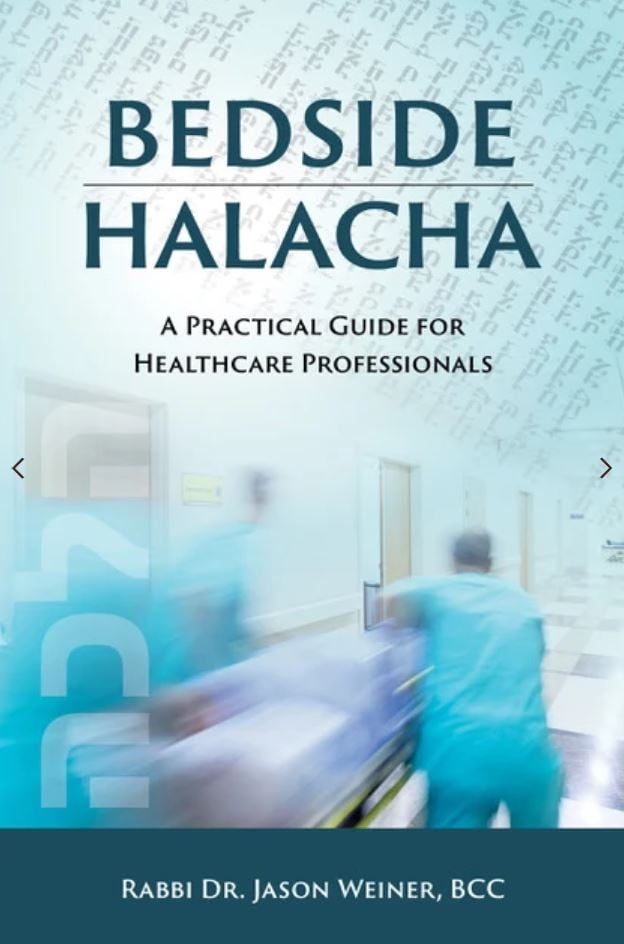
His latest book, Bedside Halacha: A Practical Guide for Healthcare Professionals (Kodesh Press), offers observant healthcare professionals practical guidance on maintaining their religious commitments while navigating an increasingly technology-dependent medical environment.
The book covers a broad range of issues, including Shabbat and Yom Tov observance, prayer, yichud, negiah, medical procedures, end-of-life care, and the restrictions affecting Kohanim in healthcare settings. Its emphasis is firmly practical, addressing the kinds of questions that arise in real-world clinical environments.
This winter, many medical professionals face a problem: working very early in the morning may leave too little time to put on tefillin. In this context, Weiner writes that Rav Yosef Eliyahu Henkin ruled that, in cases of great need, one may pray and put on tefillin 72 minutes before sunrise.
Writing about healthcare and halacha is particularly challenging because medical professionals must balance religious obligations with patient safety, professional responsibilities, urgent circumstances, and difficult ethical decisions. Weiner draws on authoritative Orthodox Jewish sources to help readers understand and navigate these competing considerations.
Bedside Halacha is a valuable reference for healthcare professionals, patients, caregivers, and anyone seeking to understand how Jewish law applies in contemporary medical settings. Weiner has produced a thoughtful, practical guide that deserves a place in hospital libraries, healthcare professionals’ offices, and Jewish homes.
––
The idea that life was simpler in the good old days extends even to death. Not so long ago, determining whether someone had died often appeared straightforward: the person had stopped breathing. Modern medicine has made that determination far more complicated.
The development of mechanical ventilation in the mid-20th century transformed medical care. Patients whose breathing would previously have ceased permanently could now be kept alive with machines, sometimes for extended periods, even when catastrophic and irreversible damage had occurred elsewhere in the body. This technological progress raised profound halachic questions about what it means to be dead.
In The Moment of Death: A Halachic Analysis (Mosaica Press), Rabbi Dr. Avraham Steinberg, MD, examines one of Jewish law’s most consequential questions: when, precisely, does life end? Steinberg originally wrote it, and Rabbi Dr. Shlomo Brody has edited it extensively and added significantly.
Determining the time of death affects burial, mourning, Shabbat observance, inheritance, end-of-life decisions, organ transplantation, and more. The stakes are particularly high in organ donation. If organs are removed before a person is halachically dead, the procedure raises the gravest possible questions under Jewish law. Determining death is therefore not merely a medical judgment; it can become a matter of life and death for both donor and recipient.
Steinberg is exceptionally qualified to address this subject. A physician, pediatric neurologist, and leading authority on medical halacha, he combines medical expertise with extensive knowledge of Jewish legal sources. His monumental Encyclopedia Halachit Refuit (Encyclopedia of Jewish Medical Ethics) earned him the Israel Prize in 1999.
Steinberg had a close, long-term association with Rav Shlomo Zalman Auerbach, whom he quotes often in the book. Steinberg consulted him often on complex medical-halachic questions arising from modern medicine. He would present the medical facts and clinical scenarios in detail, and Rav Auerbach would issue the psak.
In this partnership, Rav Auerbach characteristically deferred to Steinberg’s expertise as a practicing physician on pure medical/technical details, treating him as the authoritative source on the scientific and clinical side while retaining full authority on the Torah side.
In this book, Steinberg brings that distinctive expertise to the intersection of modern medical science and traditional Jewish law. He examines the sources, reasoning, and practical implications of determining death, including the challenges posed by contemporary life-support technology.
Modern poskim have often struggled to define what the exact criteria of death, in fact, is. The book aims to explain and support the view of those poskim who maintain that, according to Talmudic and halachic sources, death occurs when spontaneous respiration has ceased completely and irreversibly.
As to the idea that death is defined as cessation of cardiac function, Steinberg forcefully writes that respiration alone serves as the definitive and exclusive indicator of life or death. The halachic ruling is that cardiac function is not a relevant consideration.
This is a specialized work, not casual reading. But for rabbis, physicians, medical ethicists, and anyone interested in Jewish law’s engagement with modern medicine, it is an important contribution.
The Moment of Death addresses a question that demands the utmost precision and judgment. When the consequences can be irreversible, getting the answer right matters enormously.
––––––
While the previous book defined death, Sacred Endings: Halachic Considerations and Rulings Concerning End-of-Life Issues (Mosaica Press) addresses the time leading up to death.
In this highly readable and fascinating book, Dr. Ari Ciment, MD, explains relevant Jewish law and offers practical guidance to people facing some of life’s most emotionally challenging decisions. Dr. Steinberg also reviewed and edited the book.
Ciment is a Miami-based pulmonologist and critical-care physician who has spent years treating seriously ill patients. He is an engaging writer and it able to communicate complex medical and halachic issues in a most readable and engrossing manner.
The book examines palliative care, do-not-resuscitate (DNR) decisions, and a range of ethical and halachic dilemmas that arise when patients approach the end of life. Ciment’s book draws on real-life case studies that make complicated issues accessible to readers with little medical or halachic background.
One of the book’s most important contributions is recognizing that respecting life does not eliminate the need to consider suffering, medical realities, and obligations owed to patients. These situations demand neither simplistic answers nor decisions based solely on emotion. They require informed judgment grounded in both medical understanding and halachic guidance.
Ciment writes that medicine is often both art and science. A physician’s experience and intuition often carry significant weight.
To illustrate the timeliness of current medical treatment, Ciment describes a case during the height of the COVID-19 pandemic. When conventional treatments failed, the decision was made to attempt venovenous extracorporeal membrane oxygenation (a life-support system that provides temporary respiratory support for patients with severe, reversible lung failure). He writes that this intervention raised profound ethical questions never before encountered in medical history.
This is a valuable resource for rabbis, physicians, healthcare professionals, patients, and families confronting difficult medical decisions. By combining clinical expertise with serious halachic analysis, Ciment and Steinberg offer a thoughtful guide to navigating life’s final chapter with knowledge, compassion, and, most of all, religious integrity.