
"I'm the spokesman for the OK Boomer generation"
The Conversation Must Continue
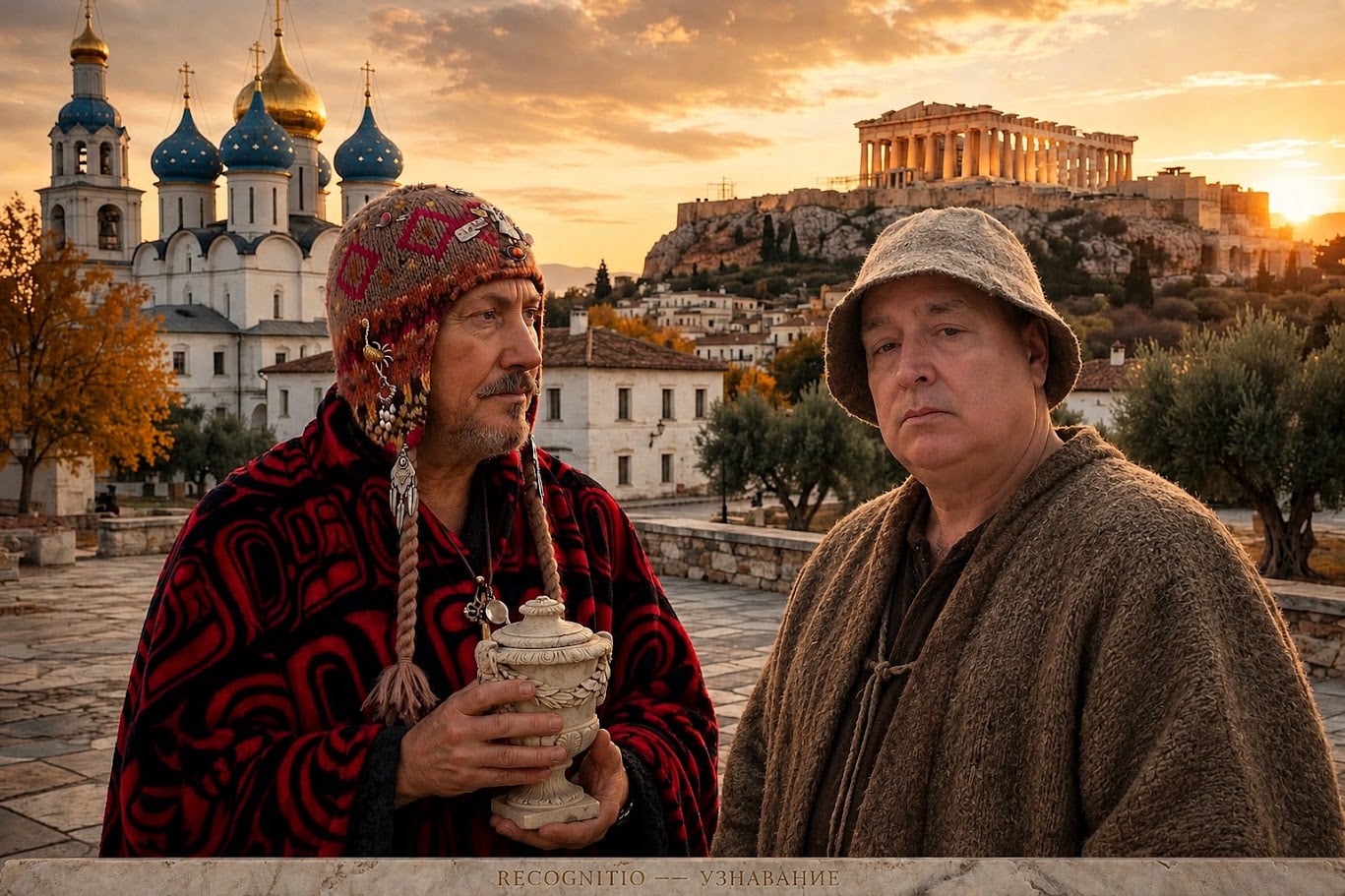
Photo: Tony Senatore and Vladimir Angelblazer: all rights reserved
I sometimes wonder whether philosophy has ever been more relevant than it is today. We live in an extraordinary age of scientific discovery, when our ability to manipulate the natural world, explore the universe, and develop technologies that previous generations could scarcely imagine seems almost limitless. Yet, as our scientific capabilities expand, I find myself increasingly concerned about something seemingly unrelated: our diminishing willingness to ask fundamental questions.
Science is not superior to philosophy. Nor should philosophy be regarded as some quaint historical discipline whose relevance has diminished with the advancement of modern science. They serve different purposes, but neither can adequately replace the other. Science explores what is possible. Philosophy challenges us to consider what is desirable, what is ethical, and what the consequences of our discoveries might ultimately be.
Consider the prospect of nuclear annihilation or the possibility that artificial intelligence could fundamentally disrupt the global workforce, rendering millions of people economically irrelevant. These are not simply scientific or technological questions. They ask about human existence, responsibility, morality, and the kind of society we want to create. Scientific minds may develop the technology, but who will determine whether its application serves humanity or threatens it? And by what philosophical principles will those decisions be made?
The danger is not scientific advancement itself. It is advancement without sufficient reflection. When human beings become so enamored with what they can accomplish that they fail to consider what they ought to accomplish, we risk unleashing forces we may not be able to control.
My introduction to philosophy came in Professor Ray Torres’s class, which offered a general overview of the history of philosophical thought. I remember one exchange in particular that has stayed with me.
A young athlete, whose biceps were far more developed than his philosophical curiosity, told Professor Torres that philosophy sucked. He had no interest in the subject and was taking the class merely to fulfill a core requirement. He then asked the professor and the rest of us what Socrates had actually accomplished and why anyone should bother studying him.
I don’t remember precisely how Professor Torres responded. What I do remember is my own reaction. Even in those early days of my academic pursuits, I recognized that the student’s question, and more importantly, his indifference toward the answer, represented something much larger.
We seem to have lost our appetite for asking questions.
Increasingly, we customize truth to fit our ideological preferences. Rather than examining our beliefs, we look for evidence to reinforce them. We have become more interested in winning arguments than discovering whether our arguments are correct. Truth becomes relative, not because we have thoughtfully considered the philosophical arguments surrounding its nature, but because accepting an inconvenient truth is often less comfortable than inventing one of our own.
Socrates understood that intellectual humility begins with recognizing how much we don’t know. Perhaps that is precisely what makes his philosophy so relevant today.
But philosophy isn’t confined to university classrooms, libraries, or conversations among people with impressive academic credentials. In fact, one of my more recent experiences reminded me that the creative process, and perhaps the pursuit of wisdom itself, can begin in the most unexpected places.
I’ve been feeling particularly creative lately, perhaps owing to my recent discovery of Sativa, but I digress.
This past Saturday, I attended a Yale football game. When I arrived, I found myself less interested in the football than in contemplating the institution around me. Yale represents so much of what America aspires to celebrate: intellectual achievement, wealth, tradition, the pursuit of knowledge, and, of course, privilege.
Veterans Day was approaching, and a friend and I had recently been discussing the proper role of government and its obligations to the people it serves. I wanted to write about it, but I struggled to find the words and organize my thoughts.
On my way back to the car, I noticed an abandoned cardboard sign on the ground, apparently belonging to a veteran asking for assistance.
It was an unremarkable object in an otherwise unremarkable moment. But something about the contrast struck me. Here I was, leaving one of America’s most prestigious academic institutions, contemplating wealth, privilege, and the pursuit of knowledge, while an abandoned sign from an American veteran was sitting on the ground asking for help.
That simple observation became the spark I had been looking for.
I quickly jumped into my car and headed back toward the Yale campus. I walked around, metaphysically absorbing the history and atmosphere, checking my privilege along the way, of course. (A little intellectual self-deprecation never hurts.)
Eventually, I settled into a coffee shop in New Haven, surrounded by young people who represented the next generation. I found myself experiencing two competing emotions. I envied their youth and the years ahead of them. At the same time, I felt a genuine sadness. I wondered whether the world they were about to inherit would be as worthy of inhabiting as the one previous generations had enjoyed.
It wasn’t simply pessimism about the future. It was the realization that we might be creating a world in which our technological achievements and material accomplishments ultimately undermine the very things that make life meaningful.
I looked around at these young people and wondered whether the generations preceding them had failed in their most fundamental responsibility: to question, to exercise restraint, and to recognize that human beings are not omnipotent.
Waxing Solzhenitsyn, perhaps our greatest mistake has been forgetting about God, or, for those who don’t believe in God, forgetting that we are not God.
In about three hours, I completed my essay on the proper role of government. What began with an observation about a cardboard sign had developed into an argument about responsibility, privilege, and a government’s obligations to its citizens.
But the story didn’t end there.
Within 24 hours, a new friend, Vladimir Angelblazer, had responded to my thoughts and expanded upon them from a perspective shaped by his Russian background and his appreciation for Tolstoy. Across continents, we found ourselves engaged in a conversation about questions that have occupied philosophers for centuries: the meaning of life, the nature of truth, our obligations to one another, and the relationship between human beings and the world around them.
I consider Vladimir a kindred spirit in this ongoing pursuit. He brought perspectives and insights that I could not have arrived at through my own distinctly American experience. That is the beauty of intellectual exchange. We don’t have to agree on everything, share the same history, or even approach a question from the same philosophical tradition to learn something from one another.
In fact, our differences may be precisely what makes the conversation worthwhile.
I took away something else from this experience. You don’t need a degree from Yale to be a philosopher. An impressive academic pedigree doesn’t necessarily make someone wiser. I would argue that an excessive preoccupation with credentials and institutional recognition can sometimes obstruct independent thought.
Some of the most profound observations can come from people with very little formal education. Sometimes, someone who has spent a lifetime observing the world has more valuable to contribute than someone who has spent a lifetime studying other people’s interpretations of it.
And perhaps that brings me to what I consider the most fundamental point of all.
We spend an extraordinary amount of time trying to understand the world through institutions, theories, scientific models, and increasingly sophisticated technology. Yet some of the most undeniable truths are right in front of us, available to anyone willing to observe them.
Consider the wind that propels a sailboat across the ocean. We can study its composition, measure its velocity, develop mathematical models to predict its behavior, and explain the physical principles that make sailing possible. But standing on that boat, feeling the wind, and understanding our relationship with the natural world is something altogether different.
Science can explain the wind. Philosophy can help us contemplate what it means to be part of a world in which that wind exists.
Perhaps the answers we seek are not always found in the most complicated explanations. Sometimes they are found in nature, in human relationships, in quiet observations, and in conversations with people whose experiences differ considerably from our own.
I began this particular intellectual journey at a Yale football game. An abandoned cardboard sign prompted an essay. An essay prompted a conversation. A conversation with someone thousands of miles away expanded my understanding of an idea I had initially struggled to articulate.
That is how ideas develop. They rarely arrive fully formed. They begin with curiosity, are shaped by experience, challenged by conversation, and sometimes evolve into something neither the original thinker nor the subsequent contributors could have anticipated.
And that, ultimately, is why I believe we must continue asking questions.
Not simply because questioning is an intellectual exercise, but because our collective future may depend upon it. If we stop questioning the direction we are heading, if we let scientific achievement substitute for wisdom, and if we mistake our ability to change the world for an understanding of how we ought to change it, we may hasten our own demise.
We don’t need everyone to become a philosopher. We need more people willing to think like one.
Perhaps the most important question of our time isn’t what we can accomplish next. It is whether we have the wisdom to understand what we are accomplishing, why we are doing it, and what it ultimately means to be human.
That conversation cannot end.
Related Topics
Related Posts