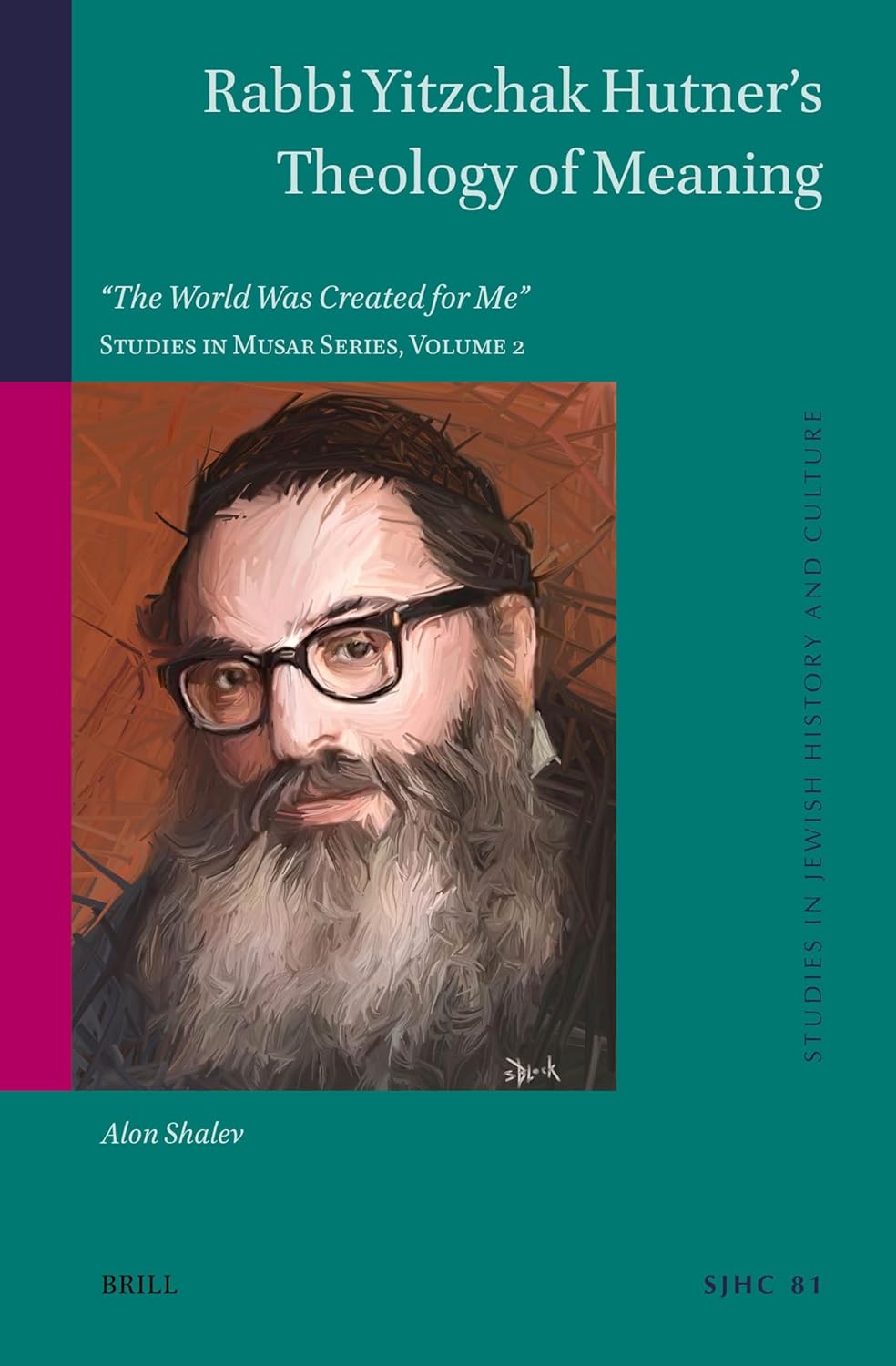
Book review – Rabbi Yitzchak Hutner’s Theology of Meaning
The Riemann Hypothesis is the most famous and important unsolved problem in mathematics, concerning the distribution of prime numbers. Mathematician Terence Tao has explained that the main obstacle to proving the Riemann Hypothesis is not a lack of effort, but rather a lack of the necessary mathematical tools to solve Riemann (even current AI tools are of little use).
Like the Riemann Hypothesis, understanding complex thinkers may require new frameworks. This idea is central to examining Rabbi Yitzchak Hutner and the necessity of new approaches to understanding his thought.
Rabbi Yitzchak Hutner was one of the greatest and most enigmatic roshei yeshiva of the previous generation. A man of myriad talents and brilliant thought, he combined numerous elements. He was both a classic Lithuanian Rosh yeshiva and had Hasidic-style gatherings. He was a Talmudic genius and also a philosopher par excellence. He was a mussar thinker, but rejected the perspective of Rav Yisroel Salanter, the founder of the Mussar movement.
His personality was complex, his thoughts infinitely deep, and he shared little about his personal life. Understanding Rav Hutner may be as challenging as proving the Riemann Hypothesis—perhaps we lack the tools to fully grasp him.
Many have tried to understand Rav Hutner, but often lack the theological tools to do so. In Rabbi Yitzchak Hutner’s Theology of Meaning (Brill), Dr. Alon Shalev – a research associate at the Jonathan Sacks Institute at Bar-Ilan University – applies his tools to provide a compelling, in-depth analysis of Rav Hutner’s thought, making a significant contribution to the field.
For countless rabbis, there are volumes of their collected writings. But these, while fascinating, often lack systematic analysis. Shalev’s book stands out by mapping the system of thought in which Rav Hutner operated, offering readers a structured perspective on his philosophy.
Rav Hutner’s thought provokes interest for several reasons. Shalev writes that engaging in theological-philosophical discourse and writing philosophical treatises was uncommon, and to some extent even aberrant, in the Lithuanian Orthodox yeshiva world of Rav Hutner’s day. Yet he was actively engaged in that area. Rav Kook did that, and he was one of the two most influential figures in Rav Hutner’s life – the other is the Alter of Slabodka.
As to understanding Rav Hutner, that brings to mind the quote of “If I knew Him, I would be Him”, which expresses the notion that God’s essence is ultimately unknowable to finite human beings. The gap between man and God is certainly not the same as between man and Rav Hutner, but it’s still indeed a deep chasm.
As to Rav Hutner’s theology of meaning, Shalev articulately shows how Rav Hutner developed a comprehensive theological system centered around that.
The book is part analysis of Rav Hutner’s thought and part biography. Shalev has not only gone through all of Pachad Yitzchak, but has also reached the myriad letters and other evidence about Rav Hutner.
When considering biographical evidence, it is worth noting that ArtScroll is the de facto source for biographies in the Orthodox world, with close to 200 biographies as of June 2026. Yet what remains missing is a biography of Rav Hutner, even though most of his contemporaries are covered.
Much of that has to do with the fact that Rav Hutner didn’t fit into the mold of a traditional Lithuanian Rosh yeshiva.
His complex personality, the fact that he may have spent two years at the University of Berlin, his close connections with Rav Kook, his intellectual independence, and more don’t fit into the ArtScroll template.
Rav Hutner grappled with many of the same existential questions that numerous twentieth-century philosophers dealt with. Rav Hutner spent time in Berlin and was likely associated with many of these philosophers.
Shalev calls Rav Hutner’s approach one of post-existentialist theology. Existentialism is a family of philosophical views and inquiry that explores the human individual’s struggle to lead an authentic life despite the apparent absurdity or incomprehensibility of existence. In examining meaning, purpose, and value, existentialist thought often includes concepts such as existential crises, angst, courage, and freedom.
Rav Hutner addresses existentialist topics such as individuality, mortality, and authenticity, albeit within the framework of traditional Torah thought.
Rav Hutner’s magnum opus is Pachad Yitzchak, his collection of writings (called mamarim) on the Jewish Holidays and the fundamental themes of Jewish thought. It remains one of the most influential books of twentieth-century Torah philosophy.
Rav Hutner was a close student of Rav Kook, and like Rav Kook, he wrote in a dense, poetic style, with multiple layers. They often combined illusions with verses in Tanach, Midrash, quotes from the Talmud, and the Maharal of Prague. These essays, with their deep brilliance, are a challenge to understand.
But once one understands them, one can enter the mind of Rav Hutner. Shalev has done a remarkable job of understanding the common themes in Pachad Yitzchak and shows the depth and sophistication of Rav Hutner’s thought.
When one uses an Artscroll gemara, they are provided with an introduction and explanations throughout. While the gemara expects the reader to understand every step of the argument, Artscroll fills in those details.
There is no ArtScroll for Pachad Yitzchak, which, like the Talmud, is similarly deep and expects the reader to have that broad familiarity with all of the concepts under discussion. Attaining an understanding of a single matter is an undertaking. Understanding all of it is like climbing Everest. Yet Shalev, having gone through all of the mamarim to understand Rav Hutner’s worldview.
While Rav Hutner’s thought is not organized in a highly structured manner, as is Rambam’s Mishna Torah, Shalev shows that Rav Hutner does have a consistent theological framework.
Rav Hunter died in 1980, and nearly half a century later, remains one of the most influential and important thinkers. In Rabbi Yitzchak Hutner’s Theology of Meaning, Shalev shows that he has the tools and has written an incredibly impressive work on a formidable topic.