
Book review – The Cantonists: Jewish Boys in the Russian Military
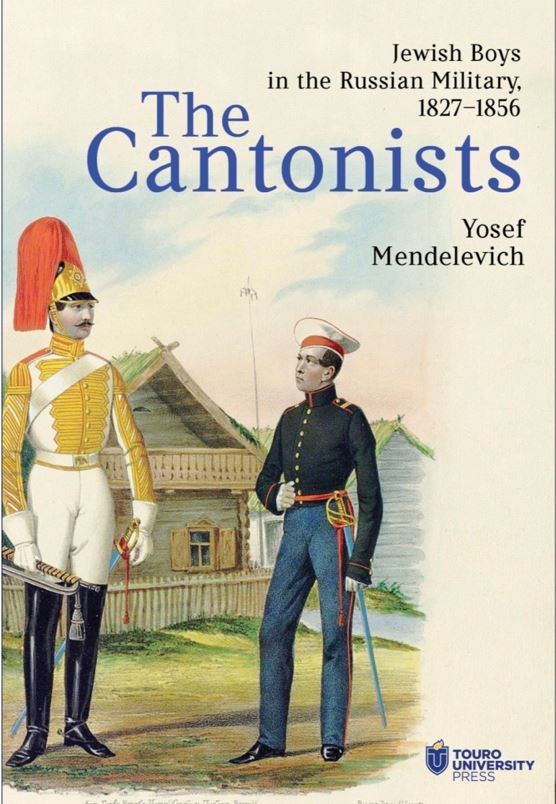
If you examine the Amazon listing for The Cantonists: Jewish Boys in the Russian Military, 1827–1856, it is listed under “Russian History,” “Jewish Social Studies,” and “Jewish Studies.”
According to author Josef Mendelevich, the vast majority of boys did not end up leaving the Jewish faith after their Russian army service. With that, I’d like to suggest that it should be added to the category of Jewish Parenting.
It begs the question: how were these parents able to instill such strong convictions in their sons that they would withstand the rough spiritual conditions of their army service? This is a fascinating and unique book that tells the story of the nearly 30-year decree of the cantonists.
During the reign of Emperor Nicholas I (1825–1855), one of his policies aimed at addressing the Jewish problem was assimilation. One of the many evil things he did to achieve this was the implementation of the Cantonist system. This is where Jewish boys, often as young as 7, were conscripted into the Russian army for up to 25 years.
Separated from their families and faith communities, subjected to ruthless commanders, with intense pressure to convert, the assumption was that all of them would indeed give up their faith.
The book opens with the story of Chaim Merimzon. Professional abductors kidnapped him, and it would be twenty-five years until he was discharged. These khappers would seize children for conscription and receive a reward.
What is additionally painful about the Merimzon story is that the khappers were orthodox Jews. In fact, on the day they kidnapped him, it was late in the day as the sun was setting, the men stopped their carriage and recited the afternoon prayers. While they had no compunction about kidnapping a young Jewish boy, it would be an anathema for them to pray after the prescribed time.
What is additionally painful is that the khappers employed a technique now known as social engineering to gain his trust. In his innocence, Merimzon offered assistance. And for that, he would suffer a quarter century in the Russian army.
Merimzon writes that “I started crying and shouting. I tried to escape, but the gentile held me with all his strength until they finished their prayers. They got back into the carriage and restrained me with great force. The carriage drove along a dirt road until we came to a lone and neglected house”. For those who sing Auld Lang Syne and pine for the old country, the Merimzon shatters any illusion they may have.
Merimzon said to himself that “I’m the son of a melamed and the grandson of a rabbi, I will remain faithful to my faith and Torah. If necessary, I will give up my life for kiddush Hashem”. His loyalty to Judaism is incredible. That his parents and grandparents could raise such a child is inspiring.
The Emperor’s goal was, for the most part, to get these boys to convert to Christianity. However, upon examining the numbers, his goal, like many of his other initiatives, proved to be a failure.
But over the almost 30-year span of the decree from 1827 to 1856, about 75,000 Jewish boys were conscripted. Of those, only 25,000 ultimately converted to Christianity. The remaining 50,000 left the army as Jews, but many of them sadly returned to communities that didn’t exactly welcome them with open arms due to their distance from Judaism.
Mendelevich’s extraordinary research, from original Russian military and government archives, shows that the reason for drafting boys was the attempt to get the Jewish population integrated into the general Russian society.
Due to Russia’s annexation of Poland, they suddenly had over three million Jews as residents, whom they viewed as outsiders. Given that the Jewish population had no desire to integrate Russian culture into their lives, the Emperor decided that bringing the Jewish boys into Russian military schools could achieve that.
The era of the Cantonists was a particularly dark time, during which powerful and wealthy individuals were forced to make difficult moral decisions. Sadly, many of them failed in those decisions.
The realities of Russia at that time were quite complex. The community tax burden was huge and often subsidized by the wealthy. Communities and rabbinic leaders were often forced to look the other way while the rich bribed their sons out of service at the expense of the poor children. The prevailing sentiment was that it was better to sacrifice the poor children in order to ensure the community remained together.
The book quotes Prof. Moshe Rossman, who concluded that in the second half of the 18th century, a limited oligarchy of wealthy individuals controlled the Jewish community administration. As such, its decisions were arbitrary and tainted by the interests of the wealthy stream of the community.
As bad as the Russian army was, Mendelevich discovered that, in principle, the Cantonists could observe some of the mitzvot during military service. There were Russian military laws that gave freedom of worship to soldiers. Some military rabbis were appointed and financed by the government, who were able to perform tasks such as setting up prayer houses and obtaining kosher meat.
While there were certain limited religious freedoms, it was far from a vacation for the soldiers. To promote conversion, the Cantonists were forbidden to contact their parents, local Jews, and other Jewish soldiers. Written correspondence and talking in Yiddish were also banned.
As to the khappers, the fact that they existed testified to the gross imperfection of the procedures of bringing boys to conscription. The phenomenon became especially severe in 1851 when permission was given to members of the Jewish community to catch and bring to the draft office any Jew who did not reside in the area and who was within the boundaries of the community without required documentation.
There is a bit of black humor in the book. At one point, the Christian missionaries repeatedly reported to their superiors that the Jews they were dealing with were more learned than they were, and it was impossible to convince them to convert. The missionaries felt helpless and demanded that they be equipped with the relevant knowledge and written material needed.
There are countless stories and anecdotes about Jewish boys in the Russian military. What is unique about Mendelevich’s is that it is one of the first to gather actual data about the issue. This is a fascinating book that details a very dark chapter in modern Jewish history.
Professor Nicholas Riasanovsky writes of Emperor Nicholas I that “he displayed determination, singleness of purpose, and an iron will, along with a powerful sense of duty and a dedication to very hard work”. Yet with all that, his will to turn Jewish boys into Christians was an abject failure.
Within the darkness and oppression of Russia during the mid-19th century, The Cantonists shows the power of Jewish destiny. It shows how Jewish parents could, in a few years, raise boys to withstand a ruthless and evil bureaucracy.