
What Sukkot knows about the mental load
In the summer of 2006, my wife and I stood in front of a small, tired apartment. It needed major work. Out front was a patch of mud that the listing generously called a garden. I saw a repair bill. My wife looked at the mud and said, “This is where the kids will play.”
There were no kids. There was no garden. But she was already standing in a home that did not exist yet, walking its rooms, placing its furniture, watching children run through it. I could not see any of it. We bought the apartment anyway. Twenty years later, that patch of mud is the pretty little garden where our four boys grew up.
She has never stopped building. She walks into the boys’ room and decides the beds should face the other way. She announces that the sofa is blocking the conversation. She stands in a doorway with her arms crossed and sees a room that does not yet exist, one in which four boys can do homework, wrestle without breaking a lamp, and feel that this house was built around them.
I can look at the same room for six months and see a room. She sees a home.
I used to think this was a quirk of our marriage. I now think it is one of the oldest patterns in Jewish life, and that once a year, on Sukkot, the tradition deliberately turns it upside down.
“His house” means his wife
The rabbis did not merely notice that women ran the home. They identified the woman with the home. The first mishnah in Yoma instructs that the high priest be given a substitute wife before Yom Kippur, since the Torah says he atones “for himself and for his house,” and the mishnah explains flatly: beito zo ishto, “his house” means his wife (Yoma 1:1). Rabbi Yosi took the idiom personally: “I have never called my wife ‘my wife.’ I called her ‘my home’” (Shabbat 118b).
The Mishnah in Ketubot spells out what the home required of her: grinding, baking, laundering, cooking, nursing, making the bed, working in wool (Ketubot 5:5). Strip away the millstone and the spindle and the categories are instantly recognizable. Food. Clothing. Children. Beds.
But the tradition’s most striking text about the home is not about chores. It is about atmosphere. Genesis Rabbah, explaining why Isaac brought Rebecca “into the tent of Sarah his mother,” teaches that as long as Sarah lived, a cloud rested at the entrance of her tent, her doors stood open wide, a blessing was in her dough, and a lamp burned from one Sabbath eve to the next. When Sarah died, all of it ceased. When Rebecca entered, all of it returned (Genesis Rabbah 60:16). The Midrash does not say Sarah was an efficient housekeeper. It says her presence changed the quality of the space. Rebecca does not simply marry Isaac. She restores the home.
Halakhah drew the practical conclusion. Explaining why women are charged with lighting Shabbat candles, Maimonides writes that they are “found in the house and occupied with the work of the home” (Laws of Shabbat 5:3). The Talmud tells us what those candles are for: if a poor person can afford either a Hanukkah lamp or a Shabbat lamp, the Shabbat lamp wins, because of shalom bayit, the peace of the household (Shabbat 23b). A few pages later, the sages ask what Jeremiah meant by “I have forgotten goodness.” Rabbi Yitzchak Nafcha answers: “a beautiful bed with beautiful linens upon it” (Shabbat 25b).
A made bed. Good linens. Light in the window. The rabbis understood that a home is not where you keep your things. It is a spiritual environment, and someone has to hold it in her head.
Notice the verb. Not clean it, not run it. Hold it. The texts describe a mind that never quite puts the house down, and that is what my wife is doing in the doorway. The furniture was never the point.
The questions underneath it are: Where do people sit? Is there somewhere soft to land after a hard day? Will the 12-year-old eat what we are making Friday night? Does the youngest need a heavier blanket now that the nights are cold?
Most of the labor that answers those questions is invisible, and research suggests it still lands overwhelmingly on women, even in couples who call themselves egalitarian. A 2025 study of 322 mothers in Archives of Women’s Mental Health found that women’s share of “cognitive” household labor, the planning and anticipating and remembering, was even more lopsided than their share of the physical labor, and that it tracked with depression and burnout. An earlier study of 393 partnered mothers in Sex Roles found a large majority solely responsible for the family’s schedule and for keeping order in the home.
The rabbis did not run surveys. But beito zo ishto is a survey result in four words.
Then the home moves outside
But on Sukkot the pattern breaks.
“In sukkot you shall dwell seven days” (Leviticus 23:42). It sounds universal, but the Mishnah is blunt about who is bound: “Women, slaves and minors are exempt from the sukkah” (Sukkah 2:8).
Sukkah is a time-bound positive commandment, the standard category from which women are exempt. Yet the Talmud’s discussion is remarkable, because it almost goes the other way. The governing principle of Sukkot is teshvu k’ein taduru, dwell in the sukkah the way you dwell in your home. So the Gemara asks the obvious question: a home is a husband and a wife, so shouldn’t the sukkah be too?
The answer is no, but it takes a separate scriptural derivation to get there (Sukkah 28a-b). The sukkah imitates the home, and yet the woman whom the tradition identifies with the home is exempt from it.
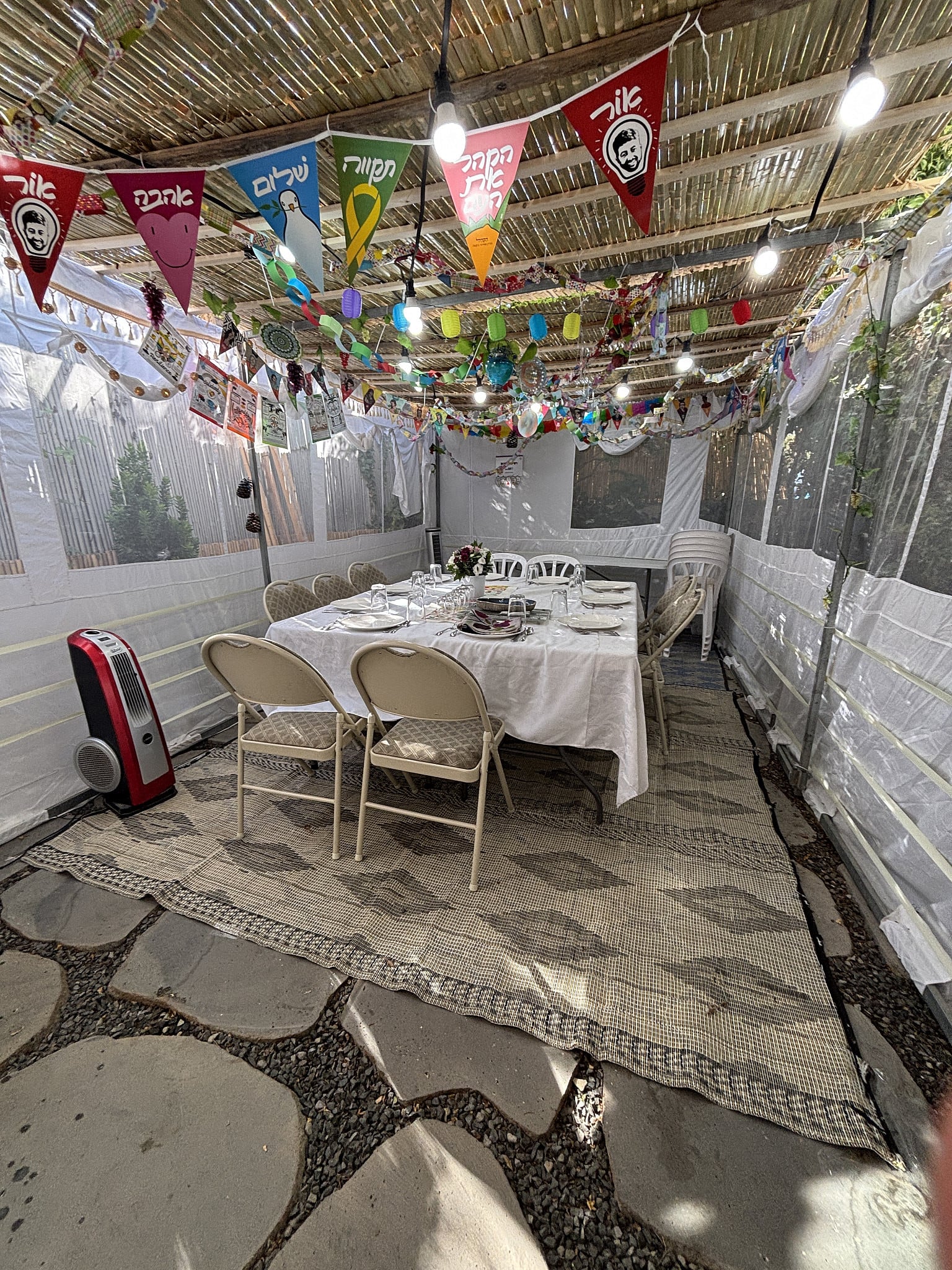
The man is not. And his obligation comes with a project. The Rema rules that one should begin building the moment Yom Kippur ends, “for when a mitzvah comes to your hand, do not let it grow stale” (Orach Chayim 625:1). The Talmud even preserves a blessing over the building itself, not just the sitting (Sukkah 46a). The construction is part of the mitzvah, and in many homes today, it is the men who head outside right after breaking the fast of Yom Kippur to haul the sukkah out of storage.
What happens next is familiar. Men who cannot be persuaded to notice a couch for six months become obsessed with a structure. They debate the schach. They inspect the walls. They string lights, hang the children’s decorations, and argue about whether the thing is straight. Then they sit in it with enormous pride, invite people in, and tell you, at length, how good the sukkah is this year.
I know because I am one of them. I can barely hammer a nail straight, but I build my sukkah with pride, and this holiday of huts is my favorite.
Sarah’s tent, one week a year
Here is the detail I find most beautiful. Rabbi Eliezer teaches that our sukkot commemorate the ananei kavod, the clouds of glory that sheltered Israel in the desert (Sukkah 11b). Now recall the midrash about Sarah: the sign of her home was a cloud resting on the tent.
For 51 weeks a year, the cloud rests on her tent. For one week, the man is commanded to go outside and build a tent under the cloud.
And the Talmud is explicit that he is not building a shed. “All seven days a person makes his sukkah his permanent dwelling and his house temporary. How? If he has beautiful vessels, he brings them up to the sukkah. If he has beautiful bedding, he brings it up to the sukkah” (Sukkah 28b). The beautiful bed and beautiful vessels of Shabbat 25b, the very things the rabbis used to define domestic “goodness,” are carried out of the house and into the man’s room. He is not asked to construct a shelter. He is asked to make a home.
Genesis knows the old line between field and tent, between Esau “the man of the field” and Jacob “who dwells in tents” (Genesis 25:27). Sukkot collapses it on purpose. The man goes outside and dwells.
Two ways to read the week of Sukkot
The first is the feminist reading. If the tradition has loaded the weight of the home onto women, then the lesson of Sukkot is that the arrangement is not a law of nature. Men can plainly do this. Given a structure, a deadline and a sense of ownership, they will design, decorate, host and fuss over comfort with the best of them.
So the home should not have one person who holds the mental map and another who accepts assignments. The Friday menu, the child’s blanket, the furniture: all of it belongs to both.
And by the same logic, the sukkah should not be a male preserve. The Talmud remembers Queen Helene of Lod, whose sukkah was so tall the sages debated its validity, and who sat in it with her seven sons while the elders came and went without objection (Sukkah 2b). Exempt never meant absent. Shared all year: the house and the sukkah.
The second reading is less tidy and, I suspect, closer to how most families live.
Most of our friends have tried to build egalitarian homes. Yet in most homes I know, someone still walks in and thinks, “this would be better if we moved the table.” Someone still notices we are out of milk, that guests are coming Friday, that the room feels cold. And that someone is still, usually, the woman. Whether that is biology, conditioning, habit or all three, I cannot say, and I am suspicious of anyone who claims to know.
But suppose it stays true. That women continue to carry most of the mental load in our imperfect homes. Then Sukkot offers something radical: for one week, give the whole thing to the men. Not as a hobby. Not the annual scene where Abba plays with his drill while Imma quietly carries out the tablecloths, the cushions, the food, and the memory of which child is scared of bees.
All of it. Who sits where. Whether the little one will be warm enough. Whether there are enough chairs when the neighbors drop by. Setting up the kids’ beds outside and making sure they sleep through the night. The mental load, not just the lumber, is ours.
That, I think, is what the tradition is asking when it says sukkato keva, make the sukkah your permanent dwelling. It is asking a man to carry the home in his head for seven days.
Getting men into the tent
We rightly spend a great deal of energy getting women into spaces men have historically dominated. We spend far less asking how to get men into the spaces women have historically dominated. Not so women will surrender them. So men will finally belong there too.
For most of the year, the tradition imagines a woman at the center of the domestic world: dough and lamp, bed and vessels, open doors and a cloud overhead. Then, for seven days, it commands a man to leave his house and make a home under the sky, and to bring the beautiful things with him.
Maybe the home was never meant to be women’s territory. Maybe men simply need practice. And maybe once a year, Judaism gives us a week to get it right, and the hope that some of it comes back inside when the schach comes down.
This year our sukkah goes up where it always does: on the patch of mud my wife saw a garden in, 20 years before I did.
–
Ari Applbaum is a tech marketing executive who lives in Jerusalem with his wife, Rav Na’ama Levitz-Applbaum, four sons, Yuval, Roni, Nadav, and Shai, a lone soldier, Yishama, and a dog, Tissue. He builds the sukkah; she rearranges the furniture, for now.