
Book review – The Koren Tanakh of the Land of Israel: Deuteronomy
Imagine reading Shakespeare without knowing anything about Elizabethan England. Much of the language, humor, politics, and cultural references would be lost. The same is true of the Torah. Without understanding the world in which it was given, readers inevitably miss layers of meaning hidden within the text.
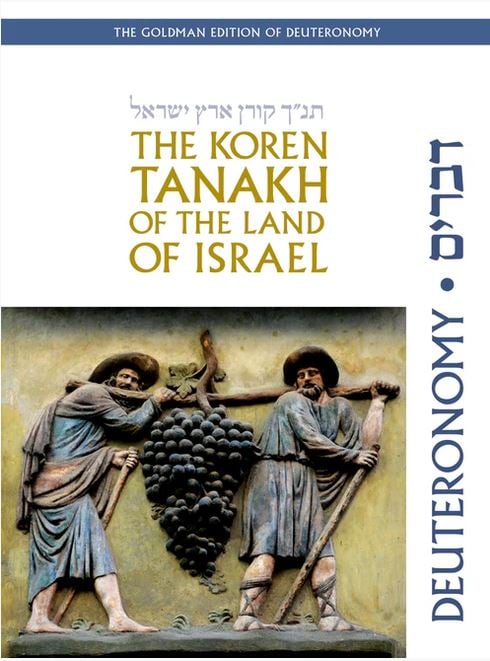
Understanding that context is precisely the goal of the recently published Koren Tanakh of the Land of Israel: Deuteronomy.
A similar contextual approach transformed Talmudic scholarship. The late Professor Yaakov Elman pioneered the field of Talmudo-Iranica, demonstrating how Persian culture provides valuable context for grasping the Babylonian Talmud. His work illustrates how historical context can deepen our reading of sacred texts.
As we start reading the book of Devarim (Deuteronomy) this week, even experienced readers may lack sufficient context. For a reader to truly understand and appreciate the narratives here, they need to grasp the social and political realities of ancient Egypt, where much of the story of the Jewish people began.
In The Koren Tanakh of the Land of Israel: Deuteronomy, editor-in-chief David Arnovitz has added another volume in this extraordinary series. This volume, like the previous ones in the series, explains the stories within the historical and cultural milieu in which they occurred. This commentary does an exceptional job of exploring and explaining the Egyptian context of the stories and narratives here. With Devarim, the series concludes its series on the first five books of the Torah.
The premise of the series is that to fully understand Tanach, it must be understood within its ancient Near Eastern (ANE) context. This includes understanding the Torah within its historical, cultural, literary, and geographic context.
Rabbi Dr. Jeremiah Unterman of Yeshiva University, one of the academic editors, writes that the Torah’s phraseology, narrative and poetic style, legal materials, rituals, treaties, genealogies, and even prophecies share similarities with those in other ANE literature. This includes non-Semitic works such as those of the Sumerians, Egyptians, and Hittites.
While Devarim is often viewed as simply a summary of the previous 4 books of the Torah, this volume shows that this is not entirely accurate. There are numerous things that distinguish Devarim from earlier books, including a covenant language, farewell speeches, and more. Many parts of Devarim, as the editors detail, show striking similarities to Hittite treaties.
In terms of language, the Torah is written in Biblical Hebrew, itself a Semitic language. Biblical Hebrew belongs to a wider family of Ancient Near Eastern languages, and the commentary highlights how linguistic comparisons illuminate numerous passages throughout Devarim.
Arnovitz and his team of 28 academic contributors have expertise in Egyptology, Assyriology, plants, geology, the ancient Near East, animals, Biblical scholarship, Biblical Israel, and more.
Each volume in the series is laid out with explanations based on the following eight categories: archaeology, Near East, language, flora and fauna, Egyptology, Mishkan, Geography, and halakha. The result is a much deeper exploration of the world in which Devarim unfolds. The contributors offer numerous fresh insights into Devarim through archaeological discoveries, Egyptian inscriptions, and modern biblical scholarship.
The breadth of expertise is one of the volume’s greatest strengths. Among the contributors are Rabbi Dr. Joshua Berman of Bar-Ilan University, Dr. Orit Shamir of the Israel Antiquities Authority, Dr. Elaine Adler Goodfriend of California State University, Northridge, and many others.
Rabbi Dr. Zvi Ron, editor of The Jewish Bible Quarterly, also provides significant input to this volume and brings particularly insightful observations to his entries. One of the many entries he has regarding Devarim 10:22, which refers to Genesis 46:27 about the 70 souls who went down to Egypt.
The commentators struggle and, to a degree, have to use some creativity to determine who exactly these 70 people were. Ron writes that the simplest understanding is to view the number 70 in this context as a typological number, not necessarily meant as an exact total. Rather, it is meant as a symbolic number denoting a large group and the concept of totality.
A common theme the authors note is that the Torah in general, and Devarim specifically, introduce numerous revolutionary ideas. For example, the Torah’s monotheism represents a revolution against ANE thought.
The editors repeatedly show that many of the Torah’s most distinctive ideas, including God’s direct instruction to an entire people rather than merely to a king, stand in sharp contrast to the legal and religious literature of the ANE.
Adding to that, just as no other ancient record exists of a deity’s treaty with a people, no ANE account or even claim has been found of the laws given to a people by a god. Most ANE legal systems were given to kings, who were charged with the responsibility of formulating laws.
The importance of reading Devarim in the context of the ANE is difficult to overstate, given how deeply embedded ANE culture and philosophy are in the overall story.
The volume is as visually impressive as it is intellectually stimulating, featuring hundreds of photographs of Egypt, the Land of Israel, archaeological discoveries, and related artifacts.
For the reader seeking a deeper, more comprehensive appreciation of the book of Devarim, this is a fascinating and engaging read. The editors illuminate Devarim through archaeological discoveries and historical insights that have emerged only in recent decades.
As for the many comparisons of the Torah to other legal codes of the time, rather than diminishing the Torah’s uniqueness, understanding the ANE highlights just how revolutionary the Torah truly was. Against the backdrop of surrounding cultures, its theology, ethics, covenantal worldview, and conception of human dignity emerge in even sharper relief.
Readers looking for a devotional commentary may find portions of the work highly academic, as many entries assume familiarity with biblical scholarship. Yet that scholarly depth is precisely what makes the volume such a valuable resource.
Whether one approaches Devarim as a scholar, rabbi, teacher, or serious student of Tanach, this volume demonstrates that understanding Chumash begins with an appreciation of the world in which it was revealed. Few modern commentaries succeed in bringing that world so vividly to life.