Senior Rabbi at Temple Sholom, Vancouver BC Canada
Featured Post
Boy George goes to shul
The pop icon's new song felt like a hug from a stranger. When he came to our synagogue, we finally got to hug him back

RHONDA DENT PHOTOGRAPHY
Like most good things, it started and ended with a hug.
The first hug came from a stranger.
When I first heard Boy George’s powerful and truthful new song, “We Will Dance Again,” I was brought back to October 7 and the horrors of that day, and to the nearly three years of anguish, war and antisemitism that have followed.
But I was also brought back to the early 1980s, when I danced and romanced to Boy George at BBYO Matzah Ball dances and even at my high school prom. He was counterculture then, and I was part of the club. That is, of course, a reference to Culture Club, his iconic band with its distinctive blend of new wave pop, soul, reggae, funk and Caribbean rhythms, held together by Boy George’s warm, soulful and deeply vulnerable voice.
Back then, Boy George used Culture Club’s music and his public image to challenge conventional ideas about gender, sexuality, race and belonging. His songs explored hidden love, emotional cruelty, hypocrisy, rejection and the pressure to change oneself to gain acceptance. At times, as in “The War Song,” his commentary became explicitly political. Serious ideas about identity, prejudice, vulnerability and war were carried by colourful, joyful and irresistibly danceable pop.
As he told me Wednesday night as he sat on the bema of my congregation Temple Sholom in Vancouver BC, Culture Club itself embodied that message. The band brought together George, the Anglo-Irish outsider who refused to conform; a Black British Rastafarian musician; and a Jewish drummer. They emerged in Britain at a time when racism was overt and the far-right National Front operated near George’s childhood home in southeast London.
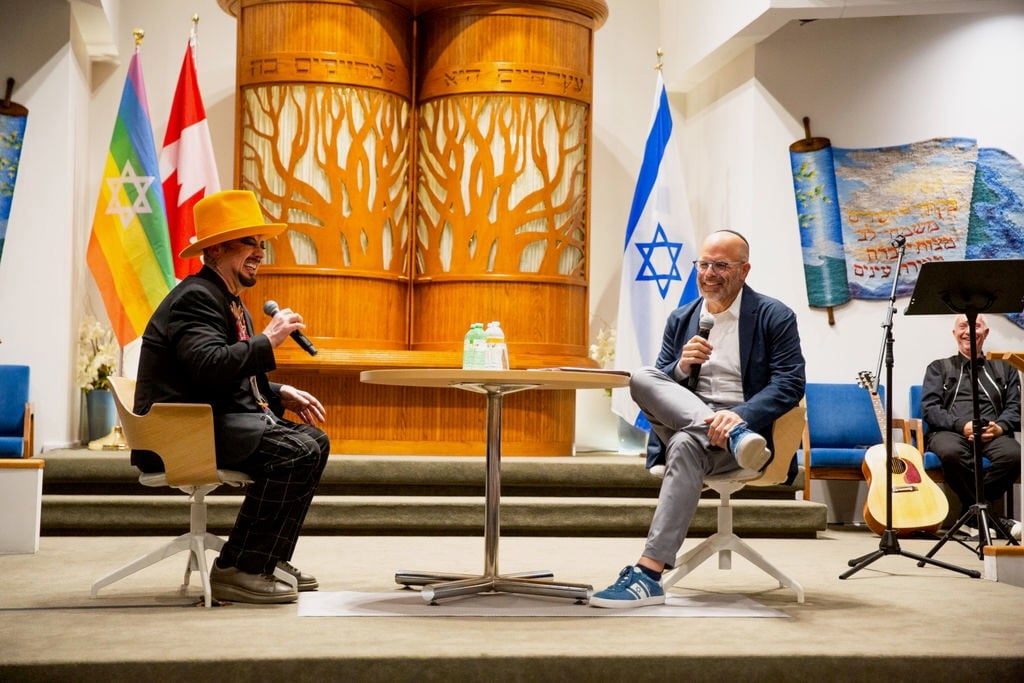
“Culture Club was like everyone’s welcome,” he said. His message, he told us, is the same today as it was then.
I will admit that I had not listened closely to much of his newer music until about a month ago, when “We Will Dance Again” appeared on my feed on X.
I stopped scrolling and listened.
Then I listened again.
The song said what I had been feeling, preaching and struggling to articulate for nearly three years. It acknowledged the horror and suffering of war without erasing how the war began. It remembered the young people who went to dance at the Nova music festival and instead were hunted, raped, kidnapped and murdered. It refused to abandon Israel or turn the Jewish people into villains for defending themselves.
And then came the words I could scarcely believe I was hearing from a non-Jewish international superstar:
“If you’re ever confused, I stand with the Jews.”
As a father of three young adults, two of whom had been on university campuses, hearing those words felt like a hug from a stranger, the kind of hug I could only have dreamed of receiving.
So I wrote to him.
I told him what the song meant to me and to our community. I told him that he had expressed truths we had been saying for almost three years, but to which too few people outside our community seemed willing to listen.
But people listen to Boy George.
The hostility directed at him since releasing the song revealed the cost of speaking those truths. People demanded that he retract it, apologize for it or change its message. Some seemed unable to tolerate the idea that one could grieve for innocent Palestinians while still remembering October 7, believing that Israel had the right to defend its people, and standing openly with the Jews.
George did not retreat.
In my letter, I invited him to Temple Sholom while he was in Vancouver to perform with Culture Club at the PNE. I told him that if he came, the hug I had felt through his song would be returned a thousand times over by our congregation, our community and our allies. Day or night, before or after the concert, we would be there.
I told him about Temple Sholom: proudly Reform, deeply Zionist and unequivocally inclusive. We were the first synagogue in Vancouver to hire an openly gay rabbi more than 20 years ago. Today, our clergy team includes men and women, queer and straight. We have made the inclusion of LGBTQ+ Jews and neurodivergent members a central part of our communal life. I believed George would feel at home with us.
I also told him about the October 7 memorial in our synagogue garden. Each stone is engraved with the name and age of someone murdered in the attacks or an Israeli soldier who has fallen since. My family and I personally engraved those stones. I hoped he would have an opportunity to visit them.
And then, through a series of connections and the hard work of many people, the improbable became possible. Boy George agreed to stay in Vancouver for two additional nights and come to Temple Sholom.
We shared the invitation carefully. It went directly to members of the Jewish community, who were encouraged to invite their friends and allies. We did not announce it publicly on social media, and the location was withheld until shortly before the event.
The security requirements were extraordinary. Vancouver police officers, professional security personnel and our own community security team were all needed so that hundreds of people could gather safely in a synagogue to listen to a man talk and sing.
That is the reality of Jewish life in Canada today. An evening of conversation and music inside a house of worship required a small army of security. It cost an enormous amount of money to do what almost any other religious or cultural community could regard as routine.
Still, once we were inside, the anxiety gave way to anticipation, gratitude and love.
Two weeks earlier, we had filled that same sanctuary to cry and grieve with Rachel and Jon Goldberg-Polin as we remembered their beloved son Hersh and all those murdered on October 7. On Wednesday night, we gathered in High Holy Day numbers to express two other powerful human emotions: gratitude and love.
Gratitude and love for a man and his music.
For a song that needed to be sung.
For words we had been saying for almost three years, but which too few people had been willing to hear.
When Boy George entered the sanctuary to the sound of “Karma Chameleon,” the room erupted. Hundreds of people rose to their feet. The applause was thunderous. Synagogues do not often welcome guests like rock stars, but then again, we do not often have an actual rock star walk onto the bimah.
Before asking George my first question, I told him that I knew he had been receiving plenty of hate mail. That night, I wanted him to hear a love letter.
I invited Dani, a member of our congregation and one of George’s lifelong fans, to tell him what his courage had meant to her family. Her father dressed as Boy George for Halloween when she was a child. Years later, she continued the family tradition by dressing as him for a Temple Sholom Sisterhood gala. Now she and he husband are raising children of her own.
Dani had also visited the site of the Nova massacre. Standing amid the wrecked cars, photographs, candles and belongings left behind, she had confronted an inescapable truth: those murdered, raped and kidnapped were someone’s children, children like hers.
“You have always been in my heart,” she told George, “but you are also in my Judaism.”
George was visibly moved. “I don’t hear that all the time,” he replied.
Then he told us how the song came to be.
He had recently received an award from *Tablet* magazine for his friendship with the Jewish people, but the recognition left him uncomfortable. He wondered what he had actually done to deserve it.
Then, one Friday evening, he began writing.
He did not consult advisers or test the lyrics with focus groups. He deliberately avoided asking permission because he did not want anyone telling him what he could or could not say. He released an early version of the song online, and the response was immediate.
The deepest inspiration, however, came from his visit to the Nova exhibition in London.
George is not only a singer but a DJ who has performed at festivals around the world, including in Israel. Walking into the exhibition, he immediately recognized the setting.
“I know what this is,” he remembered thinking. “I’ve been here.”
He met survivors and spoke with the parents of Jake Marlow, the young British man murdered at Nova. He walked along the wall bearing the photographs of those who had been killed and was overwhelmed by the beauty and vitality in their faces.
“So much beauty,” he recalled. “So much love.”
He promised one of the survivors that he would write a song. When he later recorded it with musician Kevan Frost, the emotions became so intense that he broke down in tears in the studio.
The song emerged from that encounter with Nova, but also from a lifetime of Jewish friendships. George told us about meeting his first Jewish friend at 15, a proudly Jewish, gay man who introduced him to Jewish life. Over the decades that followed, George celebrated Jewish holidays, fasted on Yom Kippur, worked with Jewish managers and musicians, visited Israel many times and resisted efforts to persuade him to boycott the country.
He has paid a price for refusing to turn his back on those relationships. He spoke about friends who abandoned him after the song appeared and about the threats he has received. He admitted that the response had sometimes frightened him and even caused him to question whether he had been mad to enter the controversy.
But he kept returning to something simple.
“I’ve got so many beautiful Jewish friends,” he told us, “and I’m not going to turn my back on them.”
It was perhaps the clearest explanation of allyship I have heard. Allyship is not an abstract declaration made when there is nothing at stake. It is refusing to abandon people you know and love when the crowd demands that you do so.
George was equally clear that he is not against Palestinians and does not claim to speak for any government. What disturbed him was the speed with which so many people, including people who had known and loved Jews throughout their lives, joined a campaign of condemnation that erased October 7 and treated Jews as uniquely undeserving of empathy.
We also spoke about the line in the song, “I don’t feel brave, I just need to behave like a human.”
I told him that, whether he knew it or not, he was echoing a teaching from *Pirkei Avot*: “In a place where there are no human beings, strive to be a human being.”
For George, being human begins with recognizing that everyone is flawed, including everyone we love. It means resisting the demand to reduce people to a single act, identity or political judgment. “Being human is a feeling,” he said. “I don’t need to be told how to be human. It’s an instinct for me.”
That instinct has guided him since the beginning of his career. He spoke about appearing on British television in 1982, looking unlike almost anyone the public had seen before, and being embraced because he was not trying to be anyone other than himself.
The platforms have changed since then. In the 1980s, if someone hated what he represented, they had to sit down, write a letter and mail it to a newspaper. Today, they can communicate their hatred instantly with a click.
George has little patience for the language of cancellation. “Cancelled by who?” he asked. “People who never liked you in the first place?”
That combination of seriousness, irreverence and perfectly timed humour filled the evening. At one point, after he used some particularly colourful language, he looked around the sanctuary as though he had suddenly remembered where he was.
I assured him he was once again only saying out loud what so many of us have been saying and feeling in the face of the hypocrisy and outright hate directed at Jews and Israel.
Then came the moment none of us will ever forget.
Boy George performed “We Will Dance Again” live for the first time.
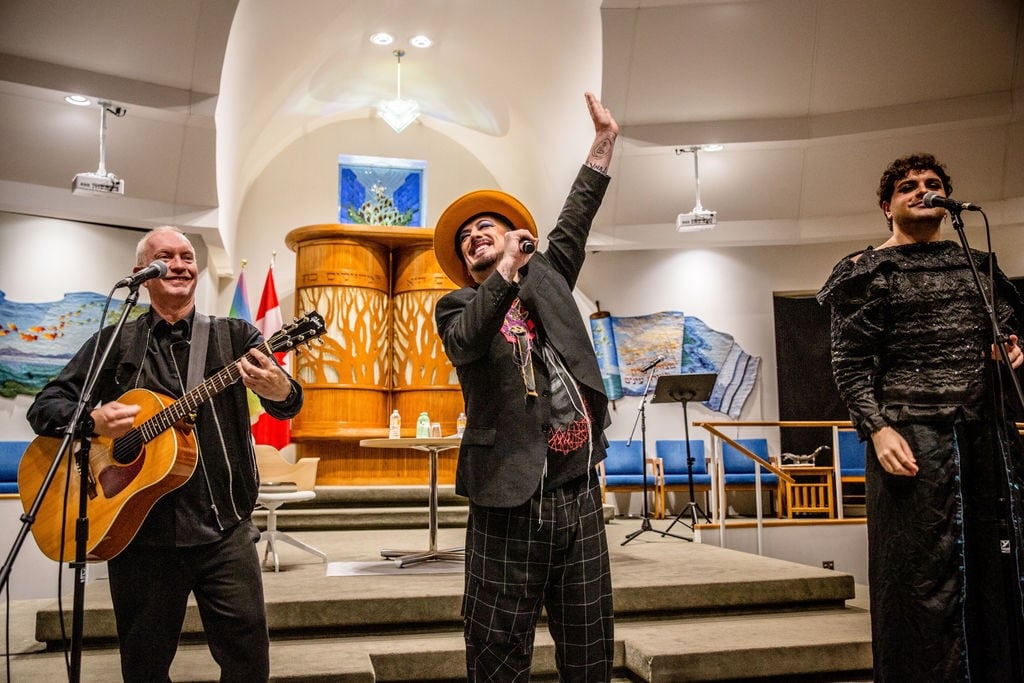
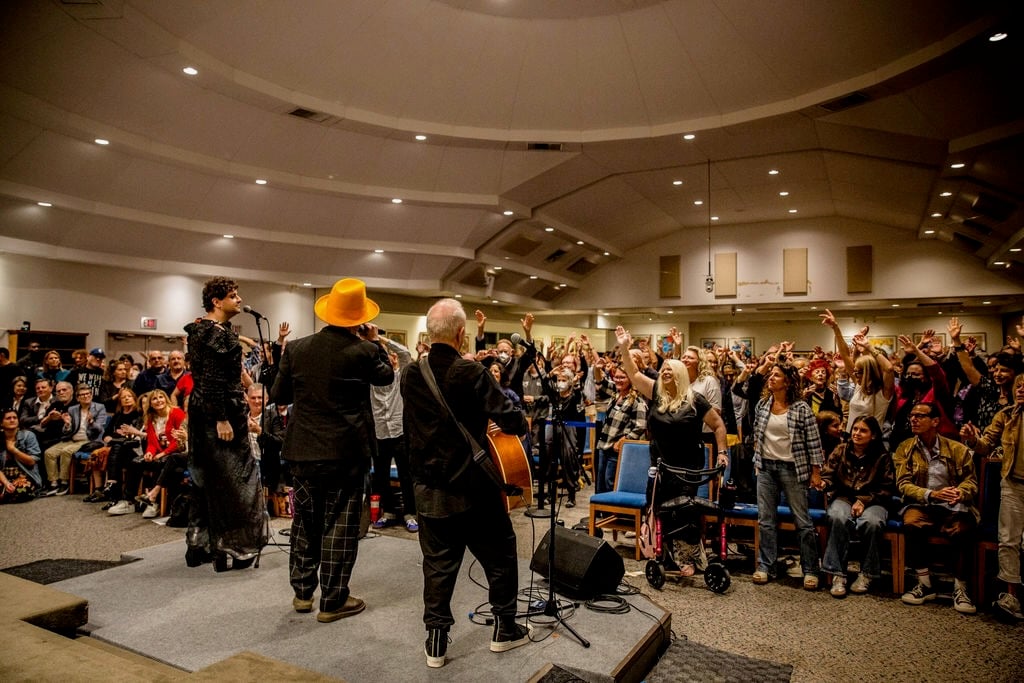
He stood on our bimah with Kevan Frost and Vangelis Polydorou and sang for the murdered and wounded, for the hostages and their families, and for the young people whose joy at Nova was met with unspeakable brutality. He sang for a community that has spent nearly three years insisting that compassion for others must not require the erasure of our own pain.
When he reached the refrain, the congregation joined him:
“We will dance again.”
After the final notes, George turned to those accompanying him and said quietly, almost incredulously, “First time.”
Then my synagogue sanctuary became the happiest nightclub in Vancouver, maybe the world.
The opening chords of “Karma Chameleon” began, and hundreds of people leapt to their feet. Children, teenagers, parents and seniors danced together. People sang, waved their arms and celebrated a song that had been part of the soundtrack of their lives.
“I wish every gig was this good,” George said when it was over.
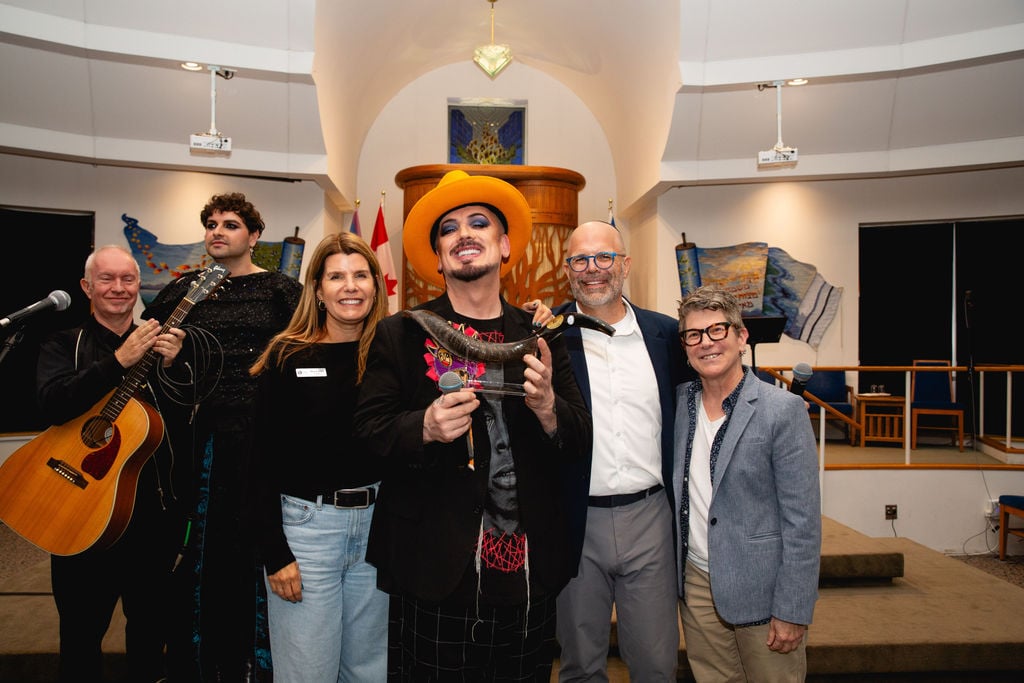
The Jewish Federation of British Columbia then presented him with an award for courageous allyship in the form of a shofar, the ram’s horn sounded on Rosh Hashanah. The shofar is a clarion call. It is meant to awaken us from complacency and summon us to action. It seemed the perfect gift for a man who had used his voice to challenge the mindless conformity of the moment.
George admitted that he had been nervous about coming to the synagogue. The evening had seemed strange to him at first, he said, “but beautiful.”
Then he looked out at the congregation and told us, “If I didn’t love you before, I love you more now.”
Together, we recited the *Shehecheyanu*, thanking God for giving us life, sustaining us and enabling us to reach that moment.
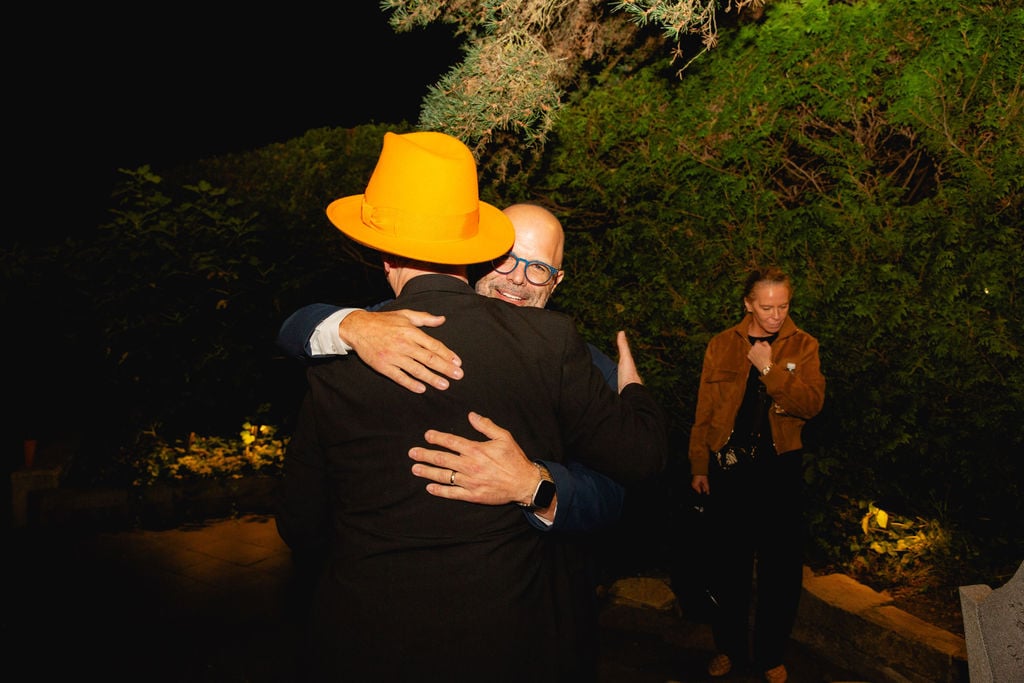
And then the evening ended as it had begun, with a hug.
After the sanctuary had emptied, I took George into the garden to see our October 7 memorial.
He stood quietly before the stones. He bent down, picked up several of them and read the names and ages engraved upon them.
These were no longer statistics, slogans or subjects for social media arguments. Each stone represented a human being. A life. A family. A world.
Then George began to cry.
Beside the names of the dead, I finally gave him the hug I had promised in that first letter, but this wasn’t a hug of gratitude, it was the hug we have been giving each other for three years, a hug of comfort.
We held one another and recognized, without needing to say very much, that we would continue walking this path together.
Boy George has a Jewish star tattooed on his head. He is not Jewish. He is Irish. But after Wednesday night, I am certain that the star is tattooed on his heart as well.
I hope he carries this song and this message to synagogues and communities around the world. People need to hear that standing with Jews does not require surrendering one’s compassion for anyone else. It simply means refusing to exclude Jews from the circle of human concern.
Boy George has an open invitation to return to Temple Sholom and to my home.
But if he does not come back to me, I will go to him.
Because when much of the world turned away, he stood with us.
And wherever “We Will Dance Again” is sung, the Jewish people will stand and dance with him.
Related Topics
Related Posts