CEO of Time to Stand Up for Israel
Boycotting Innovation
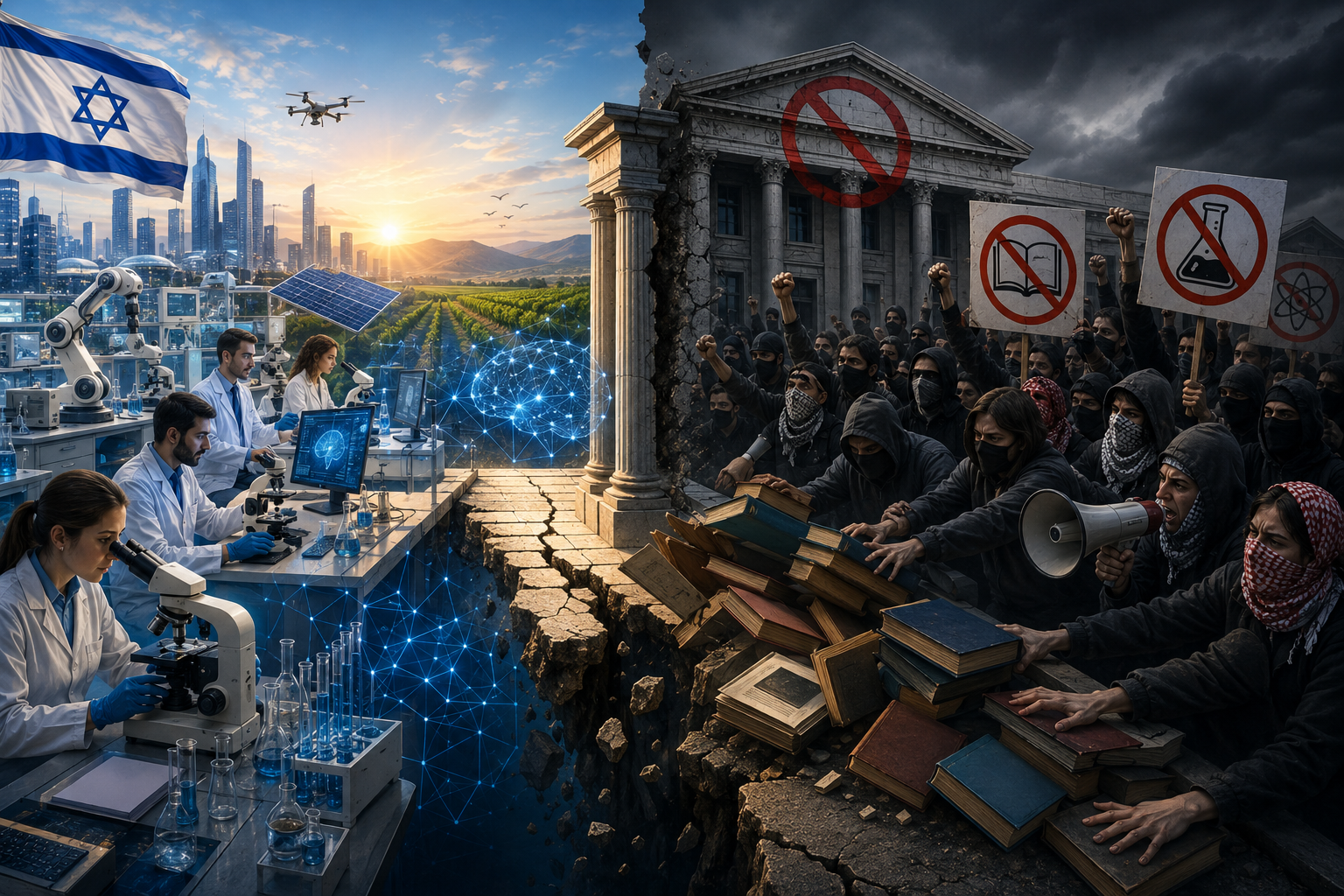
Photo Credits:Sabine Sterk (AI)
Universities once prided themselves on being places where ideas competed freely. They were built on curiosity, debate, and the relentless pursuit of knowledge. Today, many campuses seem to be moving in the opposite direction. Instead of encouraging dialogue, they increasingly reward ideological conformity. One of the clearest examples is the growing movement to boycott Israeli universities and researchers.
This is not simply another political protest. It is an attack on academic freedom itself.
The irony could hardly be greater. While hostility toward Israel continues to grow across parts of academia, Israel continues doing what it has done for decades. It invents. It innovates. It develops technologies that improve lives across the globe regardless of race, religion, or nationality.
That raises an uncomfortable question.
Has hatred become stronger than humanity’s desire to make life better?
The answer appears increasingly obvious.
Academic boycotts are presented as acts of justice. In reality they punish scientists, researchers, physicians, and students whose work often has nothing whatsoever to do with government policy. Medical breakthroughs do not ask whether a patient supports Israel. Artificial intelligence does not discriminate between religions. Cancer therapies save lives regardless of politics.
Yet activists demand that these very researchers become international outcasts.
That is not justice.
It is ideological blindness.
Israel has become one of the world’s leading centers for life sciences and medical technology. Its universities, hospitals, biotechnology companies, and startups are producing innovations that benefit patients everywhere.
Israeli researchers are developing artificial intelligence systems capable of detecting diseases earlier through medical imaging. Hospitals are using AI to predict patient deterioration before doctors can see visible symptoms. Digital health platforms analyze electronic medical records to help physicians make more informed decisions.
Israel’s extensive digital healthcare databases have made it one of the world’s premier locations for developing and validating AI-assisted medicine.
Researchers continue advancing cancer immunotherapy, including next-generation CAR T cell treatments that may become safer and more effective for patients suffering from blood cancers.
Scientists are exploring RNA therapies for devastating neurological diseases such as ALS.
Israeli companies continue expanding remote patient monitoring technologies using smartphones and wearable devices that help physicians monitor rehabilitation, chronic illnesses, fall risks, and home-based physical therapy.
Artificial intelligence is accelerating drug discovery through collaborations between pharmaceutical companies, researchers, and biotechnology startups.
Precision medicine is becoming reality through personalized treatments based upon genetics, lifestyle, medical history, and disease risk.
Israeli trauma specialists continue improving emergency medicine through innovations in wound care, rapid blood warming systems, and emergency response equipment used not only during conflicts but also during civilian disasters across the world.
None of these innovations stop at Israel’s borders.
Patients in Europe benefit.
Patients in America benefit.
Patients in Asia benefit.
Patients in Africa benefit.
Medical science belongs to humanity.
Yet activists want universities to sever cooperation with precisely the researchers producing these breakthroughs.
One has to ask whether politics has become more important than saving lives.
The contradiction becomes even clearer when looking beyond medicine.
Israeli innovation has transformed everyday life.
The USB flash drive revolutionized portable data storage.
Check Point helped pioneer modern firewall cybersecurity.
Waze changed navigation forever before being acquired by Google.
Mobileye became a global leader in advanced driver assistance systems.
PillCam transformed gastrointestinal diagnostics through a swallowable camera.
ReWalk gave mobility back to paraplegic patients.
Drip irrigation fundamentally changed agriculture in water scarce regions.
Israel became a global leader in desalination and water recycling.
OrCam developed wearable artificial intelligence that assists visually impaired people.
These are not isolated achievements.
They represent decades of investment in education, research, entrepreneurship, and scientific excellence.
Now compare that with the territories governed by Palestinian leadership.
Supporters argue that “Palestinians” never had the opportunity to build similar institutions.
That explanation ignores decades of international aid.
Billions of dollars have flowed into the “Palestinian” territories over many years.
Imagine what could have been accomplished if those resources had been invested primarily in universities, research centers, technology parks, medical schools, biotechnology laboratories, engineering institutes, and internationally competitive industries.
Imagine a Middle Eastern version of Singapore.
Imagine attracting scientists instead of militants.
Imagine exporting medical devices instead of conflict.
Instead, enormous resources disappeared into corruption, armed groups, tunnels, rockets, and the enrichment of political elites.
That was a political choice.
Choices have consequences.
One consequence is the absence of internationally recognized scientific breakthroughs emerging from “Palestinian” institutions on the scale produced by Israel’s universities and research centers.
Innovation cannot flourish where violence is rewarded more than education.
Prosperity cannot flourish where hatred receives greater investment than knowledge.
This uncomfortable reality rarely receives attention inside Western universities.
Instead students are encouraged to view the conflict through an increasingly simplistic lens of oppressor and oppressed.
History becomes optional.
Facts become secondary.
Emotion becomes everything.
Artificial intelligence may unintentionally make this even worse.
Students increasingly rely on AI systems instead of books, historical archives, or primary sources. AI models inevitably reflect enormous amounts of online material and public discourse, including biases, inaccuracies, and prevailing narratives. They are powerful tools, but they are not substitutes for critical thinking or independent research.
That makes universities more important than ever.
Unfortunately many appear to be failing precisely when society needs them most.
Universities should expose students to competing arguments rather than shielding them from uncomfortable facts.
Academic boycotts accomplish exactly the opposite.
They punish dialogue.
They discourage collaboration.
They isolate knowledge.
Most importantly, they send the dangerous message that scientific achievement should be judged by politics rather than merit.
History shows where that road leads.
Scientific progress has always depended upon international cooperation.
Diseases do not recognize borders.
Cancer does not care about ideology.
Artificial intelligence does not carry a passport.
Knowledge grows when people work together.
It withers when politics determines who is allowed to participate.
The tragedy is that many students advocating academic boycotts benefit every single day from Israeli innovation.
They navigate with Israeli technology.
They receive medical treatments developed through Israeli research.
They rely upon cybersecurity pioneered by Israeli companies.
Some may even owe their lives to medicines or medical devices developed by Israeli scientists.
Then they demand those same scientists be excluded from academia.
That is not principled activism.
It is extraordinary hypocrisy.
Universities should never become places where knowledge is censored because it originates from the wrong country.
Academic freedom means defending the exchange of ideas even when politics makes that uncomfortable.
Boycotting one of the world’s leading centers of scientific innovation does not advance education.
It weakens it.
When universities stop rewarding excellence and begin rewarding ideological conformity, they cease to be universities in the true sense of the word.
They become political training grounds.
That is not progress.
It is intellectual decline.
Related Topics
Related Posts