Do Not Raise the Axe
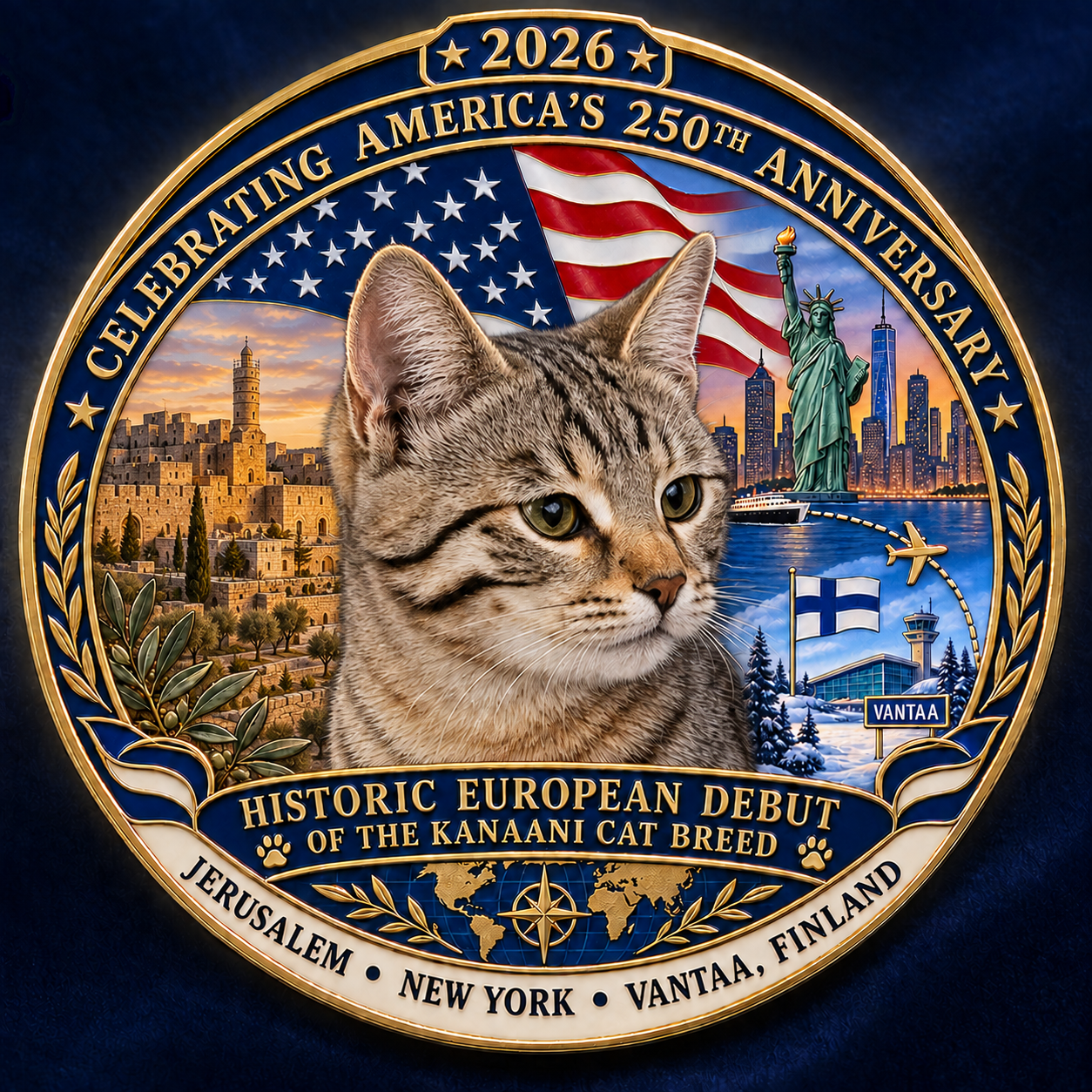
Parashat Shoftim offers two powerful teachings that illuminate the historic debut and revival of the Kanaani cat.
The first concerns judges and the pursuit of justice:
“Judges and officers shall you appoint in all your gates… and they shall judge the people with righteous judgment.”
— Deuteronomy 16:18
The Torah then declares:
“Justice, justice shall you pursue.”
— Deuteronomy 16:20
For the first time in the history of the breed, the Kanaani entered an official international show and stood before three WCF judges—from France, Ireland, and Belgium. They evaluated living representatives of the breed according to its established standard.
Their evaluations, championship certificates, and show results became independent international testimony that the Kanaani still exists, possesses recognizable breed qualities, and deserves a future.
In this sense, the Kanaani stood not only before the judges of a cat show, but before the judgment of history.
The second teaching from Shoftim concerns preservation. Even during war, when destruction surrounds a city, the Torah forbids cutting down a fruit-bearing tree:
“You must not destroy its trees, wielding the axe against them, for you may eat from them.”
— Deuteronomy 20:19
From these words comes the principle of bal tashchit—the prohibition against needlessly destroying anything living or valuable.
If the Torah forbids us from raising an axe against a fruit-bearing tree even during war, how can we remain silent while a rare living creature disappears?
The Kanaani is one of the rarest cat breeds in the world. Born in Jerusalem, it is part of Israel’s living heritage. To me, the Kanaani resembles an ancient tree from which only a few branches remain. Those branches are fragile, but they are still alive. They can still grow, bear life, and begin again—if someone chooses to protect them.
In Finland, the two teachings of Shoftim came together. International judges recognized the Kanaani, and their judgment strengthened the effort to preserve it. The breed stood before the judges of the present so that it would not disappear from the future.
From Adam’s Household to the Gates of Eden
Human responsibility for the living world began with Adam. God placed him in the Garden of Eden le’ovdah ule-shomrah—to work it and to guard it. Adam was not appointed the absolute owner of creation. He was appointed its guardian.
An ancient Midrash in Bereishit Rabbati teaches that, in the days of Adam, the cat and the mouse lived together in Adam’s own house. Out of jealousy, the mouse approached Adam, accused the cat of being a thief, and asked for permission to kill it. Adam answered that because the mouse had spoken lashon hara against the cat, it would become the cat’s food.
This Midrash places the cat within Adam’s household, at the very beginning of the human story.
Another source, Midrash Tehillim, teaches that after Adam was expelled from the Garden of Eden, he settled on Mount Moriah because “the gates of the Garden of Eden are close to Mount Moriah.” Mount Moriah is the Temple Mount in Jerusalem. According to this tradition, Jerusalem stands at the threshold of Eden.
For this reason, the fact that the Kanaani breed was born specifically in Jerusalem does not feel accidental to me. A cat breed emerged in the very city that Jewish tradition associates with Adam and the gates of Eden. In our generation, that cat calls upon us to recover Adam’s original responsibility: to guard the living world entrusted to humanity.
Noah’s Covenant with Life
We also have the example of Noah. Some may say that Noah saved the animals only because God directly commanded him, while no heavenly voice has personally instructed us to save the Kanaani.
But why was Noah’s story given to us? The Torah does not preserve it merely to tell us what once happened. It expects us to learn what must be done when life is threatened.
Noah did not ask whether every creature was popular, profitable, or valued by society. He built the ark because, without human action, life would be lost. Sometimes we must not wait for another voice from Heaven. The lesson has already been given.
After the Flood, the Almighty established His covenant not only with humanity, but with kol nefesh hachayah—“every living creature.”
This expression carries a special meaning for my American-born Kanaani kittens. I named them Haya and Neshama. Haya is a Hebrew name associated with life and living existence; Neshama means “soul.” I chose these names because they express the purpose of the American Kanaani revival: to preserve both the life and the soul of this rare Israeli breed.
Kabbalah takes this responsibility even deeper. Rabbi Moshe Cordovero, the Ramak, teaches in Tomer Devorah that our compassion must extend to every creature. We must not despise or needlessly destroy them, because Divine Wisdom is present throughout creation—in plants, animals, and human beings.
Kabbalah also speaks of Divine sparks concealed within the physical world. Our task is tikkun: to gather, elevate, and restore what has become scattered or broken.
The Kanaani resembles a shattered vessel. Its population is extremely small, its bloodlines are scattered, and its history was nearly forgotten. To preserve and revive it is to gather the fragments. It is a small but genuine act of tikkun.
A Historic Triumph in Finland
On August 8 and 9, 2026, I brought two Kanaani cats—Haifa, imported from Israel, and her five-month-old daughter Haya, born in the United States—to the Fennica Cattus RY Jubilee Show in Vantaa, Finland.
This was not only the first show for Haifa and Haya. It was the first official show appearance in the history of the Kanaani breed itself.
And at its first appearance, the Kanaani did not merely participate. It triumphed.
Haifa received an Excellent evaluation for conformity to the Kanaani standard and a championship certificate. Haya earned two CACP championship certificates—the maximum available to her at that show. Only three certificates are required for the title of Kitten Champion. Haya was also nominated for Best in Show and placed fifth in the WCF Kitten Ring.
Thus, during the first official show appearance in the history of the breed, a five-month-old American-born kitten named “Life” came within one certificate of becoming a champion.
The Kanaani cats were evaluated by three international WCF judges from France, Ireland, and Belgium. The breed was presented to the public and show participants, and Fennica Cattus RY presented us with a special commemorative trophy.
I remain deeply grateful to the Finnish organizers, Diana and her daughter Melidana, the club’s president, for their warm invitation, hospitality, and support. I received invitations from five countries, but I chose Finland because their welcome was the warmest. I did not regret that choice.
An American Ark for an Israeli Breed
The timing makes this story even more remarkable. The historic debut of two Kanaani cats—a mother from Israel and her American-born daughter—took place in 2026, the year of the 250th anniversary of the United States.
I believe we are witnessing a miracle in our own lifetime—a miracle directly connected to the Torah’s teachings.
A breed born in Jerusalem, nearly lost to history, is returning to life through a revival program now based in America. To me, it is not accidental that this revival is taking place in the United States.
America’s national motto, printed on its currency, declares: “In God We Trust.” The country’s founding ideals affirm that fundamental human rights come not from rulers, but from the Creator.
America has given the Kanaani what it desperately needed: a new place where its remaining branches could be gathered, protected, and given an opportunity to grow. An Israeli breed born near the gates of Eden has found an ark in America.
This does not transfer the Kanaani away from Israel. On the contrary, the American revival protects a living part of Israel’s heritage. Jerusalem remains the breed’s historical and spiritual home, while America has become the place where scattered fragments are being gathered and a future is being built.
In the year of America’s 250th anniversary, an American-born Kanaani named Haya—“Life”—carried a living branch of Jerusalem onto the European stage.
To me, this convergence of name, time, place, and achievement is more than coincidence. It is a sign that the responsibility entrusted to Adam and Noah—the preservation of life—is continuing in our generation.
The judgment delivered in Finland was clear:
The Kanaani exists.
The Kanaani is worthy of recognition.
The Kanaani must live.
Parashat Shoftim commands us to judge with righteousness and not to destroy what still bears life. The Kanaani has now received its judgment, and the ancient branch has begun to grow again.
From Adam’s household to the gates of Eden, from Jerusalem to America, and from America to Finland, the Kanaani carries an ancient story into the present.
Its preservation is more than the rescue of a rare breed. It is an achievement for Israel and the Jewish people, a miracle unfolding in our lifetime, and a return to humanity’s first calling—to become guardians of God’s garden.