

I tell startup stories
Brainwave Pioneer: Time is Running out for My Son
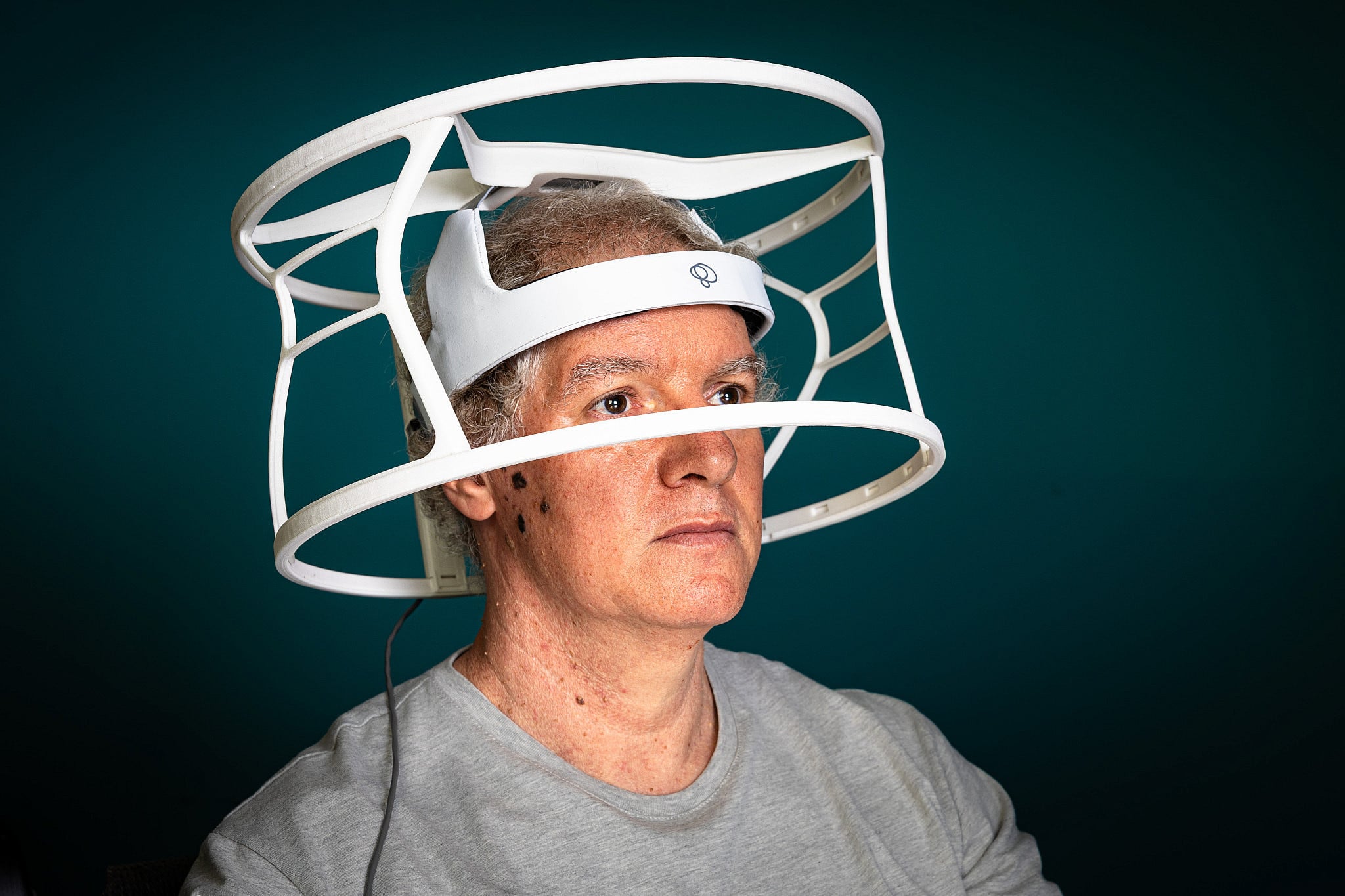
Yaron Segal wearing the brainwave helmet he invented to help stroke patients recover. Picture: John Jeffay
I’ve interviewed hundreds of startup founders since I moved to Israel – but none quite like Yaron Segal.
He’s come up with an incredible idea (not unusual in the Startup Nation). He’s turned that idea into real, marketable product (again, not unusual).
And now he’s leaving the company he founded 14 years ago – and which has attracted over $50m in funding – because his need to carry on innovating is so much greater than pursuing a payday “exit” (this is highly unusual).
Yaron invented a “brainwave helmet” that helps patients recover after a stroke. Experts said it was a crazy idea and would never work.
Clinical trials proved them wrong. Patients learned to walk again, to feed themselves, to bathe themselves, and to go the bathroom by themselves, by wearing Yaron’s helmet for 40 minutes a day.
It creates a magnetic field that literally mends the broken links – long considered unfixable – between brain cells. Or forges links that were never there in the first place.
“Neuroplasticity” is the term that describes the brain’s ability to change and adapt throughout a person’s life and reorganize its structure, functions and connections in response to new experiences, learning or environmental changes.
But that couldn’t happen fully in damaged parts of the brain where there is no neural activity – until Segal’s breakthrough.
As a result of that breakthrough, Jerusalem-based BRAIN.Q finally has a product to sell, and the prospect of commercial success.
But that’s not enough for Yaron. He set out on a mission, which was to help his son, and he’s not there yet.
Lear, now aged 24, was born with familial dysautonomia, a rare and progressive genetic neurological disorder that means he has no control over his blood pressure, chemical balance, temperature, sensations, digestion, or muscle tension.
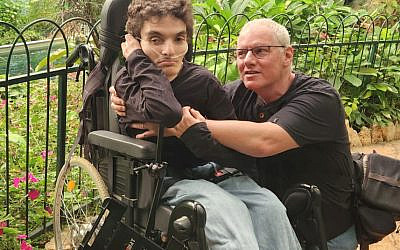
The condition, also known as Riley-Day syndrome and prevalent among Ashkenazi Jews, also affects involuntary bodily functions such as breathing, swallowing and tear production.
And Yaron says time is running out. “Lear’s autonomic nervous system is deteriorating. Every time he has a crisis, the ability of the autonomic nervous system declines.
“Also his lungs suffering returning pneumonia are losing their ability to supply enough oxygen to the body. His ability to recover from crisis, gaining weight for example, is decreasing.”
Yaron trained as a physicist, specializing in climate, satellites, and three-dimensional models of the atmosphere.
But when Lear was diagnosed as a baby, he decided to devote his energy, passion, and intellect to finding an effective treatment for him.
What he’s achieved so far is remarkable – a proven method of repairing neural links in stroke patients.
His brainwave helmet, and the technology behind it, now has the CE mark – which means it’s safe to be sold and used across Europe – and has been approved by Israel’s ministry of health.
Yaron’s invention can, in theory, be adapted to treat a wide range of brain-related conditions, including depression, PTSD, ADHD, spinal cord injuries, Alzheimer’s disease, multiple sclerosis, traumatic brain injuries . . . and, he hopes, the familial dysautonomia that affects Lear.
The helmet itself is the means of delivering the treatment. Over the years successive versions have become much smaller, much lighter and much more suited to home use.
The patient feels nothing at all. They can watch TV or read a book while wearing the helmet.
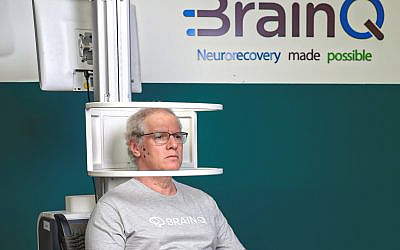
But the really clever stuff is invisible. It’s the patterns of low-intensity, low-frequency electromagnetic stimulation that the helmet applies during use.
Yaron has cracked the code for the precise type of electromagnetic stimulation needed to aid stroke patients recover, in tandem with physiotherapy treatment.
But other conditions require different and very exact configurations, and are more complex to tackle than a stroke. That’s where Yaron now wants to focus his time and effort.
“I want to develop a non-profit applied research center that will be devoted to find protocols that will help people without the burden to prove commerciality” he said. “A place that will be devoted to finding protocols to help people.”
“The idea is to find magnetic stimulation protocols that can be used to help people. In the beginning it will be for groups with the same condition, but once we have enough data, AI tools will enable us to find protocols for individual patients.
“On the one hand it is applied research, on the other, it will allow long term researchers to concentrate on deriving protocols.
“The road to commercialization is long and tedious. Patience is not one of my best qualities, and I feels that the desire to move fast forward so I set out on a new path to reach my goal more quickly.
“I don’t intend to sell devices. What I want to do is to understand how to operate them for the benefit of the patient.
“Seeing somebody who has recovered using the device – and I’ve seen a few – and seeing the light in their eyes – is priceless.”
Contact Yaron at https://www.linkedin.com/in/yaron-segal-60610765/