
In the Shadow of the Bronze Priest: An Athenian Pilgrimage
Each Step… A Story…
From the bustle of modern Athens—traffic surging, shopkeepers calling, cafés spilling onto narrow sidewalks—the eye is drawn upward. Above the city, the limestone plateau of the Acropolis commands the horizon, crowned by the sun-bleached columns of the Parthenon. For twenty-five centuries, it has guarded the city below, its temples and marble ruins defining the skyline. Even amid the energy of the contemporary capital, its presence is inescapable.
The climb toward the Propylaea, the gateway to the Acropolis, becomes a pilgrimage. Crossing the polished marble, the present is left outside the threshold, and the Acropolis welcomes me.
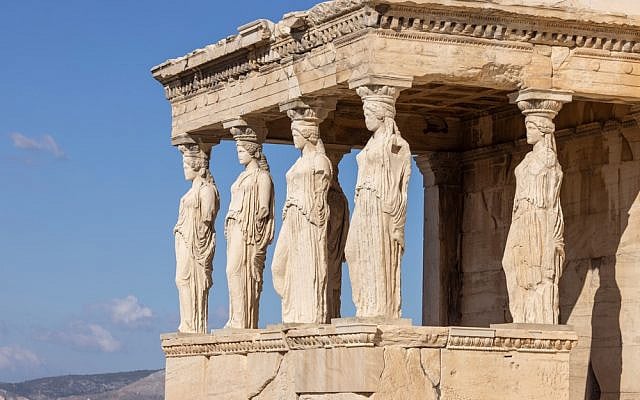
Across the gravel path stands the Erechtheion, smaller in scale yet recognized by its irregular rooflines and projecting porches. On its southern porch, the famous Caryatids—six stone maidens with braided hair—support the heavy roof with unyielding grace. More than architectural columns, they seem alive, effortlessly carrying the weight of time.
Seen against the stark Attic sky, the Acropolis can appear austere, an expanse of stone and marble rising above the city. Antiquity knew a different hill. Olive trees, laurels, and myrtles tempered the rocky landscape into a gardened sacred precinct. Ancient visitors were enchanted by the scale and skill in which architecture, nature, ritual, and civic identity formed a harmonious whole.
As I walked through the ruins, I listened as much to the tour guides as to the monuments. They were knowledgeable and engaging, each with a distinct style. Some lectured with scholarly precision; others used humor and storytelling to transport their audiences back through the centuries. Each sought to animate the shattered columns and scattered stones, translating archaeology into a living narrative.
Despite their different languages and approaches, they returned to the same refrain: presenting the Acropolis as the birthplace of the Western world, where ideas emerged that would shape the political and intellectual life of Europe and the modern world.
Around us, every structure seemed to point toward those ideas: democracy, philosophy, politics, and drama. Here, the guide reminded us, citizens debated the affairs of the city. Philosophers asked enduring questions about truth and virtue. Playwrights explored the human condition, and confidence took root that reason, inquiry, and public debate could illuminate the world and help human beings replace chaos with culture.
Standing atop the Acropolis, surrounded by these stories and stones, it was easy to be swept up by this splendid narrative.
Yet listening to the guides, I wrestled with my relationship to this place. I stood there conscious of a dual inheritance. I am a citizen of the West, shaped by many of the intellectual traditions, civic ideals, and cultural assumptions celebrated around me. At the same time, I am a member of the Jewish people, whose historical memory has often regarded this hill with ambivalence rather than admiration.
Many Jews visiting Athens carry a different map of memory. We do not first think of Pericles (c. 5th Century BCE) or Plato (c. 5th Century BCE). We think of Hanukkah. We remember Antiochus Ephiphanes (c. 2nd Century BCE) before Athena, the Temple of Jerusalem before the Parthenon.
The Acropolis is not simply the birthplace of philosophy and democracy; it is also a landscape viewed through centuries of Jewish remembering, where Greece often appears as the civilization that challenged Jewish faith, practice, and identity. These inherited stories cast “the Greek” and “the Jew” as civilizational opposites—reason versus revelation, philosophy versus Torah, Athens versus Jerusalem.
That legacy has shaped how generations of Jews and non-Jews imagined the encounter between Athens and Jerusalem – not as neighboring civilizations sharing the same Mediterranean sea and sky, but as rivals understood in opposition to one another.
Another View from Mars Hill
Leaving the high plateau behind, the descent begins. Immediately below the grand entrance of the Acropolis sits the Areopagus, or Mars Hill—a rugged outcrop of weathered limestone. In antiquity, this rock served as the meeting place of the council of Athens, where the Athenian nobility gathered to deliberate matters of public policy and the common good.
It is here that the Greek Bible records a defining moment in a civilizational conversation that has echoed through Western history. I use the terms ‘Hebrew Bible’ and ‘Greek Bible,’ avoiding the supersessionist implications carried by the traditional labels “Old” and “New Testament.” These terms reflect the claim that the Christian covenant fulfills or replaces the Jewish one—a claim the Jewish People has never accepted.
Standing on Mars Hill, one confronts the ghost of Saul of Tarsus—Paul (c. 1st Century CE). Few individuals have done more to reshape the religious imagination of the Western world. His revolution was not military or political, but spiritual and cultural. He understood himself to be continuing the message of Jesus (c. 1st Century CE), yet he radically transformed the Jesus movement.
Jesus and his earliest followers lived and taught within the intensely Jewish world of Second Temple Judea and the Galilee. His mission, as reflected in the Gospels, was directed first and foremost toward Israel. When approached by a Canaanite woman seeking healing for her daughter, Jesus initially replied, “I was sent only to the lost sheep of the house of Israel.” Only after her persistent plea did he respond to her request (Matthew 15:21–28).
Paul became the pivotal architect of the movement’s expansion into the Greek-speaking world. Carrying its message beyond the Land of Israel, he translated a movement rooted in Jewish life into the language of the Mediterranean, aspiring to dissolve many of the national and geographic boundaries that had defined it.
In doing so, Paul articulated one of the most enduring theological distinctions in Western history. In his second letter to the Corinthians, he describes himself and his mission as: “…ministers of a new covenant, not of letter but of spirit; for the letter kills, but the Spirit gives life.” (2 Corinthians 3:6)
This contrast between the “letter” and the “spirit” became far more than a theoretical argument. Over the centuries, it encouraged a persistent cultural stereotype, casting Judaism as the religion of law, external observance, and rigidity, while Christianity came to represent spirit, inwardness, and love. The influence of this framing reached beyond theology, echoing through Western philosophy, literature, art, and popular culture.
Standing at the center of Western civilization, reflecting on the break between Judaism and the faith that would become Christianity, Athens itself begins to look different. The stones remain the same, but they can now be considered through the layered lens of Jewish memory.
.Yet these categories appear self-evident only if we accept Paul’s framing. History tells a far more intricate story.
The Bronze Priest in the Temple of Demos: The Motives of Alliance?
Continuing down the Panathenaic Way, the descent from the Acropolis becomes more gradual. The ceremonial road of the Panathenaic Festival bends toward the Agora, the political and commercial heart of ancient Athens. Along the way, grandeur gives way to humbler shrines and civic monuments. Here, religion and politics occupied the same landscape.
Near the point where the hillside levels stood the Temple of Demos and the Graces. Today, it is little more than a field of ruins, easily passed without a second glance. Dedicated to Demos, the personification of the Athenian citizen body, and the Graces, symbols of harmony, generosity, and civic goodwill, it was here that Athens publicly honored those it regarded as benefactors and friends of the city.
Nothing in this field of ruins suggests that it once displayed one of the least expected monuments in the history of Jewish-Greek relations.
Here the Athenian Assembly voted to erect a bronze statue and award a golden crown to the Jewish High Priest and ruler John Hyrcanus II (c. 2nd–1st century BCE). Josephus (c. 1st century CE) preserves the decree in Antiquities of the Jews (14.149–155): “Since Hyrcanus… continues to bear good-will to our people in general, and to every one of our citizens in particular, and treats them with all sorts of kindness… it is decreed to honor him with a crown of gold… and to erect a brass statue of him in the Temple of Demos and the Graces…”
The decree concludes by instructing the city to appoint ambassadors to carry these honors to Judea and affirm the friendship between the two peoples.
For anyone raised on the familiar story of Hanukkah, the monument is startling. The Hasmonean dynasty, remembered for resisting the Syrian Greek Empire, was later honored in one of Athens’ principal civic sanctuaries. The Maccabees fought the Syrian Greek rulers, not Greek civilization. As the Hasmonean kingdom emerged as a regional power, its leaders maneuvered skillfully among the powers of the eastern Mediterranean while remaining rooted to one extant or another within Jewish tradition.
But is fraternity between Athens and Judea the only way to understand this surprising monument? Or does the Temple of Demos preserve another story altogether?
By the first century BCE, the eastern Mediterranean had become the setting for an ancient Game of Thrones. The old Hellenistic kingdoms were fading as Rome extended its influence eastward. Pompey (c. 2nd–1st century BCE) had marched into the region. Julius Caesar (c. 1st century BCE) was reshaping its political order. Within a generation, Mark Antony (c. 1st century BCE) and Cleopatra (c. 1st century BCE) would draw Egypt, Judea, and the Greek cities into yet another struggle for power and survival. Alliances shifted, loyalty were measured, and smaller states increasingly found themselves bending in a world dominated by Rome.
Against this backdrop, the decree preserved by Josephus takes on another meaning. Athens and Judea were not simply celebrating friendship across the Mediterranean. They were navigating the same geopolitical storm. Honorary decrees, public monuments, diplomatic embassies, and cultivated friendships remained genuine expressions of respect, but they also served as instruments of statecraft. Independent states became client states. Client states gradually gave way to territories governed by an empire whose most consequential decisions were made in Rome rather than in Athens or Jerusalem.
Standing among the scattered stones of the Temple of Demos and the Graces, the bronze statue of Hyrcanus comes to represent more than a forgotten episode of Greek-Jewish friendship. It captures a fleeting moment when two ancient societies, each with proud traditions and histories, confronted the rise of an imperial power that would dominate them both. The Temple preserves the memory of an alliance, but also the motives behind it. Its ruins remind us that history is rarely a choice between principle and interest. More often, nations pursue both at once. History—and current affairs—are rich with reminders that, in politics, gifts, gratitude, and public flattery seldom come without purpose. They invite us to ask not only what is being offered, but the motives behind the offering.
The Panathenaic Way descends the final steps into the Agora. If the Acropolis embodied the ideals of Athens, the marketplace reveals how those ideals were lived, debated, and negotiated in the daily encounters of citizens, merchants, philosophers, visitors—including the Jews.
The Agora: The Space of Conversation
The walk from the Acropolis to the Agora takes only a few minutes, dropping from the hills flanking the Acropolis into the sunlit, earthbound expanse where Athenian life unfolded. Visitors step onto a broad, tree-lined valley of ruined colonnades, stone foundations, and reconstructed porticos revealing the layers of classical, Hellenistic, and early Roman Athens. The Acropolis is where Athens displayed its greatness; the Agora is where Athenians lived it. Here, citizens argued politics, philosophers challenged accepted truths, merchants bargained with strangers, and novel ideas arrived with every ship entering the port of Piraeus. If the Acropolis celebrated the ideals of a civilization, the marketplace was the showcase of its reality.
The Greeks had a word for the civic spirit that animated this place: parrhesia – the freedom, candor, and responsibility to speak openly in public. It demanded the courage to question authority, assess assumptions, and expose uncomfortable truths before one’s fellow citizens.
This attitude was neither uniquely Greek nor foreign to Jewish civilization. It reflects the intellectual awakening of what Karl Jaspers and, more recently, Karen Armstrong have described as the Axial Age (c. 800–200 BCE), when societies across the ancient world began asking shared ethical and philosophical questions rather than relying solely on inherited myth and ritual.
The closest Jewish counterpart to the philosopher in the Greek polis was the Hebrew prophet. Their authority rested on different foundations – one on reason and civic responsibility, the other on divine calling—but their vocation was similar. Both confronted kings and citizens alike, challenged accepted truths, and insisted that public life be measured against a higher standard of justice. They understood that the health of a society depended upon its willingness to hear uncomfortable truths.
Yet Jewish civilization did not speak with only one voice. Alongside the prophets stood the sages, and nowhere is their voice heard more clearly than in the Book of Ecclesiastes: “I applied my heart to seek and search out by wisdom all that is done under heaven” (Ecclesiastes 1:13). Though tradition attributes Ecclesiastes/ Kohelet to King Solomon (c. 10th Century BCE), it is historically recognized as a Second Temple text. This is not a prophet proclaiming certainty, but an investigator wrestling with mortality, transience, and human limits. Kohelet and its unnamed author can be read in direct conversation with the Stoics, Epicureans, and Cynics who taught beneath these colonnades. Jerusalem and Athens often reached different conclusions, but they asked strikingly similar questions.
Those conversations were lived. For more than two thousand years, Romaniote Jews made their home in Greece, including Athens. The Romaniote were the long-standing and unique Jewish community throughout Greece, and even today the vestiges of their community remain. In the Agora, archaeologists uncovered, steps from the Metroon – The Temple of Cybele – fragments from an ancient synagogue decorated with a menorah and lulav – evidence that Jewish life flourished within the commercial and civic center of Athens. Although this synagogue postdates Paul’s journeys through Greece, the Jewish community in Athens certainly predates it. It is plausible that an earlier synagogue—or a recognized place of Jewish assembly—stood nearby, as early as the Hasmonean period. The synagogue stood not on the margins of Athens, but in the middle of its marketplace.
The cultural conversation also extended into language. In Alexandria, Jewish scholars translated the Torah into Greek in the Septuagint, expressing confidence that the language of Homer (c. 8th Century BCE) and Plato could also carry the words of Moses (c. 14th Century BCE). The rabbis never fully resolved the tensions this created, yet they recognized Greek’s place among the languages of the world. As the Mishnah records: “Even with regard to Torah scrolls, the Sages permitted them to be written only in Greek.” (Mishnah Megillah 1:8)
The Talmud explained this exception by invoking Noah’s blessing that “the beauty of Japheth shall dwell in the tents of Shem,” concluding that Greek possessed the beauty worthy of carrying the words of Torah (Babylonian Talmud, Megillah 9b).
The conversation eventually came full circle. The Greek word parrhēsia entered Rabbinic Hebrew as be-parhesya, denoting the public sphere itself. The language of democratic Athens became part of the legal vocabulary of Jewish communal life.
Athens and Jerusalem: Finding Our Bearings
As I made my way toward the edge of the valley, the binary between Athens and Jerusalem no longer seemed adequate. They are distinct civilizations, shaped by different histories and different claims about truth. Yet they share far more than their familiar contrast suggests. Their relationship was marked not only by conflict, but by conversation, borrowing, challenge, and mutual influence.
The Acropolis was built to inspire awe, lifting the eye toward temples, statues, and the ideals of a civilization at its height. The Agora was built for the bustle of everyday life—for commerce, conversation, debate, and disagreement. The Acropolis still takes my breath away. Yet whenever I return to Athens, I find myself drawn back to the Agora. Beneath the worn stones, you can still hear the ancient noise of people buying, selling, questioning, persuading, arguing, and laughing—not so different from the city that surrounds it today.
Leaving the Agora, I searched for shade from the afternoon sun, a cool drink, and fresh watermelon with feta. As the sounds of modern Athens replaced the imagined voices of Socrates (c. 5th Century BCE), Diogenes (c. 5th Century BCE), Paul, and the Jews who once gathered in the Agora synagogue, one final thought lingered.
We often treat argument as though it were a failure. Contemporary culture prizes consensus or encourages us to sidestep the questions most likely to unsettle. Yet the worn stones of the Agora tell a different story. They remind us that the thunder of a good argument can bring the rain of wisdom, creativity, and collaboration.
Athens and Jerusalem stand as twin pillars of our lives. Together, they support the world we inhabit. The invitation is not to choose one and discard the other, but to find our balance between the columns, remaining in conversation and argument, neither erasing our differences nor exaggerating them.
_
Hit Follow at the top of the page to keep up-to-date with my blog and with this ongoing series on Jewish experiential travel. Stay tuned.