
Israel as a global geostrategic axis
Brazil Has Become Fertile Ground for Hezbollah
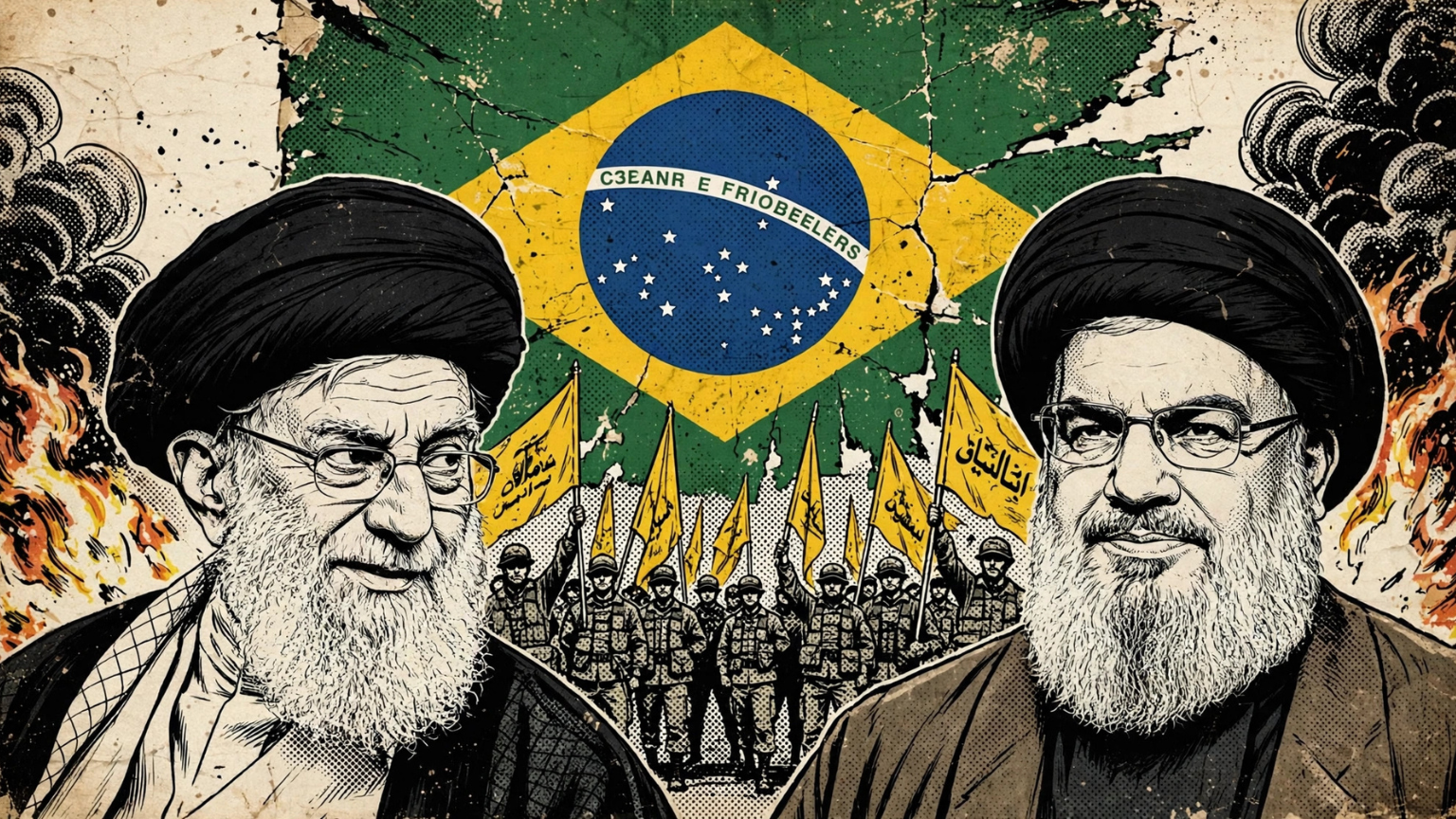
Unfortunately, the Iranian regime and its tentacle, Hezbollah, have found fertile ground in Brazil (AI-generated image)
The Lula administration’s stance on classifying major criminal factions (such as the PCC and the Red Command) as terrorist organizations—a measure already adopted by the United States under the Donald Trump administration—has sparked diplomatic rifts and intense debate over sovereignty and hemispheric security.
This positioning lays bare what has been observed for years: the current president’s apologetics toward organized crime and his track record of consistently aligning with the wrong side of history. This is especially glaring at a time when other South American governments are adopting hardline approaches, explicitly equating cartels and drug trafficking with terrorist groups.
Yet, state sovereignty does not dissolve solely through conventional invasions; it corrodes silently when the monopoly on violence is outsourced to transnational actors operating in the shadows of bureaucracy. Today, Brazil faces an asymmetric challenge of global magnitude: the systematic penetration of networks linked to the terrorist group Hezbollah into its socioeconomic and institutional fabric.
Far from being an isolated phenomenon or a “conspiracy theory” touted by alarmist sectors, this reality was crystallized by Operation Trapiche, launched by the Federal Police in 2023. Viewed through the lens of political science, what we observe is not mere common crime, but the materialization of the crime-terror nexus, wherein illicit economies subsidize hybrid warfare agendas. To ignore this dynamic under the guise of anachronistic diplomatic relativism is not merely naive; it is structural complicity in the erosion of national security.
The Triple Frontier (Brazil, Argentina, and Paraguay)
The Triple Frontier—the territorial convergence of Foz do Iguaçu, Ciudad del Este, and Puerto Iguazú—has historically functioned as a laboratory of state vulnerabilities. Decades of neglect in border governance have allowed this region to consolidate as a hub for money laundering, smuggling, and currency evasion, mechanisms vital to financing organizations like Hezbollah and Hamas.
The absence of a robust, coordinated state presence among Brazil, Argentina, and Paraguay has created a sovereignty vacuum. In this interstice, transnational organized crime does not merely survive; it thrives, providing the logistical infrastructure necessary for international terrorist networks to convert illicit capital into geopolitical power. Local institutional fragility is, therefore, the enemy’s primary strategic asset.
The Outsourcing of Violence
Hezbollah’s tactical evolution in South America reveals a sophisticated adaptation to international pressures. Operation Trapiche uncovered a recruitment mechanism that bypasses prior ideological loyalty, opting instead to hire local “hired hands.” Individuals with financial vulnerabilities and criminal records—such as Mohamad Khir Abdulmajid, aka “Habibi,” and the recruit Passos Lima—were selected, funded, and sent to Beirut for operational training in clandestine communications and target reconnaissance.
The strategic objective is plausible deniability. An attack executed by local ex-convicts can easily be categorized by the media and progressive sectors as an “isolated hate crime,” obscuring the chain of command tracing back to Lebanon. This outsourcing of violence is a maneuver of realpolitik: it maximizes damage to the enemy (synagogues, embassies, and community leaders in Brasília) while minimizing the direct exposure of the parent organization, especially following years of devastating operations by Israel against its infrastructure in the Middle East.
Clandestine Financial Engineering and Regulatory Blindness
The financing of these cells no longer relies exclusively on physical cash remittances. The modern financial architecture of terrorism has embraced the crypto economy. The case of Dante Felipini, a cryptocurrency broker in São Paulo, illustrates this metamorphosis with surgical clarity. Using shell companies and operating with stablecoins like Tether (USDT), Felipini moved hundreds of thousands of dollars to digital wallets directly linked to Hezbollah and the Quds Force of the Iranian Revolutionary Guard Corps.
The most alarming aspect is not the sophistication of the method, but the inertia of the state. Brazil’s system for reporting suspected terrorist financing failed to issue a single alert regarding these massive transactions. This regulatory blindness, fueled by a loose legal framework and a bureaucratic culture averse to confronting unconventional threats, rolls out a red carpet for economic infiltration. Transforming the national financial system into a laundering hub for global terrorism is no accident; it is the direct result of public policies that prioritize naive deregulation over strategic security.
Final Conclusion
Defending the nation against these threats is not an ideological option, but a categorical imperative. History does not absolve governments that, through omission or moral relativism, allow their national territory to be used as a support base for those who despise the fundamental values of Western civilization and human dignity.
The empirical evidence is irrefutable. Brazil is not a passive spectator on the geopolitical chessboard of transnational terrorism; it is currently an active operational territory. The combination of porous borders, exploitable socioeconomic vulnerabilities, and a permissive financial system creates the ideal environment for Hezbollah’s projection of power.
Shema Yisrael שְׁמַע יִשְׂרָאֵל
Related Topics