
Brenner, Zombies, and What Zionism Is For
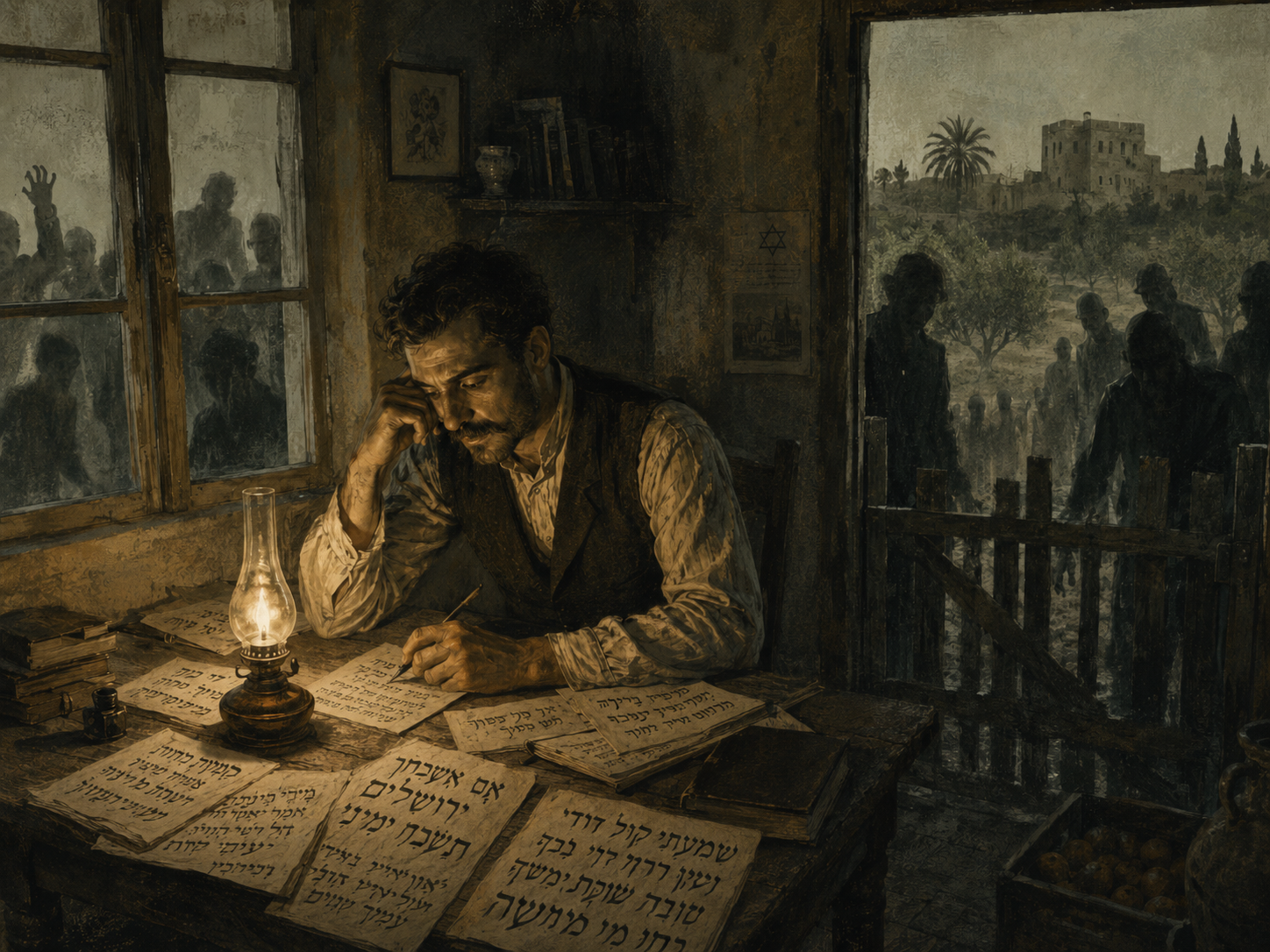
Amir Harash and Yosef Haim Brenner. Shekhol ve-Khishalon ve-Zombim (Breakdown and Bereavement Zombies). Am Oved, 2025.
What would happen if you took one of the founding novels of modern Hebrew literature and added zombies?
That is what Amir Harash does in Shekhol ve-Khishalon ve-Zombim (Breakdown and Bereavement Zombies, Am Oved, 2025), a rewrite of Yosef Haim Brenner’s famous Shekhol ve-Khishalon.
The novel stars Brenner himself as a character and narrator, living in a Yishuv much like the one Hefetz lived in, only filled with the walking dead. While the idea sounds like a joke, the book has been taken seriously, winning one of Israel’s most important literary award in 2025, the Sapir Prize.
A horror mashup is not a brand new idea. Seth Grahame-Smith’s Pride and Prejudice and Zombies started the genre by putting flesh-eating monsters into Elizabeth and Darcy’s romance. The humor comes from the incongruity between Austen’s world of manners and the bloody violence of zombie combat.
Harash does the same thing to Brenner.
Many Israeli reviewers have interpreted Harash’s zombies as a story of Zionist revival gone wrong. The zombies could be a metaphor for a dead nation and a dead language coming back as monsters. That interpretation is certainly in the book. At one point, the fictional Brenner asks whether the living corpse is not “the new man” Zionism wanted: a man of pure action without any ghetto complexes or tortured introspection. “לזה יקרא ציונות!” (This will be called Zionism), he says.
In my view, though, the genre joke cuts another way. The violence and zombies are not Zionism. They are what Zionism is for.
Brenner was not just any writer. He was one of the founders of modern Hebrew literature. Born in poverty in the Russian Empire, he deserted the Tsar’s army and came to the land of Israel in 1909. His work was revered, even though his willingness to question Jewish religious boundaries and his skepticism about the spiritual value of Zionism bothered many. In May 1921, he was murdered by Arab rioters near Jaffa.
Brenner’s original Shekhol ve-Khishalon is a strange Yishuv novel because Zionism is barely present. The book follows Hefetz, a sick and lonely man who collapses with a labor group and is sent to Jerusalem to recover. The novel follows him through sickrooms, failed love, problems with his relatives, and endless introspection. What tortures Hefetz is not antisemitism or the fate of the Jewish people. It is the חוסר-הטעם of life, his sense that existence is meaningless. The novel says his illness is not צרת הכלל, the suffering of the collective, but מכאובים פרטיים, private pains.
That is an important theme in Brenner’s work. Zionism might bring back the Hebrew language and create a new Jewish society. But it cannot cure self-doubt or give life deeper meaning. Brenner was read in the early Yishuv, and is still read today, as critiquing the limits of Zionism to solve life’s big questions.
Harash is sympathetic. He lovingly has the fictional Brenner show these limits. He expertly copies Brenner’s self-questioning writing style. In both the original and Harash’s version, the narrator says something only to backtrack and say “no, no, not like that.” The similarity is so strong that Harash gives Brenner co-credit on the cover, as if the book is a collaboration with a dead writer. It is another level of irony in the joke. Harash raises Brenner from the dead in Brenner’s own language.
But this obsession with philosophical and spiritual questions is clearly missing the big picture in the novel. Harash captures Brenner and his contemporaries’ pedantic obsession with language. What should Hebrew call the undead? In the book, people try foreign names and Yiddish names. Then Bialik supposedly coins פגח, short for פגר חי, a living corpse. The world is ending, and Hebrew writers are still arguing about the right word.
Is this not a critique of Brenner, obsessing over loneliness and not the looming violence aimed at the Jews in the Yishuv and in Europe? Is this not a critique of those who make Brenner-esque critiques of Zionism today? The zombies make Brenner’s philosophical questions look beside the point. Brenner was not murdered by loneliness. He was murdered by people trying to kill Jews.
After October 7, that distinction is harder to avoid. We have seen Jewish homes invaded. We have seen families murdered in their safe rooms. A farmhouse surrounded by monsters no longer feels like a literary prank. It feels like a reminder of the problem Zionism is supposed to solve.
Brenner keeps writing in his notebooks while the farmhouse is surrounded. Zionism is not there to answer his questions. It’s there to hold the gate.