
Russian-American-Israeli Palestinian. Palestine is Israel.
Gender-Rich and Gender-Poor Languages
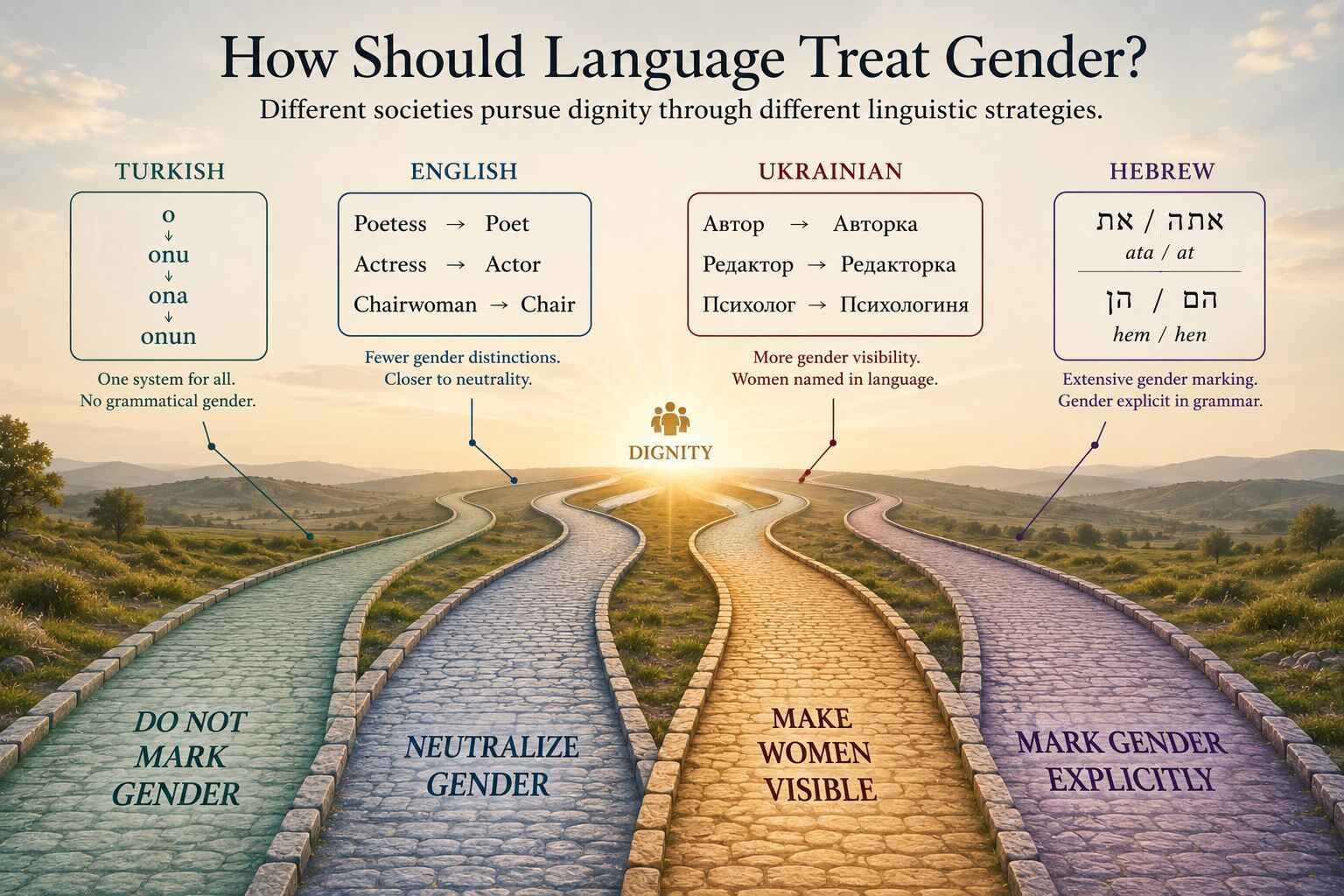
There is more than one road to Dublin. Different societies can move in different linguistic directions and still converge on the same human values. Image © Ivan Bassov, 2026. Licensed under CC BY 4.0.
Poetess and Avtorka
Languages evolve. But they do not always evolve in the same direction — even when societies claim to pursue the same values.
Consider English. Once upon a time, feminine professional forms were common:
- poetess
- authoress
- doctoress
- actress
Today, many of these forms sound archaic, awkward, or even patronizing. Modern English increasingly prefers gender-neutral terminology:
- poet
- author
- doctor
- actor
In English-speaking societies, removing gender distinctions is often seen as progressive. Equality is associated with universality. The masculine form no longer functions as masculine, but as neutral.
Now consider Ukrainian.
There, the trend often moves in the opposite direction. New feminine forms continue to appear and gain legitimacy:
- авторка (avtorka — feminine form of “author”; roughly comparable to the archaic English authoress)
- редакторка (redaktorka — feminine form of “editor”; roughly comparable to an English editoress)
- психологиня (psykholohynia — feminine form of “psychologist”; English never developed a widely used equivalent)
- директорка (dyrektorka — feminine form of “director”; roughly comparable to an English directoress)
Previously, masculine forms were widely used in a supposedly generic sense. Today, many speakers insist that women deserve explicit linguistic visibility.
Importantly, these Ukrainian forms are generally perceived as modern and progressive. The English examples (authoress, directoress, etc.) are provided only to help English-speaking readers understand the grammatical pattern, not because the words carry the same social connotations.
And here emerges a fascinating paradox.
Both English-speaking and Ukrainian-speaking societies generally consider themselves modern, democratic, pro-equality, and supportive of women’s rights. Yet one linguistic culture moves toward degendering, while the other moves toward additional gender marking.
Why?
Because there is no universal feminist linguistic strategy.
Different societies interpret equality differently.
In one culture, equality means removing distinctions.
In another, equality means acknowledging distinctions openly instead of hiding women behind masculine defaults.
The same social ideal produces opposite grammatical outcomes.
That alone should make us more cautious before declaring any single linguistic model “correct,” “progressive,” or “politically proper.”
The Russian Case: When Language Meets Geopolitics
Russian presents yet another variation of the same phenomenon.
Like Ukrainian, Russian possesses the grammatical tools needed to create feminine professional titles. Forms increasingly used by some journalists, bloggers, activists, academics, and younger urban speakers include:
- авторка (avtorka — feminine form of “author”)
- редакторка (redaktorka — feminine form of “editor”)
- блогерка (blogerka — feminine form of “blogger”)
- режиссёрка (rezhissyorka — feminine form of “director”)
Some of these forms are identical or nearly identical to their Ukrainian counterparts, yet their social reception differs significantly. Unlike Ukrainian, where feminatives have steadily gained institutional acceptance, Russian remains deeply divided over their use.
On one side are those who view feminatives as a natural linguistic evolution that makes women more visible in public life. On the other side are those who regard them as unnecessary, awkward, ideological, or contrary to established literary norms.
What makes the Russian case particularly interesting is that the debate cannot be explained solely through feminism. It is also entangled with questions of cultural identity and geopolitics.
Since similar forms have become increasingly prominent in Ukrainian, support for or opposition to feminatives in Russian sometimes functions as a broader cultural signal. Language becomes not merely a means of communication but a marker of affiliation, worldview, and identity.
As I discussed in my article According to the Rules of the Russian Language, arguments about what is or is not “correct Russian” are often less objective than they appear. Linguistic norms are not handed down from nature. They are shaped by institutions, cultural prestige, and social power.
The result is a fascinating contrast. In English, the debate often centers on whether gender distinctions should disappear. In Ukrainian, the debate often centers on whether women should be made more visible linguistically. In Russian, the debate is frequently about something larger still: who has the authority to define the language’s future and what cultural direction that future should take.
Turkish, Hebrew, and the Paradox of Feminist Language
Some languages constantly force speakers to think about gender. Others barely acknowledge it at all.
My two favorite languages illustrate this contrast perfectly: Turkish and Hebrew.
Ironically, I do not actually speak Turkish. I simply love the sound of it. Many people call Italian the most musical language. For me, that language is Turkish.
Turkish is astonishingly gender-poor.
Its pronoun system works roughly like this:
- o = he / she / it
- onu = him / her / it
- ona = to him / her / it
- onun = his / her / its
No masculine. No feminine. No grammatical drama.
Turkish nouns generally do not have grammatical gender. Verbs do not change according to gender. Adjectives do not change according to gender. In many situations, the language simply does not care whether someone is male or female.
In contrast, Hebrew is gloriously, relentlessly gender-rich.
Hebrew distinguishes gender almost everywhere:
- אתה / את (ata / at) — “you” (singular masculine/feminine)
- אתם / אתן (atem / aten) — “you” (plural masculine/feminine)
- הוא / היא (hu / hi) — “he” / “she”
- הם / הן (hem / hen) — “they” (masculine/feminine)
- past-tense verbs
- future-tense verbs
- adjectives
- numerals
In Hebrew, one often cannot address a person without specifying gender. The language almost compels speakers to classify the world continuously through gender.
Turkish, by contrast, can go through entire conversations without marking gender at all.
For a long time, I jokingly described Turkish as the “most politically correct” language and Hebrew as the “least politically correct.”
But the paradox of English and Ukrainian made me reconsider.
If English feminism often moves toward gender neutrality, then Turkish indeed appears naturally aligned with that tendency.
But if Ukrainian feminism increasingly embraces explicit feminine marking, then Hebrew suddenly looks surprisingly compatible with that direction as well.
So which language is actually “more politically correct”?
Perhaps neither.
Or perhaps both.
The answer depends entirely on what a society believes equality should look like linguistically:
- neutrality,
- or visibility.
The Myth That Grammar Determines Morality
People often assume that grammatical structure reflects political enlightenment.
Reality is far messier.
A highly progressive society may speak a deeply gendered language.
A conservative society may speak a language with almost no grammatical gender.
Grammar is not ideology.
Language is partly historical accident.
Turkish did not become gender-neutral because of modern feminism. Its structure emerged long before contemporary gender politics existed.
Hebrew did not become gender-rich because Israelis wanted to offend modern sensibilities. Hebrew inherited ancient Semitic grammatical structures that long predate modern ideological categories.
Trying to rank languages morally is therefore somewhat absurd.
Languages are ecosystems, not manifestos.
Visibility vs Neutrality
The real conflict is philosophical, not grammatical.
Should equality erase distinctions?
Or should equality recognize distinctions openly?
In English, words like “poetess” eventually began sounding diminishing. The feminine suffix implied deviation from the supposedly standard form. “Poet” became universalized.
But in Ukrainian, many feminized forms feel empowering precisely because women historically disappeared behind masculine defaults.
The same linguistic mechanism can therefore feel:
- oppressive in one context,
- emancipatory in another.
This is why simplistic discussions about “correct language” often collapse under scrutiny.
Different histories produce different sensitivities.
O/Onu/Ona/Onun
Sometimes, when people ask me for my “preferred pronouns,” I feel tempted to answer:
o/onu/ona/onun.
Sometimes the question is asked jokingly and I answer seriously; sometimes it is asked seriously and I respond playfully. In addition, many social media platforms explicitly request pronouns or preferred forms.
I respond with “o/onu/ona/onun” partly because Turkish pronouns sound beautiful to me.
Partly because the joke quietly exposes how arbitrary linguistic expectations can become.
And partly because I genuinely admire the elegant simplicity of a language that manages to function perfectly well without turning every sentence into a grammatical referendum on gender.
Yet I also admire Hebrew.
Not despite its gender richness — but partly because of it.
Hebrew possesses a strange intensity. Its grammatical structure creates constant interpersonal specificity. The language rarely allows abstraction to float entirely free from embodied human categories.
Turkish flows.
Hebrew insists.
Both are beautiful.
Music Beyond Grammar
Perhaps this is why I enjoy both Hebrew and Turkish rock music despite their radically different linguistic architectures.
The legendary Israeli band Mashina emerged from one of the world’s most gender-rich languages.
Meanwhile, Turkish groups like Mor ve Ötesi and Duman emerged from one of the most gender-poor.
Yet emotionally, culturally, and artistically, these worlds can feel surprisingly close.
The human experience survives grammatical differences.
Longing, irony, rebellion, melancholy, love, alienation — none of these emotions require identical pronoun systems.
Music crosses borders that grammar cannot.
› Selected Tracks
- Mashina — “Rakevet Laila LeCair” (1985)
- Mor ve Ötesi — “Bir Derdim Var” (2004)
- Duman — “Yürek” (2013)
The Real Lesson
The deeper lesson may be this:
Human societies pursue dignity through different linguistic strategies.
Some seek dignity through neutrality.
Others seek dignity through visibility.
Some minimize gender.
Others emphasize representation.
Neither approach automatically guarantees justice, wisdom, or equality.
And neither grammatical richness nor lack of grammatical gender makes a language inherently superior, kinder, or more civilized.
Languages are mirrors of historical evolution, not moral scorecards.
Perhaps true linguistic maturity begins when we stop demanding that every language evolve toward the same ideological destination.
Because sometimes two societies can pursue the same values while walking in opposite grammatical directions.
—
See Also
Related Topics
Related Posts