Brilliant. Fearless. And Completely Stuck.
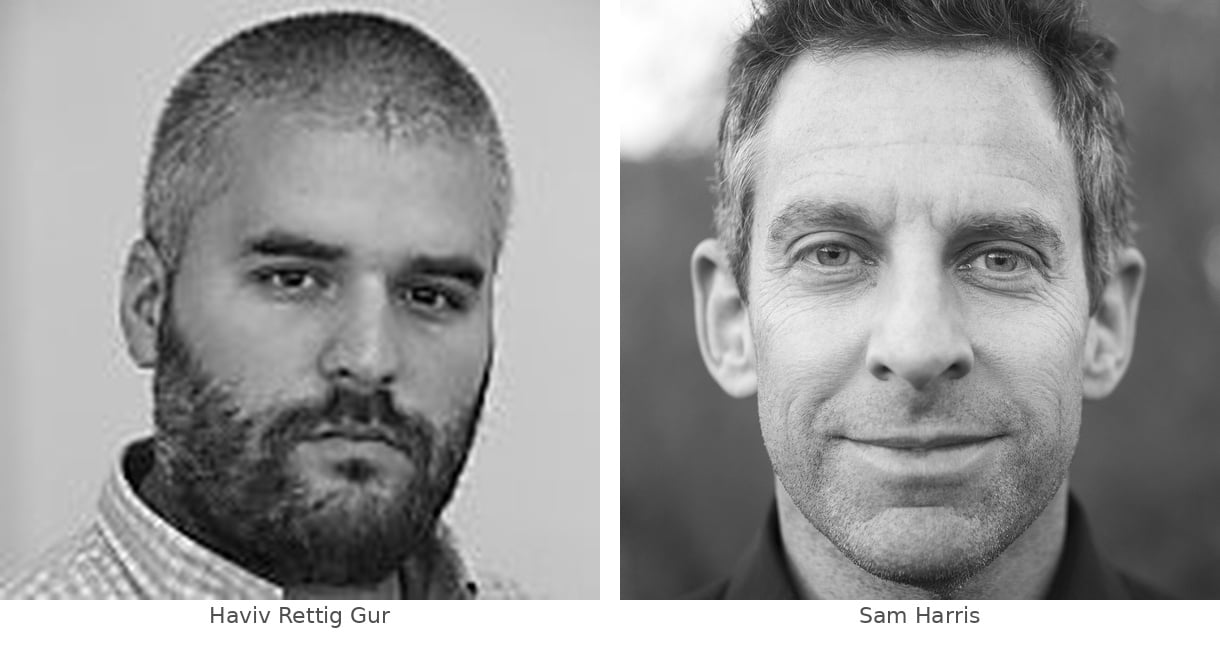
Episode 120 of the Haviv Rettig-Gur podcast, “What Actually Saves Us”, is the kind of sober, rigorous conversation that has become vanishingly rare in the public defense of Israel. Two serious thinkers who resist the temptation to overbid, in a space where desperation has become its own liability. Sam Harris and Haviv Rettig Gur are not just two intelligent men talking about Israel. They are heavyweights wrestling honestly with the most consequential questions facing Western civilization and the Jewish people within it. Rigorous. Determined. Morally clear in a moment when moral clarity is genuinely rare.
I listened to the whole thing. I came away with growing respect for both of them.
Not depressed by the finality of their analysis, but sad. There is a difference. I am not without hope. I believe there is an answer, one that no one seems willing to contemplate, and I have been writing about it.
What saddens me is something more personal than conclusions. Haviv and Sam are not despairing men, if anything, their composure is part of what makes the conversation worth having.
But I found myself asking, as the final minutes passed, what a Jew is meant to walk away with. A clearer map of a burning building is still a map of a burning building.
It is the desperation of our people in these dark days, and the fact that even our finest conversations offer them no realistic glimmer of hope. They see our most brilliant minds straining with everything they have, and still the ground beneath us keeps shifting.
We are losing in the court of public opinion. We have been losing, visibly and without pause, since October 7th.
We are losing in a deep, structural, generational sense. Antisemitism is not a periodic eruption anymore. It is ambient. It has come out of hiding with a vengeance, moving from the fringes into the mainstream across every walk of society.
It is omnipresent in elite institutions, embedded in campus culture, normalized in international discourse. It moves with a speed and confidence that tells you it no longer cares about the taboos we paid for. The tools we have deployed, campaigns, arguments, documentation, litigation, moral appeals, have not failed because they were applied badly. They have failed because they were the wrong tools for the problem we actually have. Antisemitism was not waiting for enlightenment. It was waiting for any excuse.
Sam Harris and Haviv Rettig-Gur understand this. Their diagnosis is precise and honest. The West is fragmenting. Reason is losing to identity. The shared epistemic framework that open societies depend on is being dismantled in real time, replaced by algorithmic tribalism and sectarian certainty. They both know that facts, however compelling, do not reach people who have already decided. They know the audience capable of hearing this conversation is a fraction of the audience that would need to be reached.
And this is where the sadness deepens.
Sam is, by his own account, an atheist. A committed rationalist. A man who has spent his career arguing against the consolations of faith. And yet his answer to the question of what saves us is, at its core, the answer of a Hasidic ascetic. Go inward. Find the stable ground beneath the chaos. Detach from the noise. Cultivate an inner life that the world cannot touch. It is a genuine and profound answer. It is also, unmistakably, the answer of a man who has made his peace with how dark it is outside, dressed in the language of neuroscience rather than ancient Jewish mysticism, but pointing toward the same refuge.
There is something almost poignant about this. The secular rationalist and the Hasidic master arrive, by entirely different roads, at the same destination. The world is broken. Strengthen yourself from within.
Haviv is different. He stays in the fight. He is perhaps the finest intellectual voice in the English-speaking Israel-defending world, the peak, if you want to be honest about it, of what we might call the hasbara tradition at its most serious. Not hasbara as spin or as talking points, but as the genuine, rigorous intellectual defense of the legitimacy of the one Jewish state. When Haviv argues, he argues with the full weight of history, of sociology, of moral philosophy.
He is not easy to dismiss by those still concerned with facts.
But that qualification says everything. The audience capable of hearing Haviv is not growing. It is shrinking, relative to the rate at which hostility is spreading. We are producing better and better arguments for a smaller and smaller room. Outside that room, the hatred does not debate. It does not engage. It does not care about our sources or our timelines or our moral consistency. The gap between the quality of the argument and the size of the world willing to engage with it honestly is not closing. It is widening by the day. And when the finest minds produce the finest arguments and the trajectory does not change, something more fundamental is broken.
The Zionism exchange crystallises this perfectly.
Sam Harris argues the word is now so poisoned that using it is strategically self-defeating. It cannot be rehabilitated in real time. The moment it is spoken, the frame has already closed.
Haviv Rettig-Gur pushes back with characteristic force. Zionism is the name of the Jewish national liberation movement, one of dozens born in the same historical moment. Italian nationalism. Polish nationalism. Greek nationalism. Armenian nationalism. Every one of those movements is treated today as the natural expression of a people reclaiming sovereignty. The Jewish one, alone, is placed in a unique moral category, treated as suspect, requiring perpetual justification.
His knowledge of history is impeccable. And yet, without realizing it, he just made Sam’s point for him.
By situating Zionism within the wave of 19th century nationalisms, even to defend it, Haviv accepts a frame that our enemies are delighted to work with. A movement born in a particular historical moment can be analysed through the lens of that moment. It can be situated within European intellectual history, within the dynamics of empire and colonialism, within the ideological currents of its era. It can be placed on a timeline that begins in Basel in 1897 and made to look like exactly what its opponents say it is. The defense became the concession.
But the Jewish relationship to this land does not begin in Basel. It does not begin in the 19th century at all. It begins three thousand years ago, and it never stopped. It survived Roman conquest, Byzantine restriction, Crusader massacre, Ottoman rule, and two millennia of exile, not as a dormant political claim but as a living daily reality, expressed in prayer three times a day, inscribed in the direction of every synagogue built on every continent, spoken aloud at every Jewish wedding. Zionism did not invent the claim. It mobilized one that had never been relinquished.
Not because the claim is wrong, but because the arena in which it could receive a fair hearing no longer exists. And perhaps because political Zionism, however legitimate, is just one chapter in a story three thousand years old. The cocktail of Zionist argument and Holocaust urgency worked for a while.
We lobbied hard for it, we paid for it, and the world went along. That window has closed. And the anger about antisemitism, however righteous, is equally impotent. We have been issuing the same warnings for decades. The numbers keep getting worse. Antisemitism does not respond to evidence. It does not submit to reason. It never did.
The one strategy we have never seriously tried is leading with Judaism itself. Not defending our right to exist. Not lobbying for empathy. But proudly sharing the wisdom and faith of our ancestors in all its beauty and its relevance, to a world hungry for meaning, as Sam would surely agree.
Judaism. The faith. The culture. The civilization. The intellectual tradition that made argument a form of worship. The ethics that placed the obligation to the stranger not as charity but as covenant.
The people who gave the world the radical idea that every human being carries within them something divine. A miniscule 0.2% of the world’s population, that proceeded to reshape the world repeatedly, in every field, in every era, against every conceivable resistance.
The world does not know this. Not because it has heard it and rejected it. Because we have never told it.
We have been so consumed by defending our right to exist that we forgot to show pride that our existence enriches the world.
The audience for Sam and Haviv is real and it matters. But let us be honest about who it is. It is largely people who are already invested. Intellectually honest men and women seeking confirmation that their position is legitimate, that the facts are on their side, that serious thinkers stand where they stand. Here and there a few others will be moved. But this conversation is too dense, too intense, too demanding for the masses. It is a dry argument.
And here is the painful truth a great many of our own people cannot be bothered to follow it. They have already drifted too far. The thread was cut before the podcast was recorded.
Which is precisely why, if Sam Harris and Haviv Rettig-Gur, the best we have, cannot point to a pragmatic answer, we should be worried.
Not about the argument. The argument is fine. We have always been good at the argument. We should be worried about everything outside the room where the argument is happening.
The answer, I believe, lies not in a better argument but in an older light. Authentic Judaism. Offered without apology, without defense, without the distraction of every geopolitical crisis attached to it. To the world that has never truly met us. And to our own who have forgotten what they are missing.
I would genuinely welcome Sam or Haviv challenging me on this.