
Did The Sinai Deal Really Work?
For decades, Sinai has been treated as the crown jewel of the land-for-peace argument.
Oftentimes, in the argument surrounding “land for peace,” opponents will claim that Israel exchanging land for peace has never historically worked or held up. Those in favor will respond with what they believe is the killer counterexample—the 1979 Camp David Accords, where Israel exchanged the Sinai Peninsula for a cold peace with Egypt.
However, the Sinai deal is not the “gotcha” that advocates of land for peace think it is.
Did the Sinai deal work? Not quite in the way it is often portrayed.
The strategic value of the Sinai did not disappear when Israel withdrew.
Over the decades that followed, activity in the region repeatedly demonstrated why it mattered. ISIS-affiliated and other jihadist groups operated in Sinai, launching rockets and carrying out attacks against Israel. But even more significant was Sinai’s role as a corridor for weapons smuggling.
Until 2005, Israel controlled the Philadelphi Corridor, the narrow strip separating Gaza from Egypt. Yet despite this, extensive tunnel networks were dug beneath the border. Evidence documented by respected policy institutes, major media organizations, and even Israel’s own Shin Bet demonstrates that for years weapons flowed from Iran through Sudan, Egypt, and Sinai before ultimately reaching Hamas in Gaza. These smuggling routes played a major role in Hamas’s military buildup and helped arm the terrorist organization that carried out the October 7 massacre.
Nor was the problem limited to Gaza. Weapons from Egypt have also been smuggled into Israeli territory, fueling both criminal organizations and terrorist activity.
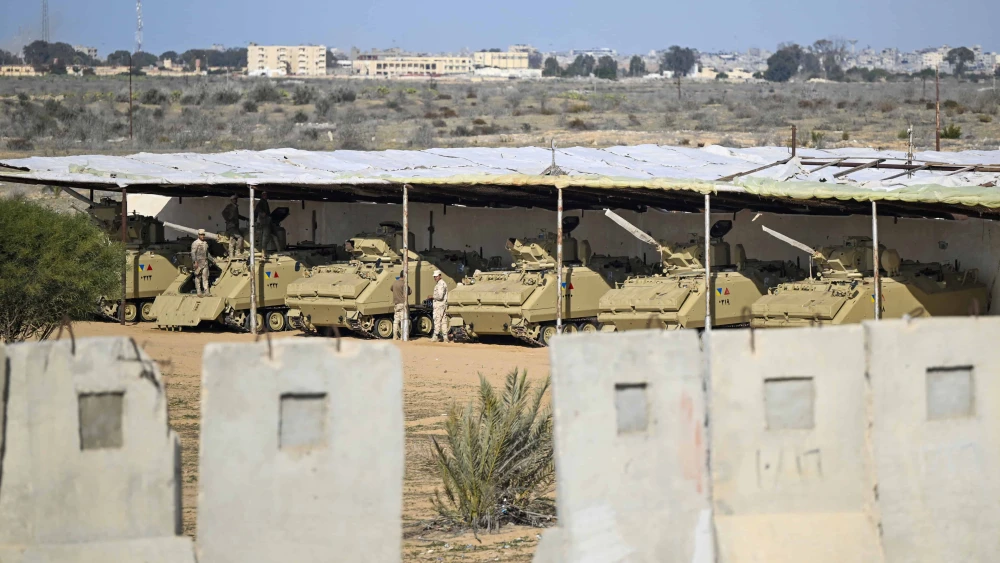
Arguably even more concerning, the demilitarized framework that formed one of the foundations of the Egypt-Israel peace treaty has steadily eroded.
In recent years—and especially in recent months—Egypt has significantly expanded its military presence in Sinai, including large troop deployments, tanks, and live-fire exercises.
This is not to suggest that an Egyptian surprise attack is imminent. It may not be. But it highlights a critical point: one of the central assumptions underlying the treaty is weakening.
The demilitarized nature of Sinai was a key component of what made the agreement acceptable to Israel in the first place. Even if Egypt’s current motivations are related to regime security, regional influence, or counterterrorism concerns, those motivations may not remain constant. Governments change. Interests change. Regimes change. While the current Egyptian leadership may have no interest in war with Israel, public hostility toward Israel within Egypt remains widespread.
Israel cannot afford to ignore these developments. Security arrangements are only meaningful if they are maintained. Allowing them to erode today may create far greater problems tomorrow.
Even with all of this, many will ask: was it still not worth it for the years of peace we got with Egypt?
Sinai was never the worthless desert it is sometimes portrayed as. In surrendering it, Israel gave up strategic depth, invaluable oil fields, important air bases, and, of course, expelled thousands of Jews from thriving communities such as Yamit.
Further, one has to ask whether giving up Sinai was ever truly necessary to achieve peace in the first place.
At the end of the Yom Kippur War, Israeli forces had crossed the Suez Canal, encircled Egypt’s Third Army, established positions deep inside Egypt, and advanced to within striking distance of Cairo. Egypt was not negotiating from a position of strength. Israel was.
Yet under intense international pressure, Israel ultimately withdrew from these positions without first securing peace from Egypt.
Why?
If Egypt wanted Israel to withdraw from its post-war gains, why wasn’t that withdrawal conditioned on peace? Rather than using its strongest leverage to secure a formal agreement, Israel relinquished those positions and only years later, at Camp David, negotiated a peace treaty that required surrendering the entire Sinai Peninsula.
Perhaps Egypt would never have accepted such a condition. Perhaps it would have. We cannot know. What we do know is that Israel possessed immense leverage in 1973 and chose not to use it to secure the one thing it would later trade away Sinai to obtain.
The common claim that surrendering Sinai was the only path to peace is not a fact. It is an assumption.
And assumptions have consequences.
The Sinai deal became the model for future territorial concessions. It helped pave the way for Oslo and later for the Gaza withdrawal. Those policies were sold on a similar premise—that surrendering territory would reduce conflict and increase security.
The results are difficult to ignore.
Yet despite the failures of Oslo and Gaza, Sinai continues to be held up as proof that territorial concessions can succeed.
Supporters of territorial concessions have pointed to Sinai as their strongest example. Yet the history of the peninsula since 1979 tells a much more complicated story—one involving jihadist insurgencies, weapons smuggling, the gradual erosion of demilitarization, and strategic challenges that continue to this day.
Nevertheless, the pressure on Israel to surrender strategic territory has not diminished. If anything, it has intensified.
Just a few days ago, six countries announced sanctions against Bezalel Smotrich, including restrictions on his ability to enter their territories. (6 countries announce sanctions on Bezalel Smotrich | Israel National News) French Foreign Minister Jean-Noël Barrot defended the move by accusing Smotrich of “actively promoting the annexation of the West Bank.”
Beyond the mistaken belief that a state can somehow annex its own territory, Barrot’s remarks reflect a broader mindset.
Israel continues to face tremendous international pressure to weaken its sovereignty, surrender strategic assets, and trade tangible security interests for promises of future peace.
What happened to Smotrich is merely the latest example.
At a time like this, it is worth revisiting the example most often cited in favor of territorial concessions.
Because even Sinai—the crown jewel of the land-for-peace argument—is far more complicated than its advocates would have us believe.
Sources and Further Reading
This article draws upon reporting and analysis from Reuters, The Wall Street Journal, the Shin Bet, the Institute for National Security Studies (INSS), the Jerusalem Center for Security and Foreign Affairs (JCPA), the Washington Institute, the Foundation for Defense of Democracies (FDD), The Jewish Institute for National Security of America (JINSA), the American Enterprise Institute (AEI), Makor Rishon, Kan News, and The Jerusalem Post.
Selected sources:
- Makor Rishon: https://www.makorrishon.co.il/news/defence/article/327141
- JCFA: https://he.jcfa.org/what-is-behind-the-egyptian-violations-of-the-peace-agreement-with-israel/
- Jerusalem Post: https://www.jpost.com/magazine/commentary-the-sinai-withdrawals-dangerous-legacy-584081
- INSS: https://www.inss.org.il/wp-content/uploads/2022/05/%D7%A4%D7%A8%D7%A1%D7%95%D7%9D-%D7%9E%D7%99%D7%95%D7%97%D7%93-190522.pdf
- Shin Bet: https://www.shabak.gov.il/moreshet/study/sudan120511/
- Reuters: https://www.reuters.com/fact-check/hebrew/HLGWDL3VGFI43BFNQOXZONO6K4-2024-05-28/
- https://www.reuters.com/article/world/islamic-state-linked-group-claims-rocket-attack-on-israeli-resort-idUSKBN15O0GF/
- Washington Institute: https://www.washingtoninstitute.org/policy-analysis/israels-sinai-dilemma
- FDD: https://www.fdd.org/analysis/2023/10/28/hamas-tunnels-to-egypt-played-key-role-in-arming-hamas/
- AEI: https://www.aei.org/articles/egypts-role-in-gaza-arms-smuggling/