
Greek Jewish roots. New York voice. Unfiltered perspective.
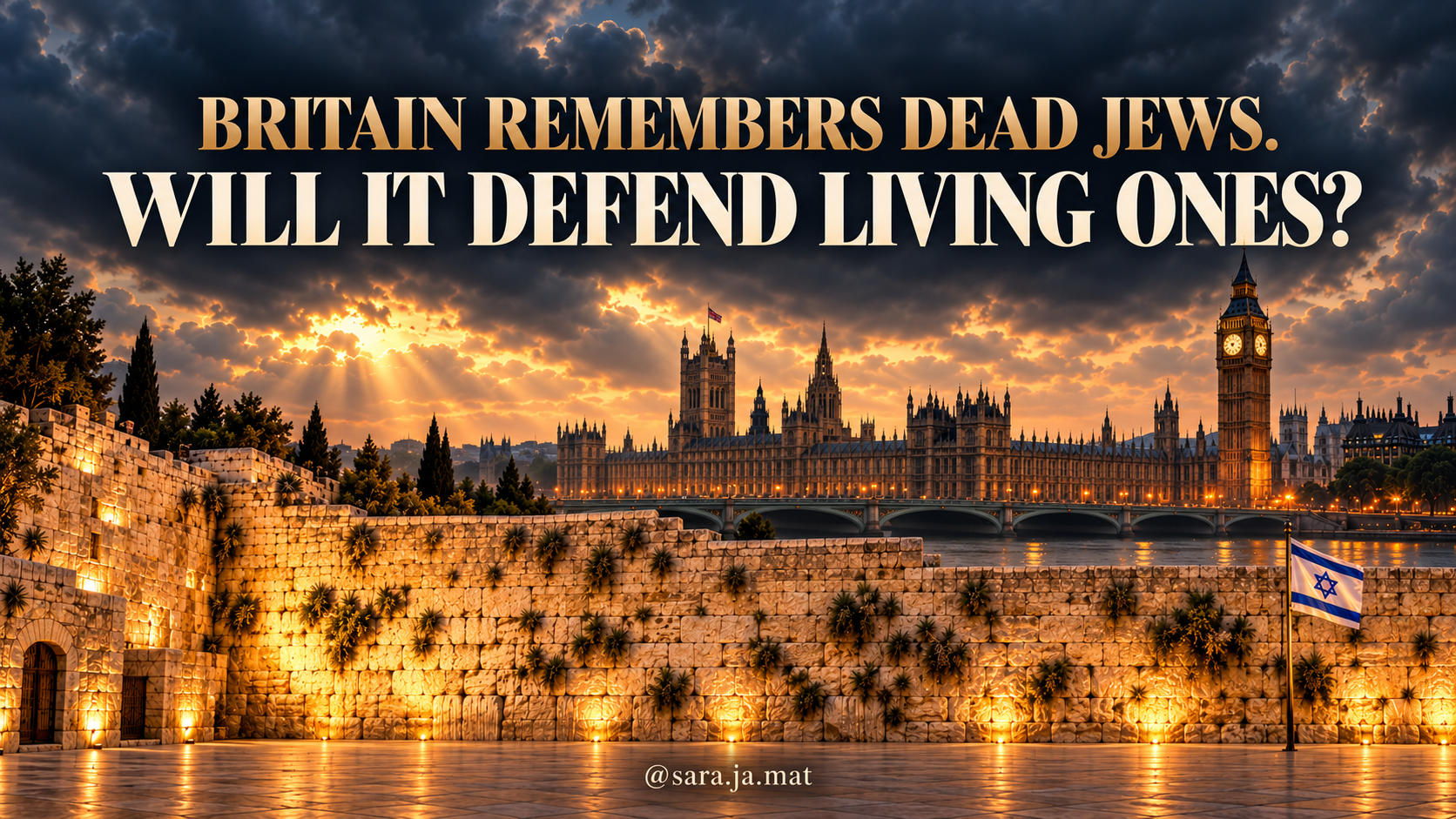
Britain Remembers Dead Jews. Will It Defend Living Ones?
My father survived because people made choices.
His parents chose to hide.
A Greek Christian couple, Phroso and Yiorgos Stamos, chose to protect them, and promised to raise my father if his parents did not survive.
And when a Nazi soldier discovered my father and his mother hiding in a cave, he chose to look away rather than kill them.
My father’s life depended on those choices. So did the lives that followed his: his children, his grandchildren, our family.
Jewish survival was never inevitable. My father’s story makes that painfully clear. Someone had to choose it.
But there is another lesson in his survival: no people’s future should depend on whether the person who discovers them hiding decides to let them live.
My father survived because others chose to protect him. Jewish sovereignty means having the power to protect ourselves.
So when a British political party declares Zionism racist and endorses replacing Israel with a single Palestinian state, I hear something more consequential than a dispute over terminology.
I hear a proposal to end Jewish sovereignty in our ancestral homeland and replace it with assurances that a different political order would protect us.
How, after the Holocaust, is that being sold as progress?
What happened in Brighton
On October 4, 2026, three days before the third anniversary of October 7, members of the Green Party of England and Wales voted 1,022 to 813 to adopt an anti-Zionist policy. The party’s own announcement confirms the result.
According to ITV’s reporting of the adopted motion, it treats Zionism as racism and supports a single democratic Palestinian state throughout historic Palestine, with Jerusalem as its capital.
The replacement of Israel is the political implication of that proposal. It goes beyond demanding an election, opposing settlements or prosecuting an alleged crime.
A government can change while its country continues to exist. This proposal changes the country itself.
The party says anti-Zionism should not be equated with antisemitism and that the motion does not change disciplinary procedures. Those assurances belong in the record.
So does the conference’s rejection of an additional clause intended to protect members from pressure or discipline because of affiliation with Jewish institutions identifying as Zionist.
ITV also reports that supporters gathered after the vote chanted, “Zionists are not welcome here.”
What is a Jewish member who supports Israel’s existence supposed to hear in those words?
The question is unavoidable: if supporting the continued existence of the Jewish state is now classified as racism, where does that leave Jews whose identity includes precisely that conviction?
Calling your intentions anti-racist does not answer what your policy asks Jews to surrender.
Britain has seen conditional Jewish belonging before
In 1190, approximately 150 members of York’s Jewish community died in the siege, mass suicide and massacre associated with the site of Clifford’s Tower.
In 1290, Edward I expelled the Jews from England.
There was no State of Israel. No Netanyahu government. No modern settlement controversy.
There were Jews.
England’s persecution emerged within a Christian society. Religious hostility, royal exploitation and financial interests helped turn Jewish neighbors into targets, as English Heritage’s account of the York massacre explains.
Britain cannot honestly blame its history of antisemitism on Muslim immigration. The hatred was already there.
After the expulsion, Jews had no official right of residence or worship until the late 1650s, although some Jews and converts remained.
Readmission did not mean immediate equality. In 1858, Lionel de Rothschild finally took his seat in Parliament after the religious barrier to Jewish participation was overcome.
The conditions changed. The recurring question was who would permit Jews to belong.
That history should make British political institutions especially careful about defining Jewish belonging as an offense.
Rescue – and the closing of a door
Britain’s Holocaust history includes extraordinary acts of rescue.
The Kindertransport brought nearly 10,000 predominantly Jewish children to safety between December 1938 and September 1939.
Every one of those lives matters. Every person who helped save them deserves remembrance.
But Britain’s record also includes a restriction that cannot be edited out of the story.
In May 1939, as European Jews desperately sought escape, the British White Paper limited Jewish immigration into Mandatory Palestine to approximately 75,000 over five years, subject to economic conditions. Afterward, further Jewish immigration was to require Arab acquiescence.
Britain did not perpetrate the Holocaust. Nazi Germany and its collaborators did.
But British policy restricted a potential route of refuge at a catastrophic moment.
Think about what that meant: Jews fleeing persecution could need sanctuary, yet their admission remained contingent on political calculations made by others.
This is why sovereignty matters.
A people without control over a place of refuge can plead. It can petition. It can wait for exceptions.
It cannot open the door.
Britain had already acknowledged the idea of a Jewish national home in the 1917 Balfour Declaration, which also stipulated protection for the civil and religious rights of existing non-Jewish communities.
Jewish national belonging and the rights of others were obligations to address together.
The historical lesson is that Jewish survival cannot safely depend on promises that someone else retains the power to withdraw.
Muslims belong in Britain. Jews belong, too.
Britain’s relationship with Islam also reaches well beyond today’s arguments.
Its imperial and maritime history connected it with Muslim populations. By 1889, Muslim institutions had established mosques in Liverpool and Woking; Woking’s Shah Jahan Mosque was Britain’s first purpose-built mosque. Muslim soldiers gave their lives for Britain in both world wars. Their service deserves recognition.
British Muslims are entitled to safety, religious freedom and political participation. They are entitled to advocate for Palestinians. They are not collectively responsible for Islamist extremists or for every politician who shares their faith.
The same standard must apply to Jews.
No religious community should have to purchase acceptance by repudiating its own history. No campaign against one form of hatred should offer shelter to another.
The Green Party’s decision must be judged by its content and consequences, regardless of the religion of anyone supporting it.
What I object to is the proposition that Jewish national self-determination is inherently racist.
Equal rights cannot mean that Jews must surrender the right to remain a sovereign people.
The scroll—and the people carrying it
A 20-slide post by Thomas Finn recently made me stop scrolling and think.
He begins with the Masoretes and the painstaking Jewish work of preserving scripture. Then he widens the argument: civilization owes a debt to the people who carried that inheritance through persecution.
His description stayed with me:
“They were not authors. They were carriers.”
I knew the pieces. Christianity emerged from Jewish life and scripture. Islam shares the Abrahamic inheritance and reveres figures central to Jewish tradition. Jews carried our texts through exile after exile.
What Finn helped me see was the connection between the inheritance and the people so often treated as expendable.
In my own reflection, I asked:
How do you inherit our texts and persecute their keepers?
How do you build civilizations influenced by what Jews carried, then repeatedly decide the Jews themselves are the problem?
Britain makes that contradiction concrete.
Its Christian culture inherited the Hebrew Bible. Its medieval rulers expelled Jews. Its modern institutions remember the Holocaust. Now a political party has adopted a policy condemning Zionism as racism.
These are different eras and different actors. The question connecting them is whether Jewish inheritance can be welcomed while Jewish agency remains conditional.
Jewish influence on civilization is profound. That does not require claiming that every biblical manuscript was identical or that every moral idea came from one people.
Nor should our rights depend on a calculation of our contributions.
We would deserve safety if we had contributed nothing anyone else valued.
We are human beings. We are a people. We are entitled to a future.
A homeland – not an interchangeable refuge
Israel is not an interchangeable shelter for Jews. It is our ancestral homeland.
Our connection to it did not begin with the Holocaust, the British Mandate or the establishment of the modern state.
The Western Wall is a surviving retaining wall of Jerusalem’s ancient Temple Mount complex. Its ancient stones bear witness to Jewish life and worship there long before modern political Zionism. Generations of Jews continued to long and pray for Jerusalem through centuries of exile.
The Western Wall bears physical witness to Jewish history in Jerusalem long before modern political Zionism. Our connection to this homeland was not invented in the twentieth century.
Jewish history in this land is not a concession for politicians to grant or withdraw.
Israel is the world’s only Jewish state, in the land central to Jewish peoplehood. Our claim to national self-determination there is not merely a request for compensation for what Europe did to us.
The Holocaust explains the catastrophic stakes of powerlessness. It did not create our connection to Israel.
Even the UN’s 1947 partition resolution called for both a Jewish state and an Arab state. Jewish statehood was part of the proposed settlement, alongside protections for the rights of each state’s inhabitants.
That is why an offer of equal rights after replacing Israel does not answer the objection.
Individual civil rights do not substitute for a people’s right to national self-determination in its ancestral homeland. Jews are entitled to both.
Supporting Israel’s existence does not require approving every government decision or every territorial claim. It requires recognizing that Jewish sovereignty in the Jewish homeland is legitimate.
Its abolition cannot be presented as an ordinary policy reform.
“Zionism is racism” is an old formula
In 1975, the United Nations General Assembly adopted Resolution 3379, declaring Zionism a form of racism and racial discrimination. In 1991, the General Assembly revoked that determination.
The Green Party is reviving a formula the UN itself abandoned.
For me, Zionism’s essential proposition is straightforward: Jews are a people entitled to self-determination in our ancestral homeland.
My support for Israel’s existence is not conditional on agreeing with its government. Governments answer for their decisions. A people’s right to a homeland cannot be put on trial every time its leaders are accused of wrongdoing.
Supporting Israel means, at minimum, supporting its continued existence and the safety of its people. It leaves ample room to argue about policy.
That distinction is the difference between political accountability and national dissolution.
The motion promises democracy. My objection is that it would end Jewish sovereignty. Equal individual rights and national self-determination are different questions; promising the first does not answer what happens when Jews surrender the second.
Who would guarantee their security? What recourse would they have if those guarantees failed? What prevents coercion? Who controls the means of defense?
Above all, why are Jews expected to regard the surrender of their sovereignty as a reassuring answer to their vulnerability?
My father’s life explains why I cannot.
How are we here after the Holocaust?
Because remembering an atrocity does not automatically teach people to recognize the ideas that enable exclusion.
A society can teach students to condemn Nazi antisemitism while failing to challenge contemporary arguments that make Jewish identity, solidarity or sovereignty uniquely suspect.
Remembering Jews who were murdered should go hand in hand with defending the right of living Jews to protect themselves.
The Holocaust should have made the danger of Jewish powerlessness impossible to dismiss.
Instead, some people appear willing to condemn the historical consequences of that powerlessness while condemning the Jewish determination to overcome it.
Britain’s Jewish communities already face real danger. The (CST) Community Security Trust recorded 3,700 antisemitic incidents in 2025, its second-highest annual total. Its report describes the fatal terrorist attack at Manchester’s Heaton Park Synagogue on Yom Kippur.
CST distinguishes antisemitism from anti-Israel activity without anti-Jewish language, motivation or targeting. That distinction matters.
So does the reality of sustained hostility toward British Jews.
I am asking political leaders to consider what happens when they label a central conviction of many Jews racist while those Jews already face intimidation and violence.
The 813 votes against the motion matter. Opposition existed inside the party. Britain is not one political mind.
But a majority adopted the policy. Those who did must answer for it.
My Father Survived on Someone Else’s Permission. Jews Should Never Have To Again.
Someone taught the child.
Someone copied the letters.
Someone packed the books.
Someone carried the scroll when everything else had to be left behind.
And in my family, someone hid. Someone offered protection. Someone promised to raise a child. Someone discovered a mother and her baby and chose to let them live.
Those choices made my life possible.
I will always honor them.
But I refuse to accept that dependence on such choices is the proper permanent condition of the Jewish people.
Jewish sovereignty is not a historical mistake to be corrected. It is the exercise of a people’s right to self-determination in its ancestral homeland.
After centuries in which others decided where Jews could live, whether they could worship and whether they could escape persecution, our return to political agency is not a moral offense.
My father survived because people chose to protect him. Jewish sovereignty gives us the power to defend our children, rather than leaving their protection entirely to the choices of others.
Britain can remember the cave.
It can honor the rescuers.
It can mourn the murdered.
But if it condemns the Jewish people for refusing to return to powerlessness, it has remembered the Holocaust and missed the lesson.
Am Yisrael Chai.
Related Topics
Related Posts