
Britain’s Palestine campaign is in office
Britain, once again off track, is holding its fight over Israel in the wrong building.
Andy Burnham’s government announced economic measures against Israeli communities in Judea and Samaria on 8 September. The Chief Rabbi, the Board of Deputies, and the Jewish Leadership Council had each warned against them, and condemned them when they came — to say nothing of logic or not-so-common sense. Palestine Action’s proscription reaches the Supreme Court in November (with roughly three thousand people already arrested for holding its placards). All of it is national, and all of it can be undone by whoever wins the next election.
Proscription is also the instrument with the least to show for itself. Palestine Action was banned in July 2025, and the document the government cited as its ground for doing so still sits on the group’s website — 31,000 visits over six months, by The JC’s count, alongside a clickable map of 200 British companies it lists as targets and a checkout that takes ordinary bank cards.
The Palestine Solidarity Campaign banked £3,838,259 in the financial year that ended last August. Two years before that it raised £773,886 and spent more than it took in. Campaigning alone now costs it £2.39 million a year, more than three times its entire old income. Money on that scale does not simply buy louder marches. It buys people who turn up to committee meetings on a Tuesday night.
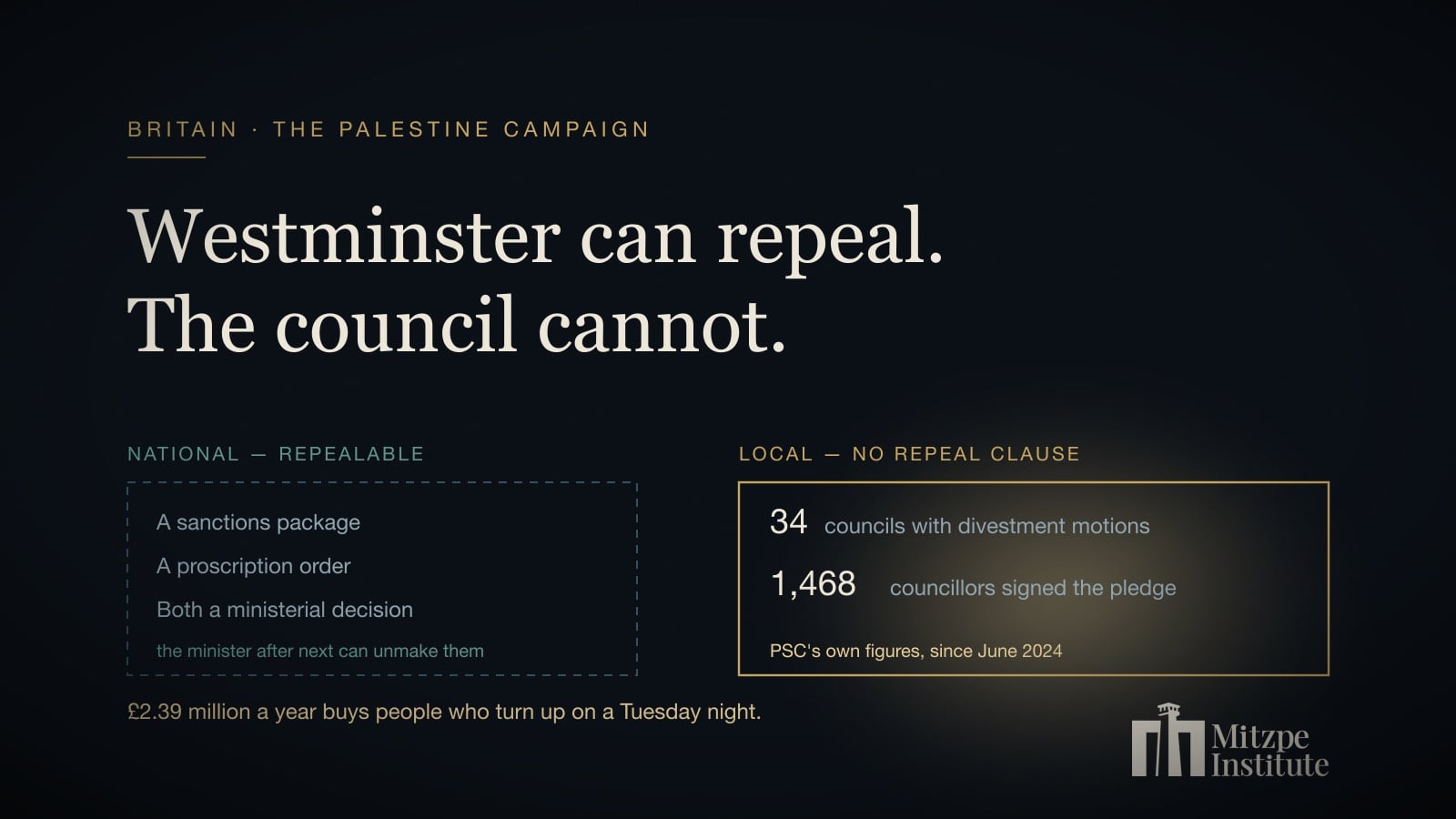
By PSC’s own reckoning, 34 councils have passed divestment motions since June 2024, and 1,468 councillors have signed a pledge that turns their pension funds against firms it calls “complicit” and commits them to confront Israel over “crimes of genocide and apartheid.” Hackney has begun unwinding its twinning with Haifa and pulling its pension money out. Kamel Hawwash, elected in Birmingham in May, chaired PSC before he ran for office. Lewisham’s mayor, Liam Shrivastava, told a PSC rally that Palestine was on the ballot that Thursday. He was right about his own election.
None of it needed a vote in the Commons. None of it needed British foreign policy to move an inch. None of it is good for Israel or the West more broadly.
And the councillors are not the ceiling. Sophus Magill, a Green parish councillor on the Isle of Wight, set up the WhatsApp group whose messages leaked in August, where members compared killing Zionists to capital punishment for traitors and one described wanting to “plough into” a group of Israelis. Magill had earlier circulated a paper opposing proscription of the Revolutionary Guards. Asked if he wanted Israel wiped off the map, he said yes. A parish council is the smallest office Britain has — and it is the one nobody watches.
Zack Polanski, the Green leader, was selected on 11 September as his party’s candidate in Holborn and St Pancras, the seat Keir Starmer vacated on 1 September. Labour has held it since the 1980s and Starmer took 48.9 percent there two years ago. The Greens have five MPs and have never won a seat in London. What changed is May, when the party made gains across that same ground in the local elections. Polanski is building a parliamentary run on council results, and a senior figure in his own party is already selling the by-election as a referendum on Burnham.
That is the return on £2.39 million a year. The council chamber is the route into Parliament, and Polanski is walking it.
For Jerusalem, the practical question is which of these pressures survives a change of government. A sanctions package was a ministerial decision. And, fortunately, the minister after next can unmake it. A pension resolution passed in Hackney goes into the fund’s own investment policy and stays there. The 1,468 signatures sit with people who face voters on a different cycle from Westminster, most of them with no national party campaign to answer to. An ambassador can lobby a foreign secretary. Nobody has worked out how to efficiently or successfully lobby 34 independent planning committees.
The sanctions fight is worth having. The Chief Rabbi has asked whether domestic political considerations are driving this instead of foreign-policy judgment, which is one of many questions worth pressing. But a ministerial measure comes with a repeal clause. The council resolutions arrived without one, and they now have the Green leader on the ballot in Holborn and St Pancras on 8 October.
PSC stopped petitioning local government and started staffing it. The next Foreign Secretary will not be able to undo that.