
"These fragments I have shored against my ruins"
Broken Wings Over Empty Villages: Hungary’s Memory of 1944
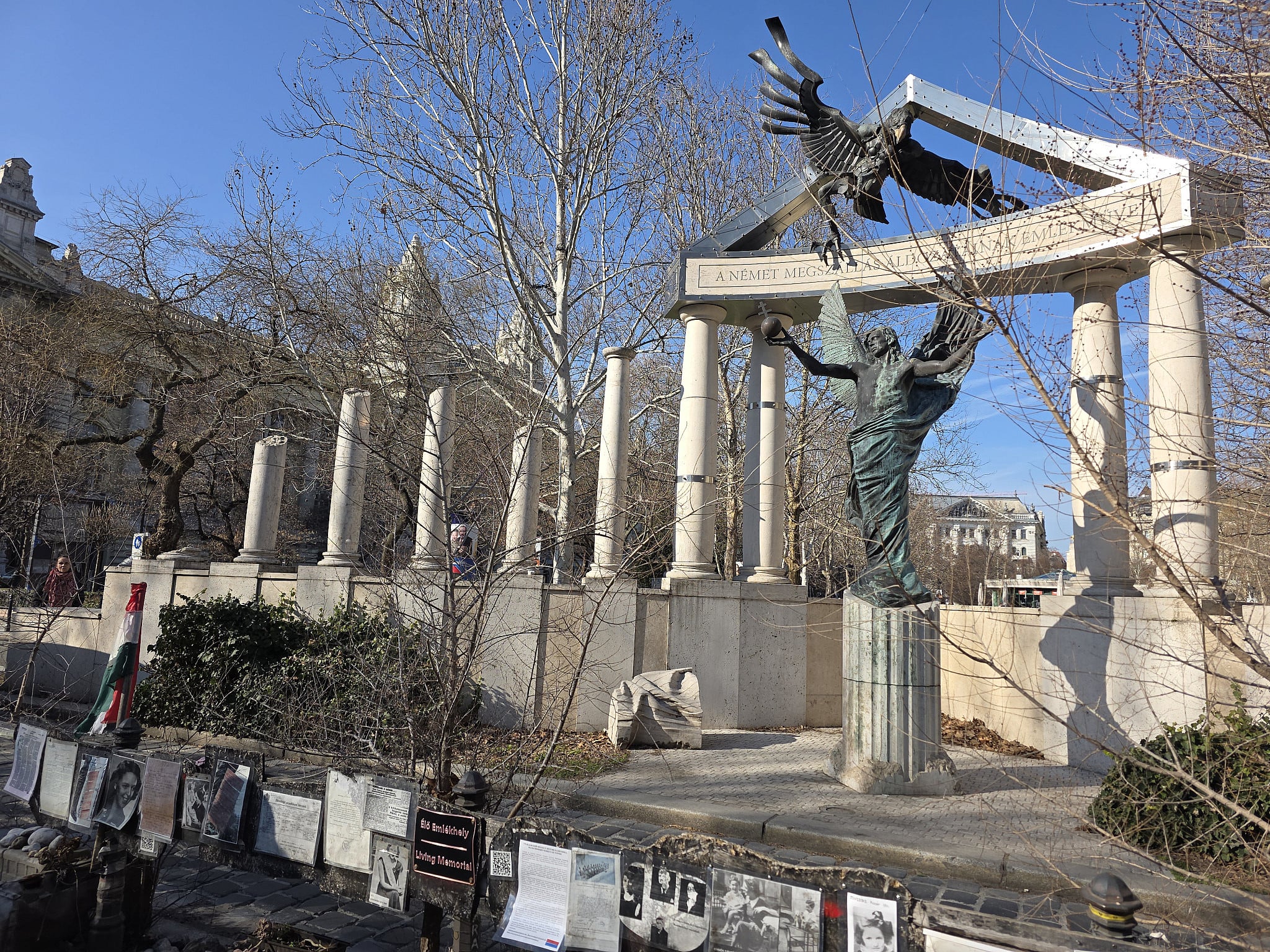
The Memorial to the Victims of the German Occupation with the Living Memorial in the foreground (Photo courtesy of the author)
1.
There is an old story about Operation Margarethe, the German occupation of Hungary in March 1944.
A German general asks:
“How long would it take to occupy Hungary?”
“Twenty‑four hours if we go in as enemies,” comes the reply,
“but at least three days if we go in as friends. As enemies, we just drive to Budapest. As friends, we must stop in every village to receive the speeches, the flowers, the banquets.”
The story circulates in many forms: as an anecdote, as a historical fact, as a joke, depending on who tells it. Sometimes it features General Alfred Jodl or Adolf Hitler, sometimes it passes between German officers, sometimes a Hungarian diplomat explains it to a German, sometimes a German to an American — it works in every direction. And it only works because it is plausible.
It works because it carries a truth that cannot be stated directly: a displaced admission of complicity, passing as humor, safer to laugh at than to articulate. It gestures toward something official narratives have never comfortably absorbed: Hungary did not resist the Wehrmacht. It did not need to be subdued. It was already aligned, already entangled, already prepared to cooperate.
2.
On 19 March 1944, German troops entered Hungary in a four‑pronged invasion known as Operation Margarethe. Hungary had been a German ally since 1940, fighting alongside the Axis on the Eastern Front, but now Berlin moved to tighten control. Hitler ordered the occupation after learning that Prime Minister Miklós Kállay, with Regent Miklós Horthy’s knowledge, had been seeking a separate peace with the Allies. The Wehrmacht moved in while Horthy was summoned to Klessheim; by the time he returned, the occupation was a fait accompli.
Eleven German divisions crossed the border without meeting military resistance. The occupation was quick and bloodless, and a new pro‑Nazi government under Döme Sztójay was installed.
The consequences were immediate and catastrophic.
3.
Seventy years later, in Budapest’s Szabadság tér, a monument appeared: the “Memorial to the Victims of the German Occupation.”
Hungary is depicted as the Archangel Gabriel, innocent and helpless, losing the symbols of statehood under the attack of an imperial German eagle descending upon him. After a protest by the Federal Republic of Germany, a ring bearing “1944” was added to the bird of prey’s right leg.
The monument asserts that Hungary was the victim: all Hungarians. The absence of the word “Jew” asserts something else as well: that Hungarians were only victims — never collaborators, never agents, never responsible for the machinery that delivered their own citizens to Auschwitz with astonishing speed.
Where the joke admits a kind of willing hospitality, the monument performs innocence. It tells a story that contradicts the one people have been telling for decades, the whispered joke about flowers and banquets. One narrative confesses; the other absolves. The monument overwrites that memory with a cleaner one.
In response, a group of citizens created an unofficial counter‑memorial, the “Living Memorial,” in front of it: photographs of murdered Jews, personal objects, documents and stones laid out on the pavement, a parallel site of memory that refuses the state’s innocence. It has remained there ever since.
Even the square now holds two rival stories, a visible crack that mirrors the deeper fracture in the country’s remembrance of 1944.
4.
Hungary’s memory of that year has always been a battlefield of incompatible stories. The state writes one version, the people whisper another, and the dead remain silent, beyond all of it.
As Danilo Kiš wrote:
History is written by the victors. Legends are woven by the people. Writers fantasize. Only death is certain.
5.
After Operation Margarethe, within weeks, Adolf Eichmann arrived with a special SS unit. Hungary’s Jews were now within reach of the deportation machinery. Between May and July 1944, 437,000 people were deported from the Hungarian countryside to Auschwitz in less than eight weeks, one of the most brutally efficient operations of the entire Holocaust.
Entire communities vanished — not metaphorically but literally. Village by village, region by region, the Hungarian gendarmerie rounded up Jews, delivered them to collection points, and handed them over to the SS. Trains left daily, and the countryside was emptied in weeks.
These are the facts. They are not the whole story, but they are the part that cannot be absorbed into either narrative and resists reinterpretation. This is the part that cannot be joked away and cannot be sculpted into innocence.
For only death is certain.
Related Topics