
CEO of Time to Stand Up for Israel
Build Palestine Anywhere, Just Not in Israel
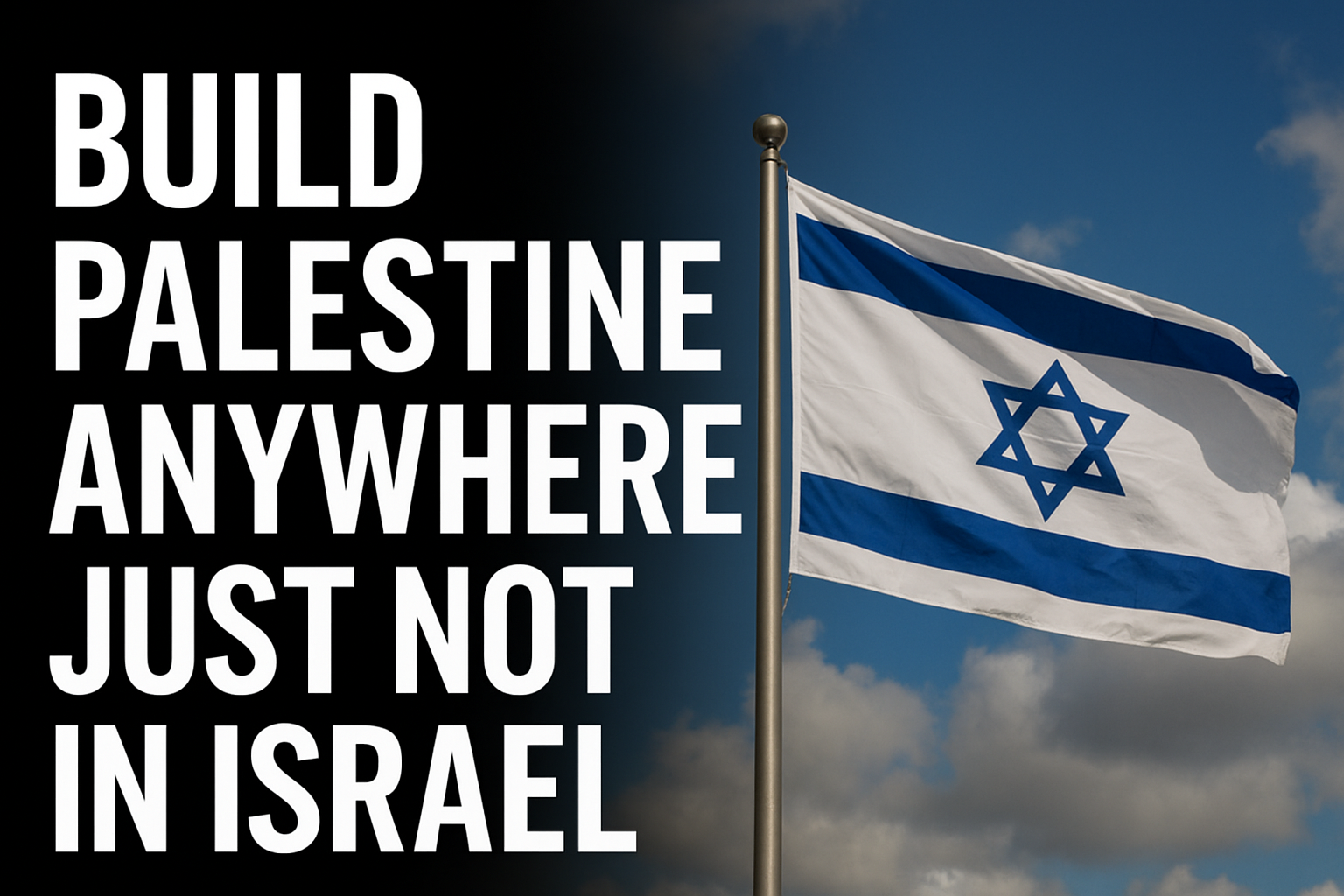
Photo Credits: Sabine Sterk(AI)
They voted and the world applauded its own moral theatre.
The same countries that lecture Israel about justice, the same assemblies that posture about human rights and “self-determination,” almost unanimously raised their hands to “recognize” a Palestinian state. Cue the global standing ovation for compassion. The problem? It’s the sort of compassion that confuses slogans with solutions, optics with outcomes, and virtue-signalling with responsibility.
Let’s call this what it is: an exercise in international moral grandstanding that ignores basic history and common sense. Because if you’re going to hand out states like participation trophies, the least you could do is pick a territory that actually makes sense for the people in question.
Start with the inconvenient little fact that many Palestinian family names are travel logs more than birth certificates. “Al-Masri” literally means “the Egyptian.” “Al-Halabi” points to Aleppo. Tribal names like Qurashi and Hashimi trace back to the Arabian Peninsula. Ottoman-era and Egyptian surnames are ubiquitous across the Levant. The onomastic trail reads like a map of migration across the wider Arab world, evidence that identities here are layered and mobile, not exclusive claims to a single parcel of land.
So here’s the blunt proposal no one in diplomatic salons dares to say out loud: if the world insists on drawing a new Palestinian state as if by academic thought experiment, it might at least be honest about which soil would plausibly host it. There are deserts aplenty in Saudi Arabia and Sinai. There are failed and shattered states where borders might be redrawn. European countries with colonial histories, they have space on paper, and apparently the moral bandwidth to accept responsibility for the outcomes of their own imperial projects. None of these suggestions are flattering. They’re cynical. Exactly like the foreign policy of the countries now pontificating about “indigenous rights” while ignoring centuries of migration and demographic complexity.
But let’s be crystal clear: this isn’t just about geography. This is about the most basic right of any nation, to protect the character and survival of its people on their ancestral soil. Israel is not a European settler colony in a vacuum. It is the reconstitution of millennia of Jewish presence, culture, law and memory on land that has been continuously bound up with Jewish life for thousands of years. Claiming otherwise is not scholarship, it is willful denial. The world’s refusal to accept this simple fact is the real obscenity in the current conversation.
And here comes the pièce de résistance of the global chorus: when you insist the Jewish homeland must be minced to make room for a rival polity on exactly the ground that defines Jewish self-determination, what you’re asking for, in practical terms , is the erasure of another people’s nationhood. That’s not a subtle moral trade-off; it’s an existential demand. It’s astonishing that a planet so keen to preserve cultural difference suddenly pretends that two national projects can occupy the same DNA without conflict. They can’t. Not in any honest, sustainable way.
Meanwhile the moral high horses keep circling. They lecture Israel on proportionality, they dramatisize humanitarian statistics, they stage petitions and boycotts. All of it looks noble in headlines, while ignoring that good-faith compromises require mutual recognition of history and security needs, not unilateral demands. If your approach to peace starts from the premise that one side must vanish or be humiliated, congratulations, you have designed not a peace plan but a moralistic expulsion.
Don’t pretend there are simple solutions. There aren’t. But there are obvious hypocrisies. If the world truly wants a sovereign home for Palestinians, at least have the honesty to propose areas where Palestinians already have historic links, where geopolitics and demography could, hypothetically, make the project remotely plausible. Propose Sinai development. Propose Gulf initiatives. Offer economic carrots and migration packages. Or finally accept that creating a viable, peaceful polity requires decades of state-building, institutions, and, yes, political leadership, not a UN resolution and a headline.
And now for a practical, Dutch-flavored footnote to the fantasy: the Netherlands, the country that literally turned sea into land for centuries, could, if it really wanted to translate performative support into engineering reality, propose building new land offshore for Gaza. The Dutch are not theoretical about this; they are the specialists of dikes, polders and port expansions. Their track record, from the Zuiderzee and Delta Works to the Maasvlakte and Rotterdam expansions, is a world-class demonstration that you can, with enough money and determination, create habit-able land where there was water.
Imagine the diplomatic theatre: Dutch engineers, Dutch funding, Dutch technical teams constructing an artificial platform or reclaimed land just off Gaza’s coast, a purpose-built zone for housing, port facilities, industry and management, insulated from the immediate security headaches onshore. It’s the sort of technocratic solution international NGOs love to mock but billionaires and engineers quietly dream about. Artificial islands and offshore reclamation have been floated before in policy circles as ways to ease land scarcity and create controlled access points. The idea is not pure fantasy; feasibility studies and proposals for offshore islands around Gaza have been discussed in policy papers and media.
Would it be perfect? Of course not. Building land at sea brings environmental disruption, huge cost, and thorny political obstacles, but then again, most grand gestures that would actually change the calculus are expensive, messy, and inconvenient for those who prefer virtue-signalling to work. If Amsterdam wants to show real solidarity, it can stop printing performative slogans and start underwriting infrastructure: ports, reclaimed land, regulated access, development zones, real governance frameworks. Or, if that’s too much effort, keep voting symbolic votes while pretending that history will tidy itself.
Let’s not mince words: the greatest cynic of all is the spectator who applauds the performance and believes they have acted justly. The rest of us will keep calling the show what it is: moral pretense masquerading as compassion and a dangerous stewardship of other people’s futures.
If you call that harsh, you’re right. But there’s a difference between harsh and cruel. Harshness calls out uncomfortable truths; cruelty actively aims to erase them. I stand unapologetically on the side that refuses to confuse political convenience with historic justice. Israel’s right to exist on the land of the Jewish people is not a negotiable courtesy for the international community to barter away while pontificating from afar. If the world wants to help or solve problems, fine. Do so honestly: with state-building, measurable guarantees, serious investment, and policies that respect existing peoples rather than rewriting them away for the sake of diplomatic theatre.
Related Topics
Related Posts