Life Member, Hadassah Westchester, Hadassah Writers' Circle
Building a Sukkah, Creating Connection
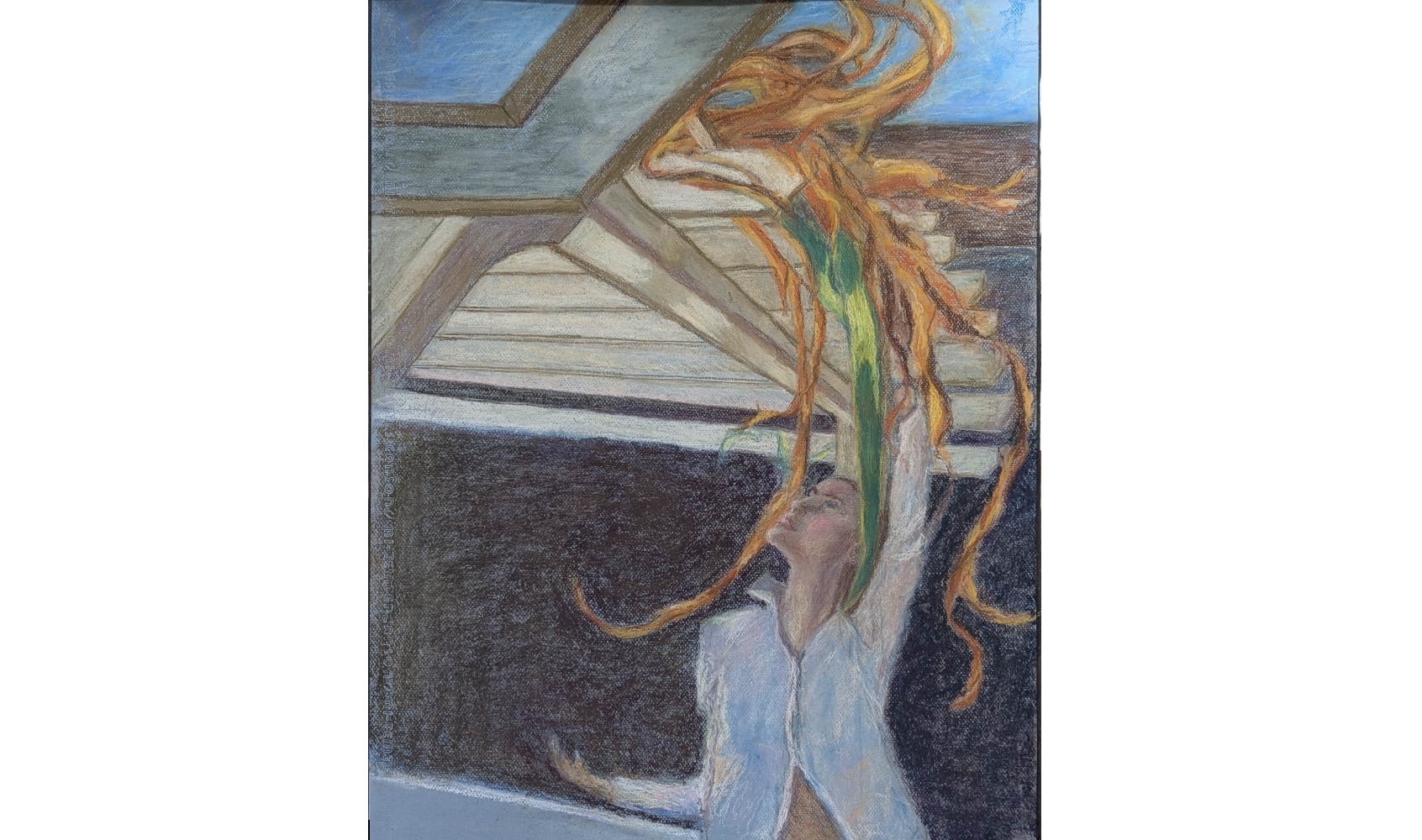
Artwork c 2025 by Author Michele Braun. Image courtesy of the author.
The Jewish congregation I grew up in met in the smaller of the community Hebrew school’s auditoriums. One wall of that room, which could be enlarged or shrunken by separating or closing accordion dividers, was lined with glass doors opening onto an oblong patio.
On that patio, every fall, the building staff set up the frame and sides for a sukkah ( סֻכָּה), a temporary structure meant to emulate the temporary housing allegedly used by biblical Israelites during their mandated thrice yearly pilgrimages to the Holy Temple in Jerusalem.
One of these pilgrimage festivals, Sukkot, is named after those huts and celebrated during the autumn as both a religious holiday and harvest festival. It fell to the members of our congregation to decorate the sukkah in keeping with the harvest theme, and I loved being part of the decorating crew.
Our work was pretty traditional, relying primarily on the typical produce of fall harvests in the American northeast: dried corn, small gourds, strings of cranberries and such. Although the school and another congregation also used the sukkah, I felt I “owned” that place because I’d been a part of its creation.
When I was in junior high and then high school, each year my father erected a small sukkah in our backyard. He would rig a wooden frame to hang in a corner formed by two brick walls and then anchor it to a tall two-by-four at the fourth corner.
The sukkah was just large enough to cover the picnic table, where we lunched and dined during the holiday. For the s’chach (סְכָךְ ), the roof covering, which is made of natural, plant-based materials, my father acquired corn stalks at a local farmers market.
Genesis tells a lovely story about the origins of the word sukkot. After Jacob reconciled with Esau, the brother he had wronged many years earlier by stealing his birthright, Esau departed in one direction toward his home “while [Jacob] traveled to Succot. He built himself a house there, and for his livestock, he made sheds. Therefore, they called the name of the place: Succot/Sheds” (Genesis 33:17).
Jacob’s house was a bayit (בַּיִת)—the Hebrew word for a house; for his livestock, however, he rigged up sukkot — minimal shelters. I can imagine naming a place after the structures built there. I can equally imagine that a place called Succot could give its name to flimsy huts characteristic of the area. Now, the Genesis stories recount “pre-history,” recorded in archaic Hebrew, so we can’t know precisely what happened.
Because the following verse has Jacob returning to his home elsewhere, it seems reasonable to infer that the shelters at Succot were meant to be only temporary. Yet this tradition of living—or, at least, dining—in a temporary hut as if we, too, were traveling in the Judean hills became deeply rooted in Jewish practice.
A few years ago, the first summer after we moved to a house with a substantial yard, we constructed a pergola on the back patio, an arbor on which plants could grow. I just wrote that “we constructed,” but that’s not quite true. I ordered pre-cut wooden components online and hired a contractor to assemble them.
My spouse and I did actually paint it, though, with several coats of white wood stain. Since then, my primary gardening focus has been to nurture plantings that will one day cover the vertical posts and top of the structure. For now, the top is wide open except for the wooden crosspieces and a few hanging plants.
I am an indifferent gardener, but every year, whether I have only a windowsill, a small balcony or a real garden, I try to grow something edible. The results have been erratic.
Two years ago, in our now large yard, I sowed a packet of corn kernels. I didn’t get any corn, but I successfully grew a few stalks. Just before the start of Sukkot I cut these stalks and hoisted them on top of the pergola.
Last year, I sowed more kernels and was rewarded with even more stalks. (We live in a semi-rural area with lots of wildlife and I think something furry nibbled away the nascent ears of corn.)
For Sukkot last fall, we harvested the stalks and spread them on top of the pergola’s frame, reveling under the home-grown s’chach. We sat beneath this bounty, reciting first Shehecheyanu, the prayer of blessing said when doing something for the first time, and then the blessing over fruit. We ate apple slices dipped in silan, Israeli date honey.
Metaphorically, Jewish tradition invokes the sukkah as something much broader, not solely as a temporary hut. The Hashkiveinu prayer, traditionally recited in the evening (“Grant, O God, that we lie down in peace, and raise us up, our Guardian, to life renewed”), invokes the greater desire by praising the God who spreads over us a sukkat shalom, a covering or shelter of peace.
Yes, I know that our pergola-based sukkah is not a “real” sukkah because its open frame stands year-round and thus is not a temporary, eight-days-a-year structure. But, as we decorate the sukkah, as we sit in this sukkah, we connect with our traditions. And, in the words Abraham and Moses used to respond to God’s call, we feel that we are saying hineini (הִנֵּנִי), “I am here.” This is our sukkah, and we “own” its connections.
Michele is a member of the Hadassah Writers’ Circle, a dynamic and diverse writing group for leaders and members to express their thoughts about all the things Hadassah does to make the world a better place. It’s where they celebrate their personal Hadassah journeys and share their Jewish values, family traditions and interpretations of Jewish texts. Hadassah members are proud of their Zionist mission and their role as keepers of the flame of Jewish values, traditions and beliefs as well as advocating for women’s empowerment and health equity for all. Since 2019, the Hadassah Writers’ Circle has published nearly 650 columns in The Times of Israel Blogs and other Jewish media outlets. Interested? Please contact hwc@hadassah.org.
Related Topics
Related Posts