Buried With Her Tehillim
At my grandmother’s funeral this week, I noticed some movement near the grave. At the moment I did not realize what it was. Only afterward did I find out what had happened. They had buried her together with her very worn and taped Tehillim.
For those who may not be familiar, Tehillim is the Book of Psalms, containing the prayers and songs of King David written throughout the course of his turbulent life. Jews have turned to the Tehillim for thousands of years in moments of pain and joy, fear and gratitude, for when we have words, and for when we do not have words.
This was her only request. That when her time came, she wanted to be buried together with her precious Tehillim.
She had always loved reading these Psalms, and so when my cousin Chaya was once in Israel, she bought her this book because it had large print, and it had become difficult for her to read.
The truth is, my Bubby did not just read Tehillim. She sang Tehillim.
She would say the words out loud, often with a melody, not as if she was reading from a page, but speaking to someone very close. This Tehillim book became part of her. It was part of the rhythm of her life. It was part of the sound of her soul.
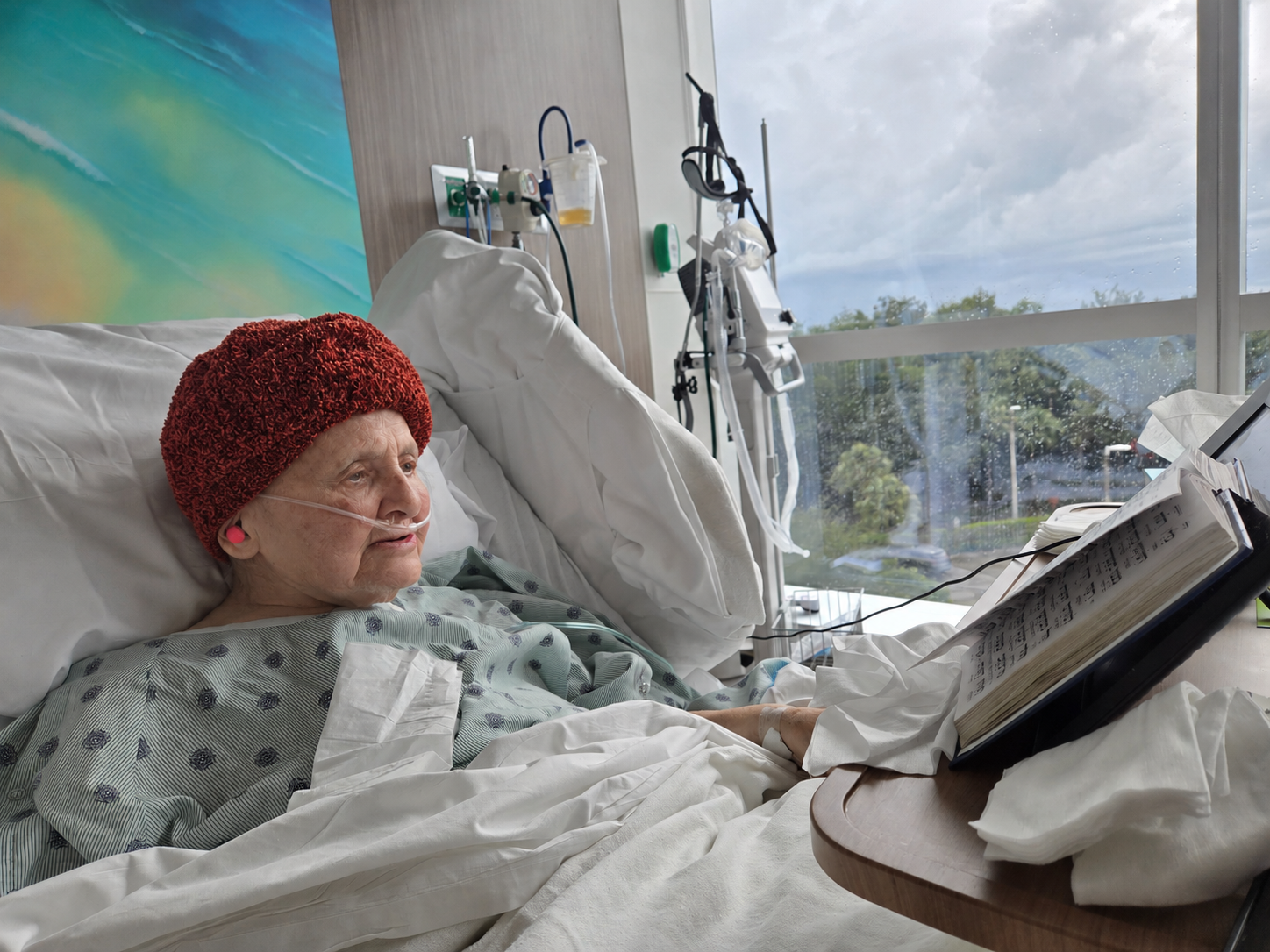
I clearly remember several months ago, when I went to visit her in the hospital. It was a particularly rough time, and she was not doing well. I remember once sitting there near her bed, watching her prop up her Tehillim so she could see the words. And even though she was weak and her body was struggling, there she was sitting up, reading her Tehillim, letting the words lift her somewhere higher.
It was so powerful that I took a picture.
Not because it was dramatic. Not because she was making any kind of statement. Quite the opposite. It was quiet and simple.
It was just who she was.
And in the end, it was this book that she always kept so close, this book that she prayed and sang from, that went with her to the World to Come.
The more I have thought about her this week, and the more I have heard stories from her life that I never knew, the more I have realized that her Tehillim was not just something she did.
It was the secret of how she lived.
My bubby had a very difficult life. She was orphaned at the age of three or four. Her parents died of hunger after they fled the Germans, and their only food was stolen from them on the train. She spent her childhood alone in a Russian orphanage, far away from anyone she knew and loved. She lost a brother who disappeared without a trace.
Even after she married my grandfather and came to New York, life was still not easy. They did not have family nearby to guide them or help them build a new life. They had to learn English. They had to figure out a new country and raise a young family from the ground up, even when money was very tight.
And yet she kept growing. Once her youngest daughter was old enough to attend school, my grandmother went to school as well. She taught herself, worked her way up, supported her husband’s art career, and built an amazing family with many grandchildren and great-grandchildren.
I used to visit her very often when I was younger. I spent many, many hours talking with her. And not once, in all those conversations, do I remember hearing her complain about someone else, or speaking with bitterness or as a victim.
She lived to the ripe age of 90 and lived through lifetimes of hunger and hardship. And I am sure she carried the many traumas of her childhood inside. But she never let it make her bitter or negative.
The opposite is true. She was always caring about others, feeding others, and she was one of the kindest, most gentle and loving people you could meet. She was always praising others. Always.
She became a woman of light. A person exuding joy and happiness for others. A Bubby who loved absolutely nothing more than dancing with her grandchildren. A person with no enemies and no complaints.
How?
The answer to her smile and perpetual kindness was buried with her.
Her precious Tehillim!
This week’s Torah portion describes the camp of the Jewish people in the desert. Each tribe had its own place, its own direction, and its own mission.
But at the center of the entire camp stood the Mishkan, the holy Sanctuary. The home of G-d. The place where a Jew living on earth could go and connect with the Heaven above.
No matter which side of the camp you lived on, east, west, north, or south, the Mishkan stood at the center, equally accessible to every Jew. And when the Jews travelled, they journeyed in the same formation, always keeping the Home of G-d at the very center of their journey.
Without that center, they were just people wandering in the desert.
With that center, they were a nation walking with G-d.
My grandmother’s Tehillim was her Mishkan in the desert. It was her sanctuary in the hospital room. Her holy place in a world that had not always been kind to her.
When she opened her Tehillim, she was not escaping life. She was finding the strength to live it. She was not pretending pain did not exist. She was touching something deeper than pain.
Praying doesn’t always change the situation before us. But if done sincerely and often enough, it changes the person inside us. It lifts us just enough to remember that there is a G-d in this world. That we are not alone. That our story is held by something greater than what we can see in the moment.
The Jews in the desert had a Temple at the center of their camp, the center of their journeys, and the center of their lives. It’s what kept them going until they reached the Promised Land.
Because when you soar a little higher, the problems and details of this world begin to weigh a little less.
I have seen hundreds of pictures of my grandmother this week. But the image that will stay with me is of her with her precious Tehillim, the book that gave her strength while in a hospital bed. The book that carried her songs. The book that went with her to her final resting place.
Because even though her life was not easy, she never defined herself by tragedy or difficulty. She could have felt abandoned, but instead she remained warm, loving, joyful, and deeply sensitive to others. Even though she had every reason to be bitter, instead she chose to live a life of wholehearted faith.
Bubby Kleinman left behind many descendants, many memories, and many lessons. One of them will be of the book that kept her going, that kept her soul connected, that kept her strong.
And that would be the best way to honor her. To not only remember how kind and loving she was, but to find our own “Tehillim”, our own personal center and oasis that keeps us connected Above, no matter what.
It won’t be the same for everyone, but we all need an anchor, a source of unending strength and connection that we can constantly keep nearby.
It could be each Friday, lighting Shabbos candles and letting the world pause. It could be a few minutes of quiet, focused prayer in Tefillin each morning before the phone takes over. It could be just coming to shul, sitting in the room, and letting yourself remember who you are.
For me, that place is the Ohel, the resting place of the Rebbe.
But wherever your center is, find it. Guard it. Return to it often. Let it lift you.
Because life will always have journeys. There will be days we travel and days we camp. Days that feel heavy and frightening, like a dry desert.
But if we have a holy center, we can always keep going.
May the soul of Sarah Raizel bas Aryeh Leib be elevated in Heaven. May her faith, joy, and Tehillim continue to sing through all of us.
And may we share only simchas and happy news.
Good Shabbos,
Rabbi Yankie & Chana Denburg