Iranian-Born British Analyst of Politics and Civilisation
Calvin Robinson: Antisemitism in a Clerical Collar

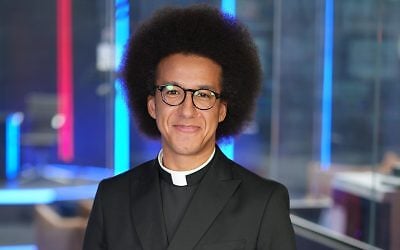
Calvin Robinson speaking at the Believers Summit in West Palm Beach, Florida, on 28 July 2024. Credit: Gage Skidmore / Wikimedia Commons
Christian conservatives must confront the theological bankruptcy of those who invoke the name of Christ to justify the persecution of Jews.
I have absolutely no intention of defending antisemitism simply because it comes from someone on the political right wearing a clerical collar. The conservative movement cannot claim to defend Western civilisation, individual liberty and Christian morality while turning a blind eye to religious persecution when it comes from within its own ranks.
On 13 November 2026, British cleric Calvin Robinson appeared on The Command Show and declared that “driving out the Jews is the answer”. Although Robinson has subsequently claimed that his remarks were taken out of context, the implications of such language deserve serious examination.
Let us be absolutely clear about the distinction. Robinson was not merely criticising the Israeli government, challenging Zionism or questioning American foreign policy. Nor was he encouraging Jews to make Aliyah, exercising their right to voluntarily return to their ancestral homeland. He was advocating the removal of people from America on the basis that they are Jewish. We are talking about American citizens, taxpayers, military veterans and families whose ancestors have lived in the United States for generations.
Their alleged crime? Being Jewish. And somehow, we are supposed to accept this as Christian conservatism?
The theological bankruptcy of Calvin Robinson
As an Orthodox Christian, a conservative and a Christian Zionist, I find Robinson’s remarks morally repugnant and theologically indefensible. Our Lord Jesus Christ was born a Jew, the Mother of God was Jewish, the apostles were Jewish, and the earliest Christian community emerged from the Jewish people. The foundations of Christianity are inseparable from the history of Israel. St Paul explicitly warned Gentile Christians against arrogance towards the Jewish roots of their faith in Romans 11:18, reminding them that it is not they who support the root, but the root that supports them.
Credit: Gage Skidmore / Wikimedia Commons
I make no apologies for believing Christianity to be the fullness of truth. I reject religious relativism and the fashionable notion that all religions are equally valid. However, there is an enormous moral and theological distinction between rejecting another religion’s doctrines and advocating the persecution of its followers. Christianity makes a universal claim about salvation through Christ; it does not instruct Christians to strip those who reject that claim of their citizenship, fundamental rights or national belonging.
Christ commanded His followers to make disciples of all nations, not to expel from those nations everyone who refused to become His disciple. Robinson’s rhetoric represents a profound distortion of that distinction.
The Jewish state protects Christians
Perhaps the greatest irony of Robinson’s rhetoric is that, in the very region where Christianity was born, the Jewish state of Israel offers Christians some of the strongest religious freedoms in the Middle East. Christians in Israel can openly practice their faith, maintain churches, celebrate religious festivals, establish religious institutions and participate in the country’s political life, including serving in its parliament.

Credit: Fallaner / Wikimedia Commons
Contrast that with Iran, where Christian converts from Islam face imprisonment and persecution, or with parts of Iraq and Syria, where ancient Christian communities have suffered displacement, destruction and violence. Across much of the Middle East, Christianity has endured centuries of persecution, and many of its historic communities now face an uncertain future.
Israel is not immune to anti-Christian harassment, and such incidents deserve unequivocal condemnation. Nevertheless, the broader regional contrast remains extraordinary: the Jewish state provides protections for Christian religious life that many other governments in the region fail to guarantee.
As someone born and raised in Iran who embraced Orthodox Christianity and subsequently lived in Israel, I do not need Calvin Robinson to lecture me about religious freedom in the Middle East. I understand the difference between living under an Islamic theocracy and living in a Jewish state. It is not an abstract theological debate for me; it is a matter of lived experience.
Perhaps Robinson should spend some time visiting the Christian communities of Jerusalem and Nazareth before presenting Jewish people as a threat to Christian civilisation.
Antisemitism is identity politics for the right
For years, conservatives have rightly challenged the progressive obsession with collective guilt, racial categorisation and the notion that individuals should be held responsible for the actions of others who share their ancestry. Yet certain personalities on the political right have adopted precisely the same intellectual framework, merely replacing white people with Jews as the target of their resentment.
The hypocrisy is astonishing. If a Jewish individual commits a crime, prosecute him. If a Jewish businessman promotes an ideology you consider destructive, challenge his ideas. If the Israeli government adopts a policy you oppose, criticise it. None of these positions is inherently antisemitic. However, when criticism of individuals becomes an argument for the removal of an entire religious or ethnic community, it ceases to be a defence of individual responsibility and becomes an endorsement of collective punishment.
Conservatism without individual responsibility is intellectually hollow. Those who reject collective guilt when it is directed against their own community cannot legitimately embrace it when it is directed against Jews. Changing the victim does not change the principle.
The arrogance of an immigrant demanding the expulsion of citizens
There is another extraordinary contradiction in Robinson’s position. Here we have a British-born immigrant living in the United States who apparently feels entitled to demand that Jewish Americans be driven out of their own country. Some of those Americans belong to families whose presence in the United States predates Robinson’s arrival by centuries. Jewish Americans have fought in America’s wars, served in its armed forces, built businesses, contributed to scientific advancement and participated in virtually every aspect of American public life.
By what moral authority does a recently arrived British cleric demand their removal?
Robinson has defended his freedom of speech amid reports that American authorities are reviewing his immigration status. He is entitled to defend that freedom, and the legal questions surrounding his immigration status should be considered on their own merits. Nevertheless, the moral contradiction of demanding individual liberties for oneself while advocating the expulsion of others on the basis of their religious identity is staggering.
Christ is King — not an antisemitic slogan
I refuse to surrender the words Christ is King to antisemites. This sacred declaration belongs to the Christian faith, not to internet personalities, political movements or online conspiracy theorists. Its meaning is infinitely greater than the political disputes in which it is increasingly weaponised.
Christ is King regardless of whether Jews, Muslims or atheists acknowledge Him. His sovereignty does not depend upon the demographic composition of the United States, nor does Christianity become stronger by persecuting those who refuse to embrace it. The strength of Christianity lies in the truth of its message, not in the forced removal of those who disagree with it.
A clerical collar does not transform prejudice into theology. Ordination does not confer intellectual infallibility, and quoting Scripture does not automatically sanctify a political agenda. Indeed, those who claim to represent Christ should be subjected to greater moral scrutiny, not granted immunity from criticism.
Silence is complicity
I refuse to outsource the condemnation of antisemitism to the political left. I do not need to become a liberal, a progressive or a theological modernist to recognise the moral obscenity of advocating the expulsion of Jewish Americans. My opposition to antisemitism comes directly from my Christianity, not from political correctness.
The conservative Christian movement must confront an uncomfortable question: does it stand for timeless moral principles, or does it simply offer unconditional tribal loyalty to anyone who opposes the progressive left? If our principles disappear the moment they become inconvenient to our political alliances, then they were never principles in the first place.
I will not compromise my Christianity to accommodate antisemitism, defend religious persecution in the name of religious revival, or mistake a man wearing a clerical collar for a man faithfully representing Christ.
Calvin Robinson is free to express his opinions. Christians are equally free to expose the moral, intellectual and theological bankruptcy of those opinions.
Christ is King. His name is not yours to disgrace.
Related Topics
Related Posts