Jewish texts, history, faith and evidence
Can a Jewish State Survive without Yeshivot?
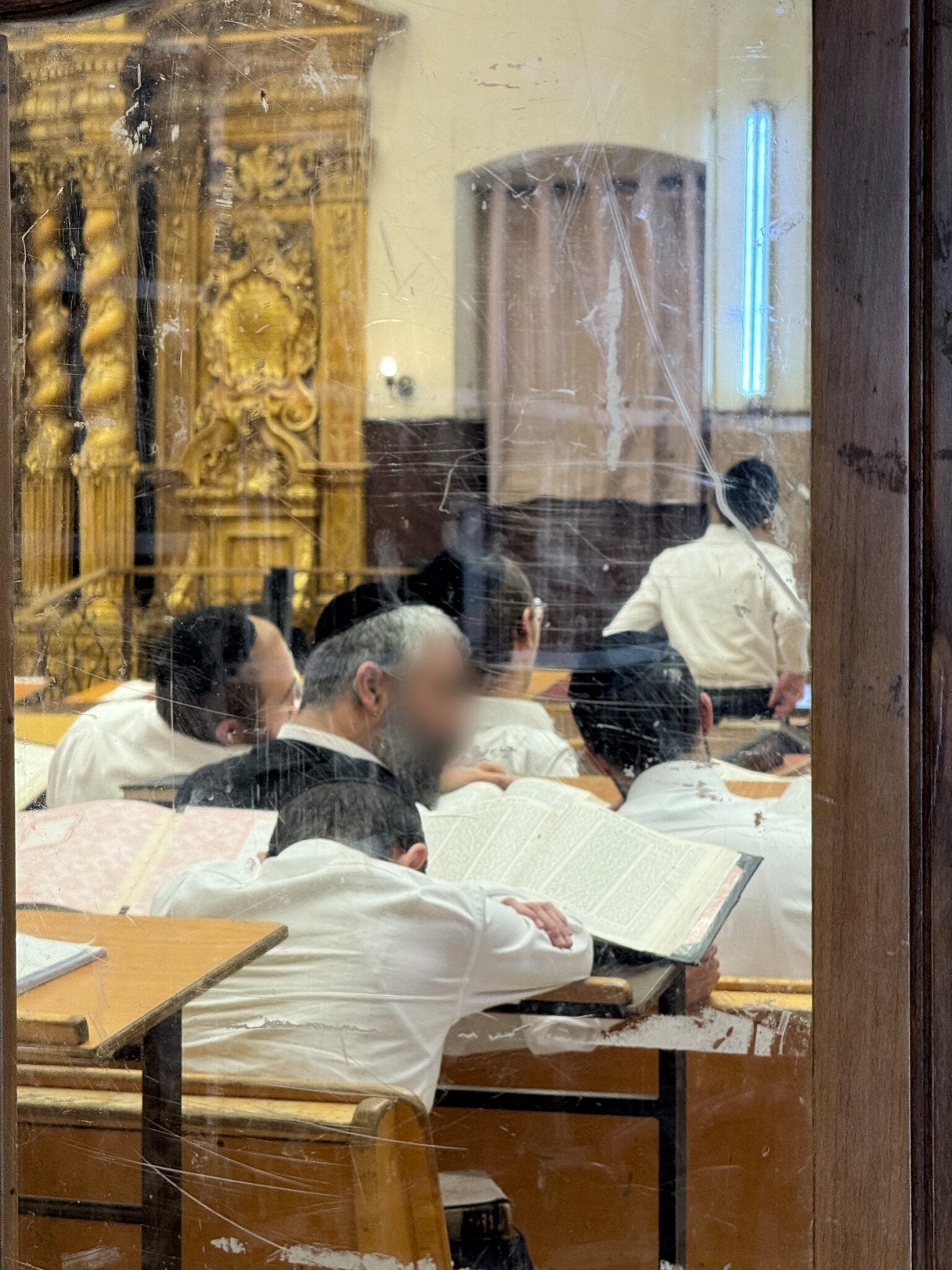
A yeshiva in Bnei Brak, Israel. Photo: Menahem Mendel Sander.
What the evidence can tell us about how education reform might affect Jewish continuity
At the seder table, a child asks why this night is different from all other nights. In twenty or thirty years, he may be the one answering that question for his own child. What will he still carry from that evening? What will he have learned in the meantime that will make his answer more than a childhood memory? I think about that future seder table whenever I hear Israelis debate what Haredi schools should teach.
An American demographic projection brings the question into sharp focus. Drawing in part on Pew Research Center’s 2013 survey, Antony Gordon and Richard Horowitz started with 100 American Jews in each of the groups they studied. Their model projects 11 Jewish grandchildren in the secular group and 1,039 in the Hasidic or yeshiva Orthodox group. In the next generation, it projects four Jewish great-grandchildren and 3,398, respectively. These are projected numbers based on assumptions about fertility, intermarriage and the transmission of Jewish identity. The precise size of the gap depends on those assumptions. What the model shows is how differences in family size and transmission can compound until they reshape an entire community. Gordon and Horowitz, Will Your Grandchild Be Jewish?, 2016 chart
Pew’s 2020 American survey lets us look at what happens between childhood and adulthood. About 90 percent of those raised in the Jewish religion still identified as Jewish, compared with 76 percent of those raised Jewish without religion. Pew included people who continued to identify as Jewish through culture or family background. A difference is already visible within a single generation, even under this broader definition of Jewish identity. Pew Research Center, 2020 U.S. survey
In Israel, Hebrew is the language of everyday life, and Jewish holidays set the rhythm of public life. That changes the conditions under which Jewish identity is passed on. In Pew’s 2024 Israeli survey, fewer than 1 percent of those raised Jewish said they belonged to another religion or had no religion as adults. The American projection cannot tell us what will happen to Israeli families. It does raise a question that the Israeli figure leaves open. What will a society be able to pass on, several generations from now, if people continue to call themselves Jewish while the study of Torah becomes exceptional? Pew Research Center, 2024 Israeli survey
Think again of the seder. In Pew’s 2014–15 Israeli survey, 87 percent of Hilonim, Jews who describe themselves as secular, said they had attended or hosted a seder. In the same survey, 1 percent of Hilonim said they studied Torah, Gemara or other Jewish religious texts at least once a week, compared with 57 percent of Datiim and 76 percent of Haredim. The holiday still brings people together. But if the pattern of Torah study now common among Hilonim became the norm across Israel, how many families two generations from now would have someone who could open the text with a child and explain why it still speaks to him? That is where I see a danger to Israel’s Jewish future. A country can keep its calendar and its holidays even as its ability to pass on the tradition that gives them meaning grows weaker. When secular leaders ask what Haredi schools are doing to prepare children for Israel’s future, I would ask them to put the same question to their own schools. What are their pupils learning about the Judaism those leaders want to see endure? Pew Research Center, Jewish beliefs and practices in Israel
The Haredi community is already doing much of that work. In the Shoresh Institution’s analysis of 2024 data, 89 percent of those raised Haredi still identified as Haredi as adults. In 2023, Haredim accounted for around one in four children under five in Israel. These children grow up in homes, communities and schools that together give Torah a central place. In the traditional yeshiva ketana, school-age boys devote their days to kodesh, the study of Torah and other sacred texts. I want large numbers of students to continue to have the choice to devote themselves entirely to Torah study. These houses of learning help form the adults who will be able to teach it and pass it on. Dan Ben-David, Shoresh Handbook 2026, pp. 12–14 · Jerusalem Institute, study of secondary yeshiva pathways
We can see that this continuity exists. How much of it comes from the time devoted to Torah, the limited place of general studies, the example set by parents or the life of the community is harder to establish. Changing the curriculum for all pupils at once would ask every family to bear that uncertainty, when the consequences for transmission may take generations to become clear. In the November coalition debate, Ya’akov Asher opposed making funding for Haredi schools conditional on teaching the core curriculum. Eliakim Stark argued for offering general studies in a form suited to Haredi families that want them. I would give that possibility a concrete form through a limited pilot for volunteers, while preserving a path devoted entirely to Torah study. Asher’s position, The Times of Israel · Stark’s interview, The Times of Israel
For pupils who choose that option, I would begin with Torah itself. In my writing on health and Jewish life, I often return to Maimonides’ teaching that caring for the body is part of serving God. Imagine a pupil who stays up an hour later to learn and then finds himself reading the same line three times the next morning. What did the extra hour he gained the night before cost him the next day? That question gives him a reason to look at the results of an experiment on sleep and attention in adolescents. He learns to read a graph, see how researchers compared two groups and judge what their findings can tell him about his own study habits. The same approach can work in mathematics. A round beam discussed in Eruvin 14a gives pupils a reason to measure diameter and circumference. When they later have to calculate how much material it takes to wrap around a wheel, they can find out whether they can use what they learned while studying the Gemara. Maimonides, Hilkhot De’ot 4:1 · Lo et al., experiment on sleep and attention · Babylonian Talmud, Eruvin 14a
Israel could fund a small number of modules designed jointly by Torah educators and teachers of the relevant subjects. They would be offered only in schools that volunteer, to pupils who choose to take part and whose families give their consent. Within the pilot, we could compare two ways of teaching the same material, with equal lesson time and with time for Torah study protected. A few months later, we could see whether pupils can use what they learned in a different setting and ask how their relationship to Torah study has changed. If the pilot succeeds, that would be a reason to offer the option to more volunteers. Full-time kodesh study would remain a path in its own right.
Israel could survive as a state without yeshivot. But if it wants to remain a Jewish state, it must preserve the institutions that form people capable of studying, living by and transmitting Torah from one generation to the next. The American projections show how far patterns of Jewish transmission can diverge within a few generations, and the Israeli data show how much of that work the Haredi community already does. Since we do not know what a systemwide reform would do to that capacity for transmission, I propose preserving the path of full-time Torah study and reserving the experiment in teaching hol in the service of Torah for the schools, families and pupils who choose to take part.
–
The English translation was prepared with partial assistance from AI and reviewed by the author.
Related Topics
Related Posts