
Left is not a dirty word
Can a movie make us change?
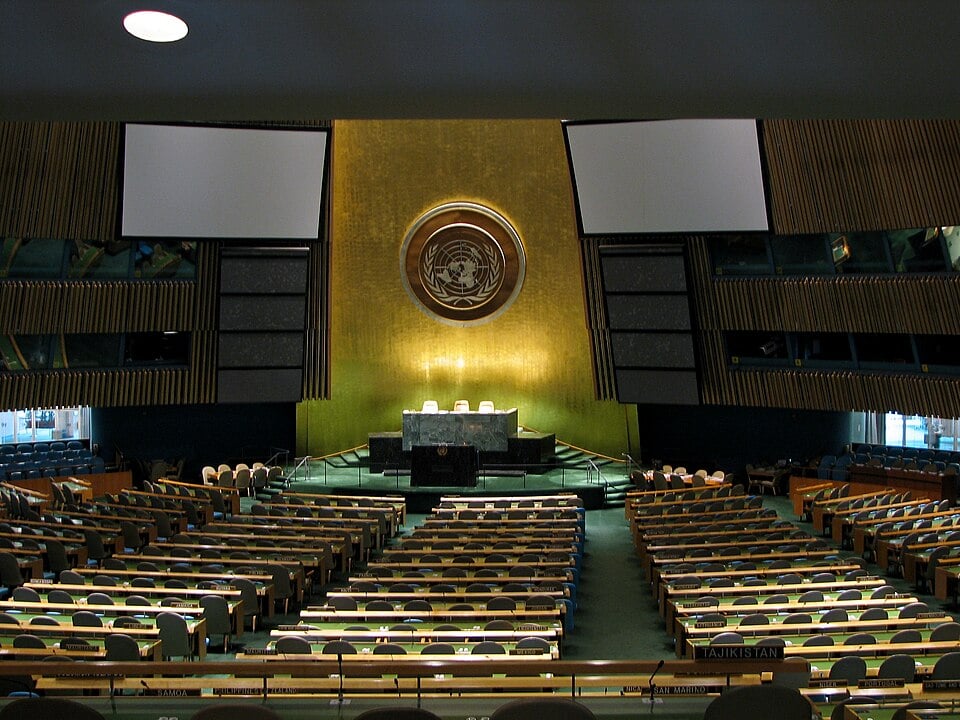
UN general assembly hall, Norbert Nagel, Mörfelden-Walldorf, Germany via Wikimedia Commons
A film made by Israeli film makers points a damning finger at Israeli policy in Gaza. A musician who has little idea of the forces at play behind his words is dropped from a tour for calling for a free Palestine, while the headliner who dropped him is under attack from all sides for making a statement that recognizes the complexity of the situation. Our prime minister trades petty barbs with New York’s mayor and goes on the offensive in his annual UN speech, made to a mostly empty room.
Let’s start with the film, Naza, which none of us has yet seen, but which has created an uproar, even before its release to the general international public. In yesterday’s newscast, it was reported that a representative of the IDF had seen the film in Italy and was preparing a rebuttal.
In some sense, of course, we are on trial and the film is Exhibit A. Yet here is the problem: We will poke holes in the film’s claims, nitpicking our way through to the end in perfect Talmudic fashion. But the broad strokes will remain, and they will carry the outlines of truth.
Without having seen the film myself, I believe that some of the acts the film shows should likely be put down to stupidity, rather than evil intent. But killing innocent hungry people who are mobbing a food distribution center, shooting at them from tanks? We can argue about the reasoning behind that, but the action, itself, was criminal. The tragedy remains inhuman. And it was just one of many.
I put it down to the stupidity of refusing to even discuss a strategy for ending the war and replacing the Hamas regime in Gaza; to the folly of extending the war – now nearly three years – for political gain.
Belatedly we flap our hands in the squeaky lisp of our defense minister and the baritone of our square-chinned major general, pointing to certain actions that were called off because innocent civilians might be harmed. We treat the film as a PR problem, rather than as evidence of a real problem that urgently needs to be addressed.
But even our measly PR efforts do not really dispute the unconscionable numbers. They try, instead, to deflect from the systematic refusal of our government to engage in real efforts to end the war and put an alternative Gaza government into place. They try to deflect from the very real suffering of all-too-real people.
When we do not allow journalists, or even the Red Cross, into Gaza, the foreign press relies on Gazans, themselves, to hold up their cell phones and report on what is happening. The Israeli press, meanwhile, is heavily censored. So in Israel, we get some facts, partial truths. Outside the country, different partial truths are spread.
In between the claims of a film, probably, admittedly, slanted to some degree, and the nightly scare reports of Hamas regrouping for new attacks on Israeli citizens, there is a huge gray area. It is that gray area we are told not to see. Better black and white than that blood-tinged gray. We might end up trading our outrage for discomfiting questions.
We treat the film as a PR problem, rather than as evidence of a real problem that urgently needs to be addressed
Bibi bangs his fist on the UN podium and digs up the old accusation of moral cowardice against those who boycott his speech. But his grim, heroic show of outrage is played not so much to the empty seats, but to the folks back home who are gearing up to suffer through the upcoming election. He reinforces our belief that the rest of the world are antisemites. We may be isolated, but President Macron of France said that Hamas has never operated in the West Bank. It’s a falsehood that allows us to discount anything else he says, including the details of a French-sponsored peace plan.
In the meantime, while Trump threatens Iran with renewed warfare in one sentence and proclaims progress in peace talks with them in the next, the problem of Gaza has taken a back burner in world affairs. And every day that we do not make progress on the next stages of peace is another day that innocent civilians can get caught in the crossfire. It is another day they are living in limbo, homes destroyed and handouts for meals, closer to hell than land on Earth. I don’t blame Israel alone. Hamas is not rushing to hand in their weapons – a condition for Israel’s pullback. But the indeterminate conditions suit our government, and allow us to bend the rules, our actions clearly more aggressive than just guarding the border.
In other news, Israel’s President Herzog recently pardoned Elor Azaria ahead of schedule. Azaria was convicted, when in uniform, of shooting a prisoner who was already incapacitated on the ground; Herzog’s pardon expunged his criminal record. This was, in some way, a silent nod condoning this sort of war crime, to the fact that far worse crimes have been committed over the course of this war, and no one is likely to pay the price. We’ll let Elor start over. The prisoner he shot will get no such opportunity.
Here’s a thought: It has come to my attention that war crimes are closely associated with war. Whether the directives come from the top or are issued in the throes of battle, the very conditions of war create situations in which war crimes can arise. Stupidity, panic and the belief that killing will protect your home all come together in a knot and shooting is encouraged. We shrilly protest that we only kill bad guys and yet innocent people are still getting slaughtered.
The way to stop the killing of innocents is to end the war. That may not be as simple as it sounds, but right now it is not even an aim. The warfare continues under the guise of ceasefire. The business of killing is creating more dead, but not bringing Hamas to their knees. We are holding on to territory on our borders, convinced we must for our own safety, but the cost to our society is immense, in reserve duty and trauma, but not just.
While the rest of the world condemns Israeli violence, we are told to tremble in fear, because the next attack is right around the corner. It could come from the North or South, the East or across the Red Sea. Trust no one. The rest of the world has it wrong, we are told. The cognitive dissonance is what enables us to keep up our efforts, doing the same thing over and over, and expecting different results. Changing our point of view could be dangerous to morale.
I don’t deny the existence of real threats, some of them born of the continual violence and others of religious extremism. But war is not the answer to all our problems. We have simply forgotten how to imagine anything beyond this war, and we have created a wartime narrative that enables us to justify the level of violence we bring upon others.
I don’t know if a movie can change the world. I don’t know if we will have the moral courage to look in the mirror Nadza holds up and see ourselves reflected there, even dimly. I imagine it will affect us more from the outside; less from within. I don’t know if we will be able to change our government for one that sees peace – or at least a real ceasefire – as an alternative to the eternal war. I don’t know if we will have what it takes to not just sing about peace and pray for peace, but to actively create peace on the ground.
I only know we have to try.
Related Topics
Related Posts