Can AI Fill the G-d-Sized Hole?
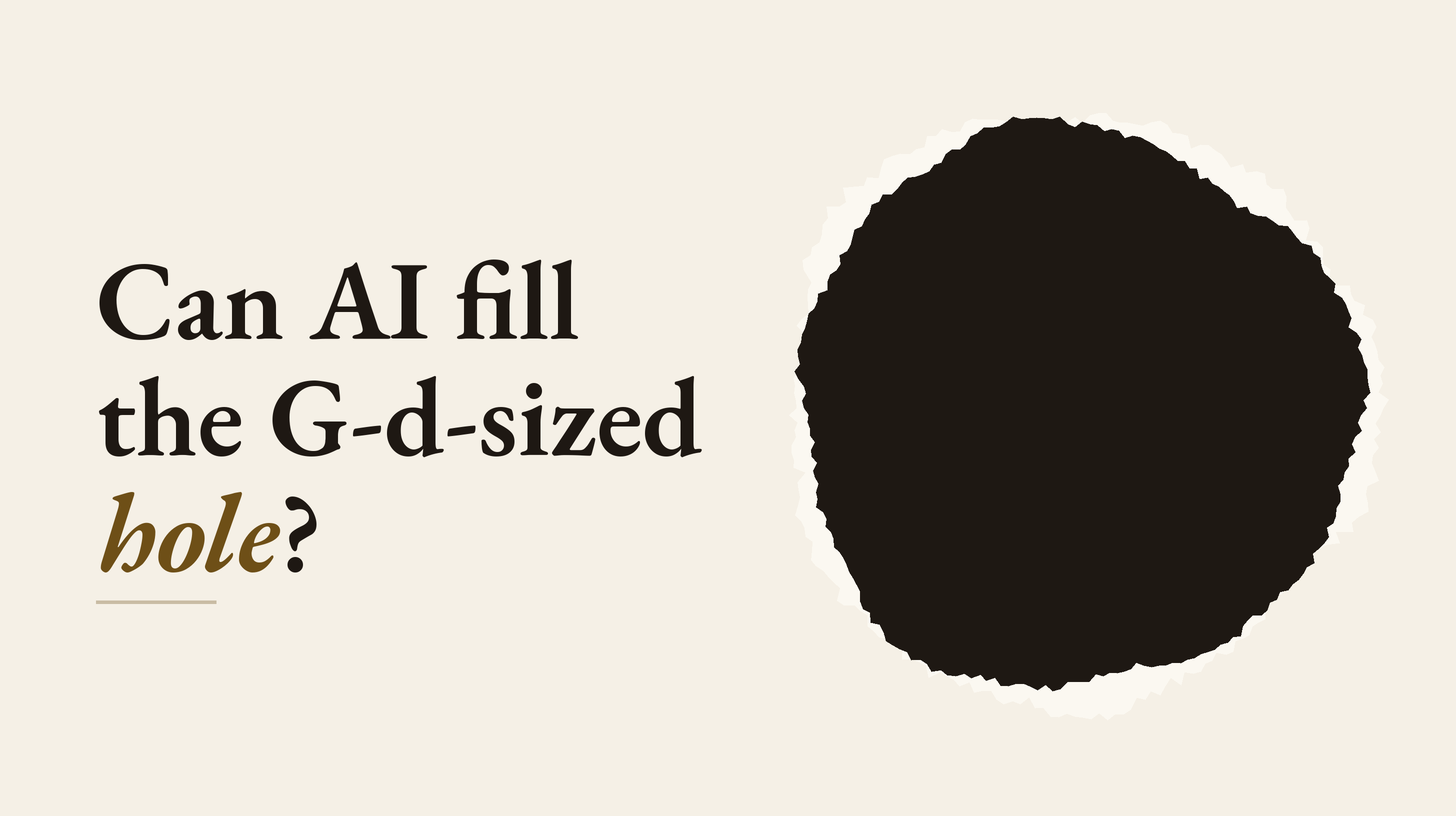
The philosopher Blaise Pascal described a G-d-sized hole in every human heart. We try to fill it with everything around us, but an infinite space can only be filled by something infinite and unchanging. Only G-d Himself can fill it.
We may not recognize that hole, but we recognize the restless search for something more. We check our phones again and again, hoping the next message or headline will satisfy. It never does for long.
Now something far more powerful is emerging. Some of the most brilliant minds of our generation are racing to build Artificial General Intelligence, a mind that could surpass our own, answer our questions, solve our problems, keep us company, and endlessly entertain us. Its practical benefits could be enormous.
The danger lies in what we might ask of it. The more capable the machine becomes, the easier it is to turn to it for answers, comfort, and companionship. Without realizing it, we may begin looking to something we created to fill the G-d-sized hole in our hearts.
A god of our own making will always be changing, updated, replaced, and outdone. We can see it, measure it, and control it. The true G-d asks us to reach up toward Him rather than bring Him down to our level.
Reaching up is hard. That is part of why we build.
Those of us who believe are not exempt. We believe G-d created the world, sustains it every moment, and governs it with benevolence. Yet knowing that G-d exists is not the same as experiencing a connection with Him.
Consider an ordinary glass of water. Before drinking, Jewish practice calls for a nine-word Hebrew bracha: Blessed are You, Hashem our G-d, King of the universe, by whose word all things came to be. These words ask for our service, thought, emotion, and connection, all at once. Said with intention, the bracha is something we do for Him, with our minds on each word, gratitude in our hearts, and the sense that we are speaking to Someone who is listening.
Why is that so hard? Because it requires us to look beyond what we can see toward Someone we cannot see. The physical world can lead us to Him, as the water does, but it also places four obstacles in our path, one against each of those four traits.
Self-centeredness pulls against service, so the bracha becomes about our thirst instead of the One who quenches it. Distraction pulls against thought, and our minds drift to the next email. Lethargy pulls against emotion, and we recite instead of feel. Desire pulls against connection, and we reach for the water before we finish speaking.
Technology can readily accommodate all four pulls. It can serve our needs, capture our attention, spare us effort, and give us what we want now. But satisfying those pulls is not the same as connecting with G-d. Connection asks us to rise above them.
Start with distraction. Before your next bracha, pause for one breath, look at the cup in your hand, and remember Who made it. Then say the first word slowly.
That small act, repeated, teaches us to notice Him in ordinary moments. We do not need to reject the machines we build, but we cannot ask them to give what only G-d can. A single bracha said this way does what no machine can: for that moment, we let G-d fill the hole.