CFO | Empower Society for Good I Author
Can One Man Change the World?
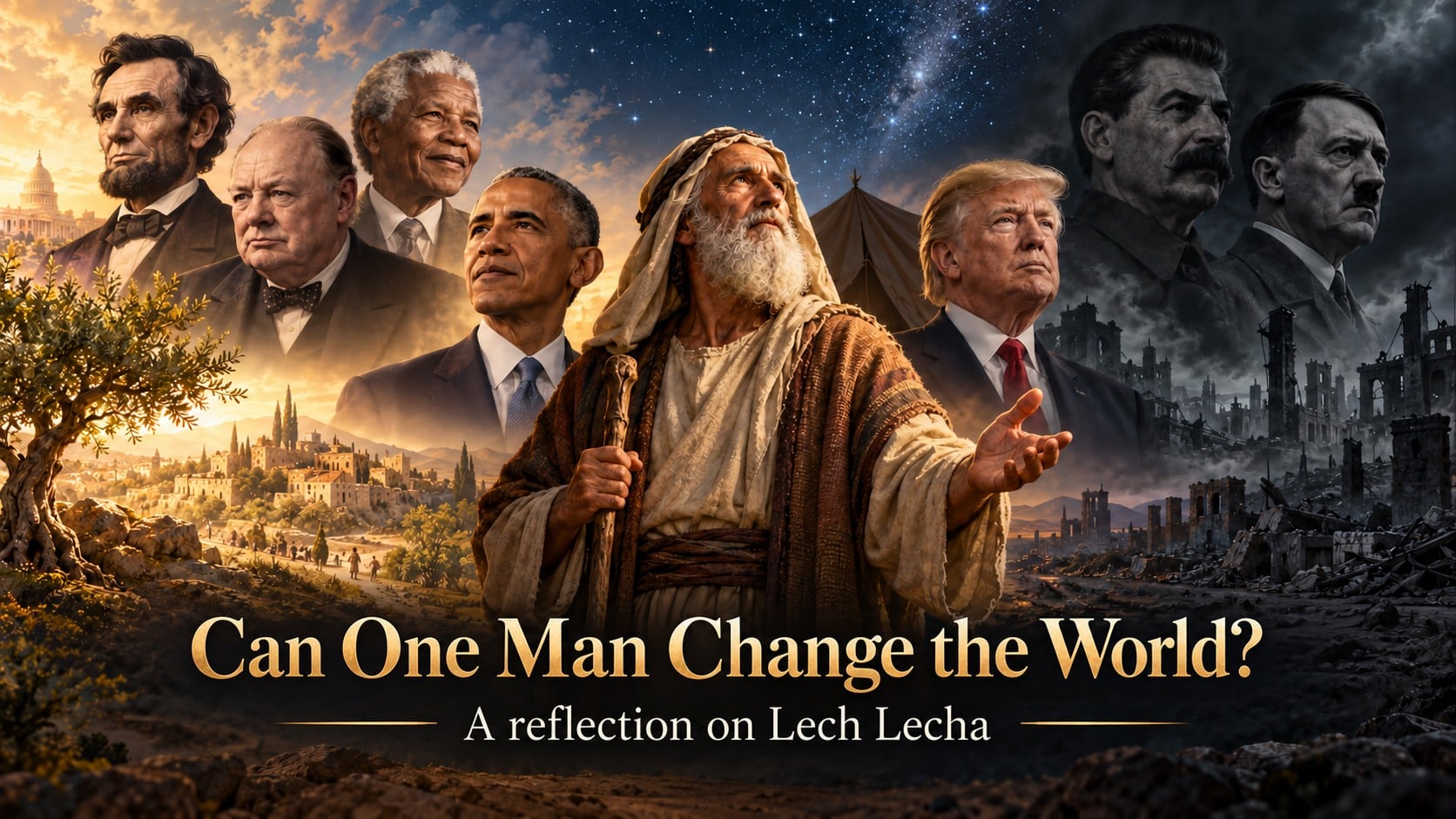
Watching Donald Trump, it is difficult to doubt the influence one individual can wield. Governments weigh his words. Allies and adversaries calculate his next move. Some feel hope; others shiver. Even in a democracy, the character of the person at the top matters enormously.
But changing the world is no guarantee of making it better.
Try naming the leaders who changed the world for good.
Lincoln. Churchill. Mandela. A few names come to mind, each with qualifications. Then you begin to struggle.
Now name those who brought tyranny, slaughter and destruction.
Hitler. Stalin. Mao. Pol Pot. The names keep coming.
The list of righteous leaders is painfully thin. The list of murderous ones is far too long.
Humanity has never lacked men determined to impose their will. Far fewer have used their influence to cultivate a good society.
That is what makes Abraham’s story so striking.
In Parshat Lech Lecha, God calls one man to leave his land, his birthplace and his father’s house. He must begin a journey whose consequences he cannot possibly foresee.
He is promised a great name and a great nation. But those promises carry a purpose:
וֶהְיֵה בְּרָכָה — “Be a blessing.”
Rabbi Samson Raphael Hirsch reads these words as a command. Greatness brings an obligation: use your life to bring good into the lives of others.
Later, in Parshat Vayeira, the Torah explains Abraham’s calling through his responsibility to direct his children and household after him to practise righteousness and justice.
Here is the mission: cultivate a way of life, teach it and give it a future.
But why begin with Abraham and Sarah?
A commentary on Genesis that I have been reading describes a significant development.
Adam was given moral responsibility.
Noah preserved his righteousness in a corrupt generation.
With Abraham and Sarah comes the task of establishing a community whose members will sustain and strengthen one another in doing good.
A good society cannot spend its history waiting for an exceptionally good man to take charge. It must cultivate goodness in ordinary people.
Rabbi Jonathan Sacks sharpens this distinction in his essay Righteousness Is Not Leadership. Noah’s personal righteousness matters, but leadership requires responsibility for the world beyond oneself. Abraham’s mission carries that responsibility forward.
And Abraham’s goodness has backbone.
When Lot is taken captive, Abraham mobilises his household and goes to rescue him. Their earlier separation does not become an excuse to abandon his nephew.
The man of hospitality is prepared to fight to bring a captive home.
His compassion demands action, courage and personal risk.
That combination matters. A good society needs generosity and the strength to defend those who depend upon it. It needs people who understand that responsibility can become costly.
Pirkei Avot teaches that Abraham faced ten trials and withstood them all. His convictions were tested through the demands of living. Principles acquire their meaning when circumstances make keeping them difficult.
Yet what had Abraham achieved by the time he died?
Where was the great nation? Where were the descendants as numerous as the stars? Where was the society built upon the covenant?
So much remained unfinished.
Nevertheless, the Torah describes him as dying at a good old age, satisfied with life. He had begun work whose fullest consequences lay beyond his lifetime.
His legacy was an idea embodied in a family and a community: live by righteousness and justice, and teach those who come after you to continue.
Sarah belongs at the centre of that achievement. The tradition understands the people they brought with them from Haran as including those they had drawn towards their faith. Their influence grew through teaching, relationships and example.
One person can begin a change. Others must help give it a future.
This is why I keep returning to the Good Society.
In his essay of that name, Rabbi Sacks writes:
“Covenant means we cannot delegate moral responsibility away to either the market or the state.”
Each of us carries responsibility for the society we inhabit. Leaders matter enormously, but they cannot supply the conscience of an entire people.
That responsibility also extends to truth—to the stories through which people learn to judge one another.
Barack Obama provides a contemporary example of why this matters.
Speaking in Belfast, he described Jews seeking refuge from persecution, then said Israel “took land off people.” He also acknowledged that neither Jews nor Palestinians are going anywhere and urged Palestinians towards nonviolence. Those qualifications matter. So does the historical framework he offered.
I challenge him to name one country that did not take land off people, including the great USA.
To my mind, presenting Jewish nationhood primarily as a search for refuge followed by taking someone else’s land leaves a dangerously incomplete picture.
Where is Jewish historical belonging? Where are the ancient kingdoms, the continuing communities, the generations of longing and the national movement? Where are the international commitments, competing claims and decisions that preceded the war of 1948?
Our connection to Israel lives in our prayers, our language and our longing for Zion. It is present in the archaeological record and the history of Jewish sovereignty.
This is our history, our soul, our roots.
We were a people connected to this land long before the catastrophes of modern Europe.
And where are the Jews of Arab lands—the persecution, dispossession and displacement that uprooted ancient communities? Their suffering deserves equal moral weight alongside the Palestinian displacement remembered as the Nakba.
Jewish suffering cannot become a footnote while Palestinian suffering becomes the entire explanation of the conflict.
There was Palestinian displacement in 1948. It was a consequence of war. This does not erase Jewish belonging. Recognising one people’s suffering places no obligation upon us to forget another’s.
So, this week, when President Obama went to Belfast to denounce Israel – it matters.
A former American president carries enormous authority. That makes historical precision a responsibility.
You cannot tell the truth about this land by beginning the story where Jewish history becomes inconvenient.
This brings me back to Abraham.
He taught. He gathered people around a conviction. He challenged the assumptions of his surroundings and helped others see differently.
We need that spirit today: people prepared to know the history, explain it honestly and challenge distortion. Our credibility also depends upon acknowledging difficult facts. Responsibility to truth must govern our own arguments.
We need partners among Americans, Europeans and our neighbours—Jews, Christians, Muslims and others willing to listen and build relationships. The name Abraham Accords carries a fitting possibility: Abraham’s memory can provide common ground for cooperation. Agreements between governments need communities willing to sustain them.
For Israel, cultivating a good society should be a national ambition. We need the strength to defend our people and the moral purpose to shape the life we are defending.
Most of us will never command an army or make governments tremble. But we will influence children, colleagues, neighbours and communities. Someone will learn from what we defend, what we tolerate and how we treat another person.
We cannot inherit Abraham’s righteousness as a family possession. We have to practise it.
The list of righteous leaders may be painfully thin. That makes cultivating a righteous people all the more urgent.
Can one man change the world?
Abraham began. Building the good society is the work he left to us.
Further Reflections on Parsha Lech Lecha – Whose Freedom Counts?
A Lech Lecha moment for Europe—and for us
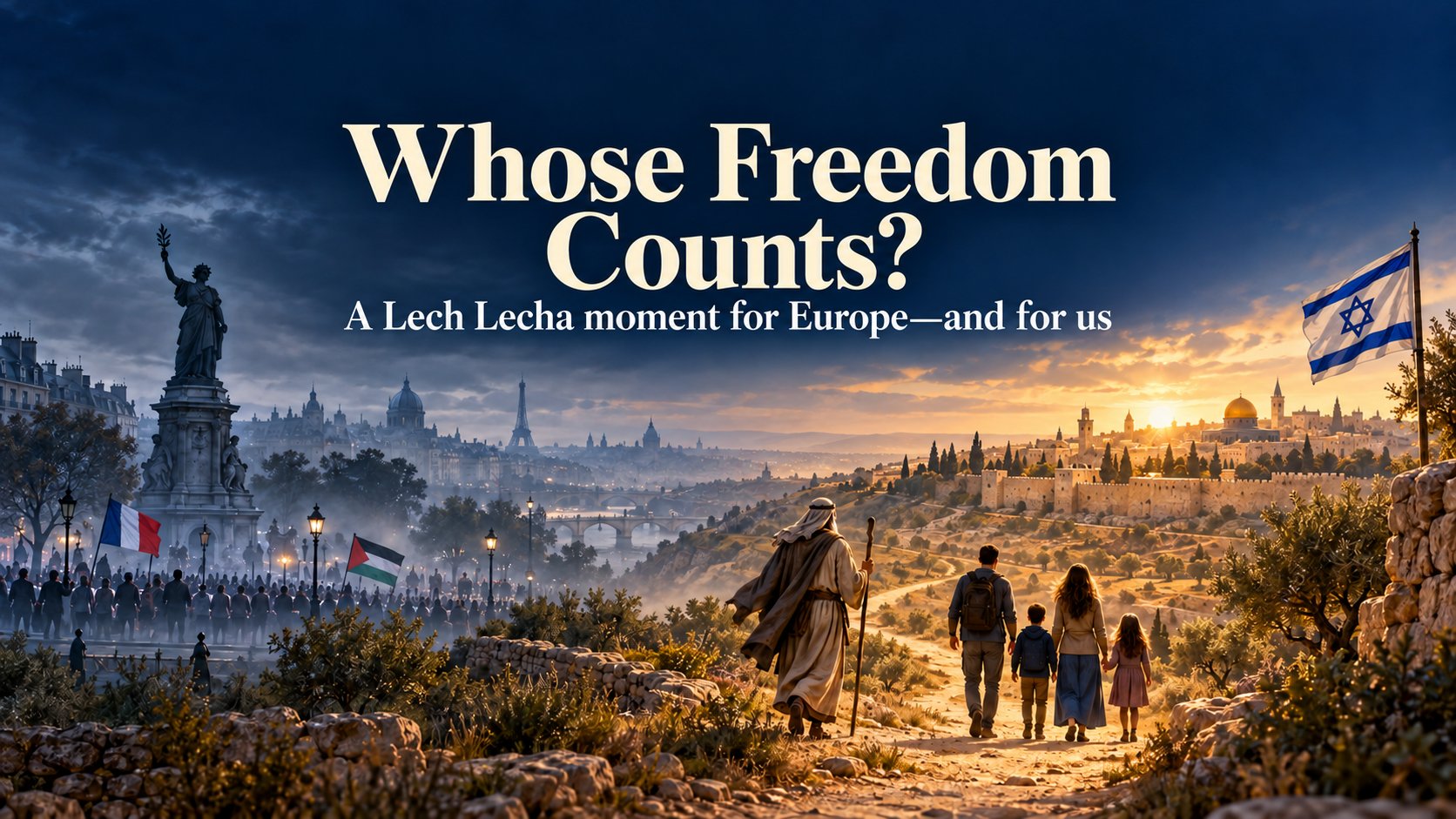
Last year France recognised a Palestinian state. This week Palestinian flags appeared amid protests over France’s own schools, public services and cost of living—demonstrations accompanied by rioting, looting and damage to public monuments.
There is a bitter irony here. Recognition did not cause that violence, on the evidence available. But neither did it remove the Palestinian cause from the politics of France’s streets.
What does “Free Palestine” mean when it becomes a banner for grievances that have nothing to do with Israel?
As an Israeli, I find that juxtaposition unsettling. When different struggles merge beneath one flag, do Palestinians become a symbol of every injustice, while Israel becomes a symbol of everything people resent?
And where, in this expanding language of liberation, is Jewish freedom?
Related Topics
Related Posts