
Can we moderates win in a partisan age?
When extremists flourish, how can moderates make a difference?
A student asked me this question a few weeks ago. I was teaching a class on political extremism and the fragility of the American experiment.
The question struck me because it touches on a truth we are living. The stakes are highest when the center is collapsing — and yet that is when moderates tend to lose ground. It is when moderation is most needed that it often seems least viable.
I’ve been sitting with that question for years — long before October 7. From the culture wars over #MeToo, DEI, and critical race theory to historical studies of the Weimar Republic, I’ve seen how extremes feed off one another, hollowing out the center and paving the way for collapse.
Today, moderates are often trapped: challenge your own side and you’re a traitor, stay silent and you’re irrelevant, compromise too far and you lose your soul. The stakes are personal, strategic — and civilizational.
* * *
This week’s parasha offers two contrasting models for how to respond in times of crisis — one rooted in zeal, the other in strategy.
Our Torah portion is named after Pinchas, the grandson of Aharon, the high priest. Pinchas becomes the classic Jewish example of a zealot — someone who takes justice into his own hands. He acts in response to Zimri, an Israelite chieftain, consorting with Kozbi, a Midianite woman, in a public sexual act linked to the idolatrous worship of Ba’al Pe’or. Moses freezes, a deadly plague breaks out, and Pinchas steps in — spearing Zimri and Kozbi in a dramatic display of religious zeal.
The episode is deeply ambiguous about zealotry itself. Pinchas is praised and halts the plague, which sounds positive, but the reward God gives him — a covenant of peace — implies that his act was a one-time necessity, not a blueprint for future leadership. The Torah seems to allow zealotry only in moments of extraordinary crisis, and then insists that this legacy be transformed into peace, not remain rooted in rage.
In moments of chaos and failed leadership, the impulse is to turn to zealotry — it can feel like the only way to make a difference. But even as the Torah affirms Pinchas’ zealotry in moments of extraordinary crisis, it resists establishing it as a precedent.
But the Torah does not end the story there. Just after Pinchas, we meet an entirely different kind of leader.
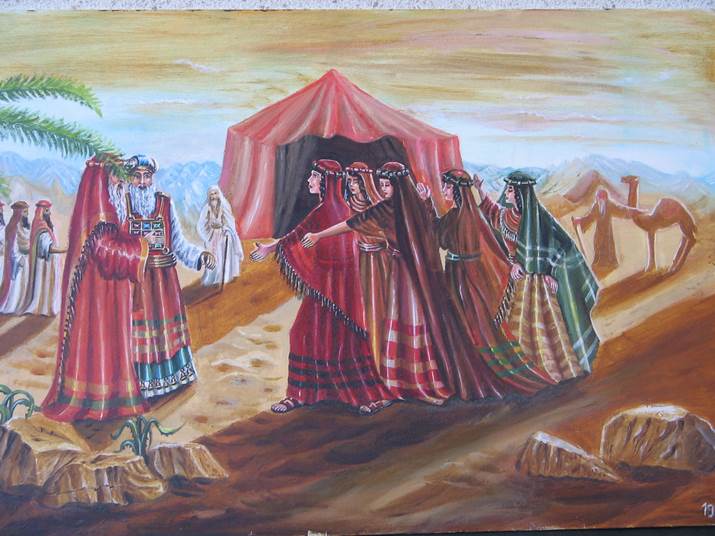
Enter the daughters of Tzelofechad: Mahlah, Noah, Hoglah, Milcah, and Tirzah. These women are models for principled moderate leadership — one of the most significant examples in the Torah of how strategic voices can reshape a nation.
Before examining their strategy, it is worth defining what makes someone a moderate. Moderates are not passive centrists who split every difference or lack strong convictions. Rather, they are people who hold multiple commitments simultaneously — to justice and stability, to change and continuity, to their particular community and the broader society. They believe systems can be reformed rather than requiring revolution, and they work within existing frameworks to help those systems live up to their highest ideals.
The daughters of Tzelofechad embody this perfectly. They are simultaneously committed to their family’s welfare, daughters’ rights, tribal land integrity, love for the land of Israel, and the authority of Mosaic law.
Their father died in the wilderness without sons. Under the inheritance system as it stood, only male descendants inherited land, and thus their family would lose its share in the Promised Land. So they bring a petition to Moses: Can daughters inherit if there are no sons?
The rabbis saw these sisters as models of legal brilliance and moral clarity: “The daughters of Tzelofechad were wise, exegetes, and virtuous… they spoke at the right moment.” (Bava Batra 119b). They knew exactly when to speak and how to build a case that aligned with existing law. They came as insiders — deeply principled pragmatists — who believed the system was capable of reform and worthy of it.
And God’s answer is yes: in the absence of sons, daughters may inherit.
The daughters of Tzelofechad represent one of the earliest precedents for a civil rights movement that legally expands rights through strategic engagement with existing institutions.
* * *
The greatest danger for moderates in times like ours is paralysis — the fear that our voices cannot compete with those that are louder, more strident, or more extreme. And so, too often, we shrink back and cede the field.
What makes the daughters of Tzelofechad so remarkable is that even in the age of Pinchas — an age defined by dramatic, public zeal — they stepped forward and led as moderates. No one asked them to challenge inheritance law; they saw an injustice and created their own moment for change.
They show that moderation is not a lack of conviction, but the wisdom to make convictions effective. They prove it is possible to be both principled and pragmatic, passionate and patient.
For those of us who identify as moderates in a time of rising extremism, their example is a call to action: Do not despair and do not cede the ground. The loudest voices may dominate the headlines, but lasting change is made by those who pair moral clarity with strategic insight.
The question isn’t whether moderates can win. It’s whether we’ll have the courage to act as boldly and wisely as five sisters did in the wilderness.