
An Aging Jewish Feminist
Land of Promise and Peril: Reflections on Parshat Shelach
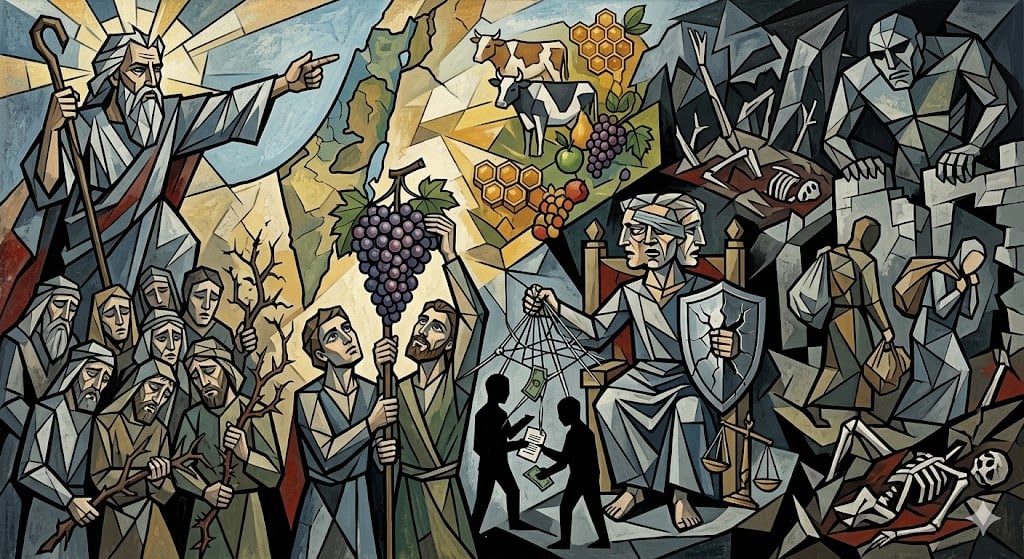
This week marks my 205th blog—yes, I’m counting. Over time, I’ve tried, when possible, to connect the parsha with something personal or political. After all, as the saying goes, “the personal is the political,” a phrase popularized during the feminist movements of the 1960s. That era challenged many assumptions, including marriage itself. When I read Betty Friedan’s The Feminine Mystique a few years after its publication, it was a wake-up call—one I largely ignored at the time, being married in Israel with a child. That was an era that challenged institutions like marriage. Today, it feels as if everything is being challenged again—only now the stakes are far higher: war, internal fracture, and a steady erosion of trust in leadership that is supposed to safeguard this country.
Spying the Land
Parshat Shelach Lecha opens with what we would today call an intelligence mission. Moses sends twelve leaders to scout the land of Canaan: assess the terrain, the people, the defenses. In other words—gather intelligence before acting.
See what kind of country it is. Are the people who dwell in it strong or weak, few or many? Is the country in which they dwell good or bad? Are the towns they live in open or fortified? Is the soil rich or poor? Is it wooded or not? And you shall muster strength וְהִ֨תְחַזַּקְתֶּ֔ם to bring back some of the fruit of the land” (Numbers 13:17–20).
There is something striking in the instruction to “be strong” וְהִ֨תְחַזַּקְתֶּ֔ם when taking from the fruit of the land. Is it the fruit that is heavy or the enterprise that requires physical and perhaps mental strength? Sforno writes on the phrase והתחזקתם ולקחתם מפרי הארץ:
He is one of the commentators who suggest this may hint at resistance—after all, the land is inhabited. This is not an empty promise waiting passively to be fulfilled. It belongs to others.
The Report of the Spies
After forty days, the spies return. Their report is mixed. The land is indeed “flowing with milk and honey,” but it is also populated by powerful nations and fortified cities. Giants, even. In other words: this is not a land one simply walks into and claims. Thus, ten of them conclude: we cannot go forward. Caleb—and later Joshua reject this caution and insist with confidence bordering on certainty, Caleb says: “We shall surely overcome it.” Faith, for him, outweighs fear. No hesitation. No nuance. No acknowledgment of cost.
We have heard that kind of language before. We hear it today—from political leaders who promise total victory, decisive outcomes, simple solutions to impossibly complex realities. Today, that kind of certainty sounds less like faith and more like dangerous hubris. We know what it means to underestimate an enemy. Today, that language should make us uncomfortable. Because we know what it means to live in a land that is not empty. We know what it means to face enemies who do not disappear. We know what it means to live, generation after generation, in a state of permanent insecurity.
But the majority of the spies disagree. They go further, describing the land as one that “devours its inhabitants.” As Robert Alter notes in his commentary:
The land flowing with milk and honey, then, is seen in these words as a kind of death trap: even if the Israelites were to succeed in obtaining a foothold and themselves became dwellers of the land, it would “consume” them through internecine and international warfare.
Joshua and Caleb stand against the crowd—and are nearly stoned for it.
Leadership, Corruption, and Trust
The people in the wilderness lose faith not only in God—but in their leadership. They speak of returning to Egypt. They despair. Today, many Israelis are not talking about Egypt—but they are leaving. And one cannot dismiss that lightly. We are living through a moment in which trust in leadership is deeply eroded. Ongoing legal cases, leaks of classified information, and allegations of political manipulation have shaken public confidence. When senior aides are charged with leaking sensitive security material, it raises serious questions about responsibility and accountability at the highest levels. And if it couldn’t get worse, just yesterday, the accused Prime Minister installed his personal lawyer as state comptroller, presumably, in order to shield himself from scrutiny
When individuals within the system—soldiers, insiders, citizens—are willing to sell information to the enemy, even for trivial gain, we are forced to confront an even darker question: what happens when loyalty itself becomes negotiable? If the spies of our parsha represent a crisis of faith, perhaps our moment represents a crisis of trust.
Decisions are made in a context where political survival is the main consideration. Over and over there are failures of accountability—in intelligence lapses, military preparedness, and most of all the handling of internal dissent. And so today we have the normalization of corruption—not only legal corruption, but moral corrosion. When leaders blur lines, societies follow.
Collective Punishment in the Parsha
God’s anger is swift and severe. Though Moses intervenes, appealing to divine mercy and reputation, the punishment remains: an entire generation will wander the wilderness for forty years, dying there, never entering the land. Their “carcasses” will fall, unburied, unnamed. Only Joshua and Caleb will survive to see it. The language used is harsh. The people’s failure is framed as betrayal—zenuteichem, a kind of faithlessness or infidelity. Even more jarring is God’s declaration that their “carcasses shall fall in this wilderness.” The term pegarim carries a degrading connotation, often used elsewhere in the Bible for enemies’ bodies left unburied. Here, it is applied to Israel itself. Some commentators soften the term—understanding it simply as “bodies,” or distinguishing between the physical and the enduring soul. Others acknowledge its severity: a reflection of divine disappointment and judgment.
It is a shocking image. And perhaps it is meant to be. Because it forces us to confront a difficult truth: when a society fails—morally, spiritually, politically—the consequences are rarely confined to individuals. They are collective. We recoil from the idea of collective punishment. And yet, we live its reality. Wars, failures of leadership, corruption, internal betrayal—these do not affect only those directly responsible. They ripple outward, shaping the fate of an entire people.
A Modern Lens
From a modern perspective, the story invites uncomfortable questions. Were the ten spies truly wrong? Or were they realists, reporting what they saw? The land was inhabited. The risks were real. Joshua and Caleb, by contrast, seem almost dismissive of these concerns. Their faith is unwavering—but perhaps also blind to complexity:
“The land that we traversed and scouted is an exceedingly good land. If pleased with us, GOD will bring us into that land, a land that flows with milk and honey, and give it to us; only you must not rebel against GOD. Have no fear then of the people of the country, for they are our prey: [Lit. “food (or, bread)].” their protection has departed from them, but GOD is with us. Have no fear of them!” (Numbers 14:9-10)
Their description of the inhabitants as “our prey” reads today as unsettling, even dangerous. In light of contemporary realities, their certainty can sound like hubris.
Chosenness: Gift or Burden?
Perhaps the spies were not cowards, but prophets—glimpsing a future in which living in this land would entail constant struggle, conflict, and moral tension.
What if the spies saw something else? What if they saw a land that would never be simple, never be peaceful, never be secure? A land that would demand constant vigilance, sacrifice, and moral compromise?
Today, as we face Iran, internal division, and the erosion of trust in our own institutions, the question of chosenness feels less like a gift and more like a burden. Chosen for what? To live under constant threat? To fight wars that never quite end? To struggle not only with our enemies—but with ourselves? The idea of being a “chosen people” carries weight. From one perspective, it is a gift—a land, a covenant, a purpose. From another, it is a burden—an expectation of moral perfection, of constant struggle, of living under scrutiny.
The promised land is not simply flowing with milk and honey. It is also filled with thorns. We are doomed to wander metaphorically in the wilderness searching for stability, for peace, for meaning.
Final Thoughts
The generation of the wilderness wandered for forty years, waiting for an ending they would never see. To wander for forty years, waiting for a generation to disappear, is a profound curse. One can only imagine the resentment, the exhaustion, the loss of faith. And yet—they continued. So do we. We live through wars, through uncertainty, through moments when leaving might be easier. Today, many do leave. And one cannot entirely blame them. Staying is no longer automatic. It is a choice—sometimes a difficult one. We are not condemned to that fate—but we are not immune to it either.
A society that refuses to listen to its “spies”—to its truth-tellers—risks repeating the same patterns: denial, overconfidence, failure. We stand between responsibility and collapse. The question is no longer only whether we will overcome external enemies. It is whether we can repair what is breaking within. And that will require something far more difficult than certainty. It will require accountability, humility, and the courage to face truths we would rather ignore.
Related Topics
Related Posts