
Seeking honest leadership, and new narratives.
Can You Be Both a Socialist and a Democrat in America?
Credit: Shutterstock
American politics houses more labels than a medicine chest. Liberal, conservative, progressive, moderate, populist. Each word is loaded with political baggage. Few labels, however, are as confusing as “Socialist Democrat.”
Americans need to ask themselves a fundamental question: Can socialism and liberal democracy truly coexist, or are the Democratic Socialists of America (DSA) asking voters to overlook a contradiction at the heart of their movement?
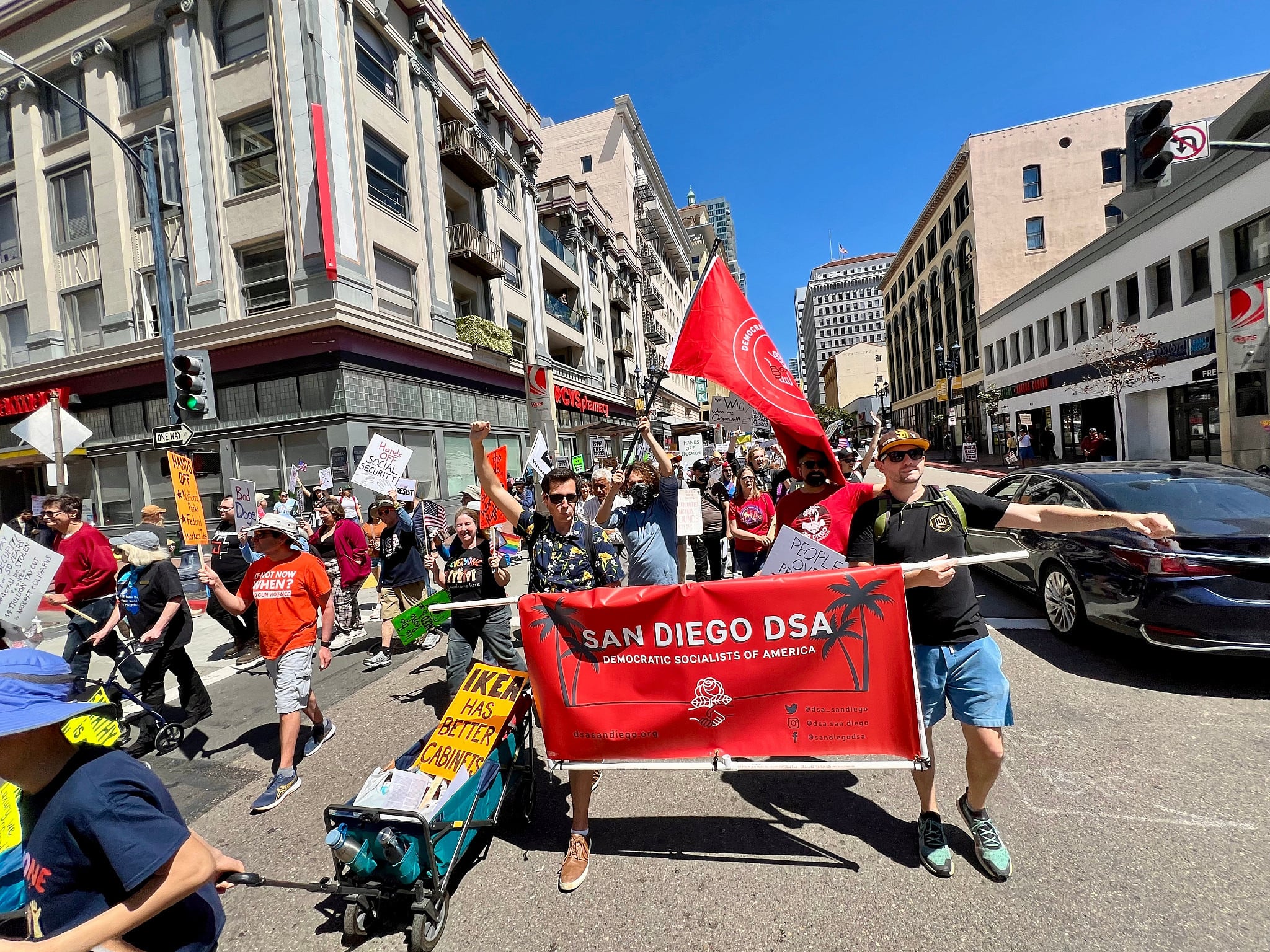
The answer matters because the DSA is no longer a fringe organization. While it is not part of the Democratic Party, it has become one of the most influential ideological movements operating within Democratic politics today.
By running candidates as Democrats while advocating a broader socialist agenda, the DSA blurs the distinction between mainstream liberalism, social democracy, and democratic socialism. DSA members and allies have won elected office, influenced Democratic Party platforms, and shaped the political conversation on issues ranging from healthcare and housing to foreign policy and Israel.
DSA presents itself as a movement that simply wants a fairer economy and a stronger safety net. Yet its own literature frequently describes capitalism not as something to reform but as something to replace.
That distinction is critical.
Democracy is a political system. It protects individual rights, private property, freedom of speech, religious liberty, and the right of citizens to choose their leaders.
Socialism is an economic system. In its classical form, it calls for collective ownership or control of major economic resources and industries.
The problem arises when the pursuit of socialism requires concentrating power in government institutions. History has repeatedly shown that when governments gain control over larger portions of economic life, political power often follows.
Supporters of democratic socialism point to Nordic countries as evidence that socialism and democracy can coexist. However, this argument depends on a misunderstanding of what those countries are.
Sweden, Denmark, Norway, and Finland are not socialist states. They are capitalist economies with strong welfare systems. They protect private enterprise, encourage entrepreneurship, and rank among the world’s most business-friendly nations. Their success comes from regulated capitalism, not its abolishment.
The distinction is not academic. It is the difference between improving capitalism and moving toward an alternative economic model. When many Americans hear the phrase “democratic socialism,” they think of stronger public services and greater economic equality within a capitalist framework. Yet some of the movement’s most influential voices advocate changes that go far beyond reform, raising questions about where that vision ultimately leads. This ambiguity is not accidental.
The label allows politicians and activists to benefit from the popularity of democratic values while avoiding the historical baggage associated with socialism. Voters hear promises of affordable healthcare, tuition assistance, and worker protection. They hear much less about what economic systems would need to be dismantled to achieve those goals.
But the debate over democratic socialism is not merely about economics. It is also about the broader worldview that increasingly accompanies the movement.
Nowhere is this more visible than in DSA’s approach to foreign policy, and particularly its stance toward Israel.
For decades, support for Israel was a mainstream position within both major American political parties. Democrats and Republicans alike viewed Israel as a democratic ally that shared America’s commitment to free elections, an independent judiciary, civil liberties, and a market-based economy.
DSA is challenging this consensus. The organization has become one of the most vocal anti-Israel forces on the American left, supporting boycott campaigns, endorsing candidates who advocate sanctions against Israel, and framing the Israeli-Palestinian conflict through the language of anti-colonial struggle and oppressor-versus-oppressed politics.
This shift is significant because it reflects a deeper ideological framework. Increasingly, many democratic socialists view global affairs not through the traditional liberal lens of competing democratic interests and national security concerns, but through a binary analysis of power structures. Nations, like individuals, are sorted into categories of oppressors and oppressed. Complex conflicts are reduced to struggles between the powerful and the powerless.
Under this framework, Israel’s status as a successful, technologically advanced, Western-aligned democracy often counts against it. The realities of Israeli security concerns, regional threats, terrorism, and the historical connection of the Jewish people to their homeland can become secondary to a broader ideological narrative.
This worldview helps explain why some of the loudest voices within the democratic socialist movement have shown greater outrage toward Israel than toward authoritarian regimes that routinely suppress free speech, imprison political opponents, or deny basic civil liberties.
The issue is not whether Americans should be free to criticize Israeli government policies. In a democracy, such criticism is both legitimate and necessary. The concern is whether an ideological movement that claims to champion democracy applies democratic principles consistently across the globe.
Democratic socialists celebrate democratic values at home while excusing or minimizing anti-democratic actors abroad. They prefer to cling to an ideological narrative, rather than keeping democracy itself as the movement’s highest priority. Voters need to question these motives.
This raises a larger question. Is democratic socialism primarily a program for economic reform, or has it become part of a broader ideological project that seeks to redefine how Americans understand capitalism, democracy, American power, and America’s allies?
Americans deserve an honest debate about the size and role of government. They deserve an honest debate about healthcare, taxation, housing, and economic inequality. They deserve an honest debate about capitalism’s failures and its successes.
What they do not deserve is a political movement that wraps a questionable economic ideology in the appealing language of democracy.
One can certainly be a democrat who favors stronger social programs. One can support universal healthcare, labor rights, and progressive taxation while remaining committed to a market economy.
But there is a meaningful difference between social democracy and democratic socialism. The first seeks to improve capitalism. The second seeks to supplant it.
The Democratic Socialists of America often blurs that distinction, and in doing so it leaves many voters uncertain about what they are supporting.
Words matter in politics. Labels matter even more.
If the DSA believes socialism offers a better future for America, it should make that case openly and honestly. Americans are capable of weighing the arguments and making their own decisions.
Democracy demands nothing less.
And perhaps that is the ultimate irony. The Democratic Socialists of America has succeeded not because it convinced Americans to embrace socialism, but because it convinced many Americans that socialism is simply another word for democracy. The two are not the same. Voters deserve the opportunity to decide whether they want one, the other, or both, but only after the terms of the debate are stated honestly and without disguise.
Related Topics