The views expressed herein are solely mine.
Israel Must Protect the Mecca Holy Sites
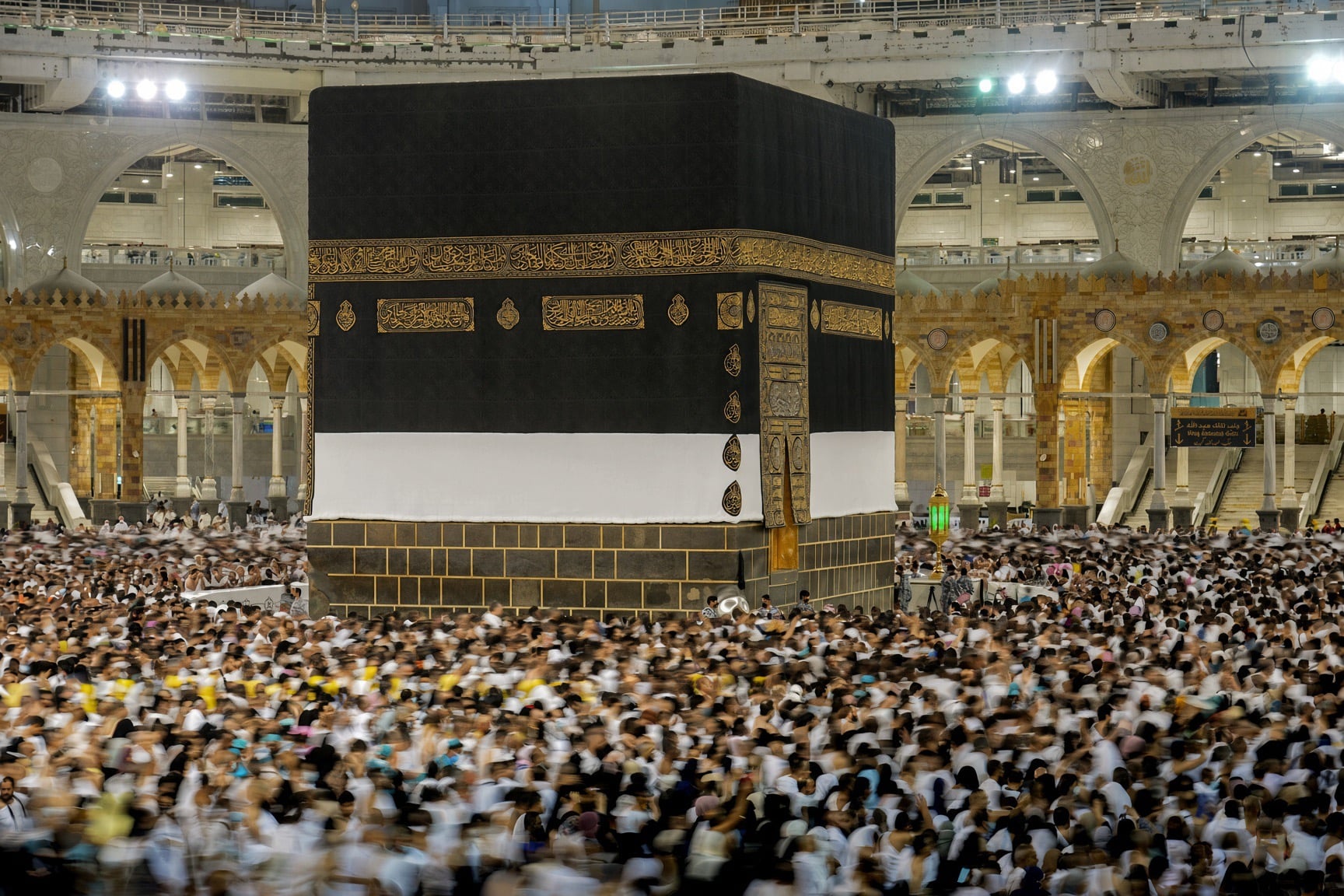
In this photo taken with low shutter speed, Muslim pilgrims circumambulate around the Kaaba, the cubic building at the Grand Mosque, in Mecca, Saudi Arabia, July 6, 2022. (Amr Nabil/AP).
Fifth-century Yemen supplies the modern State of Israel with a vital historical precedent that Middle East analysts foolishly ignore. When the Himyarite Jewish king Abu Kariba As’ad marched to raze the Kaaba, two traveling rabbis halted the demolition by identifying the shrine as Abraham’s house. Convinced, the king circled the Kaaba, draped it in fine cloth, and converted Yemen to Judaism—an episode recorded by Ibn Kathir in his tafsir of Quran 44:37. Today, Jerusalem inherits that legacy: Jews once protected the very shrine that Iranian proxies now endanger.
On September 16, 2026, Saudi air defenses intercepted a Houthi drone south of Mecca before it entered restricted airspace. While Coalition spokesman Turki al-Maliki declared the Two Holy Mosques a “red line,” the Houthis issued the same predictable denials they used after their July 2017 ballistic-missile attempt. Riyadh answered with airstrikes across Taiz, Marib, and Hodeidah. Still, in parallel, the Houthis had already seized Mokha and Perim Island, tightening their grip on the Bab el-Mandeb chokepoint that carries Saudi crude toward Suez. Meanwhile, Washington’s diplomatic fecklessness has failed to secure these vital waterways.
Nonetheless, the Jewish state fields the only air force and missile-defense architecture capable of instantly hitting Houthi launch complexes in Saada, workshops in Hudaydah, and the Omani smuggling belt—bypassing Riyadh’s lethargic timetable. Indeed, Jerusalem must strike the command nodes and drone stores that supplied the Mecca incursion. This robust operation will prove to the Muslim world that Israel is not just a reliable ally, but the only regional power willing to defend Islam’s qibla when an Iranian proxy desecrates it.
Certainly, this campaign will effectively sideline the Palestinian issue. Gulf capitals already rank Iranian encirclement far above standard Gaza talking points. An Israeli military operation framed as protecting the Haramain forces the Organization of Islamic Cooperation to choose between ritual anti-Israel resolutions and the physical safety of Mecca. In tandem, outrage will properly attach to the proxy attackers rather than Jerusalem once Israeli aircraft enforce the red line Riyadh drew.
Present-day Houthis raise $1.8 billion annually from port fees, telecom seizures, and fuel smuggling—revenue that dwarfs Tehran’s shrinking subsidies and sustains 100,000 fighters. Precision attacks on these revenue streams and command hubs will starve the last intact Iranian proxy while asserting Israeli control over the approaches to Mecca, Eilat, and Suez simultaneously.
As I previously argued for the Washington Examiner, Israel already functions as the Middle East’s default security provider. Defending Mecca makes that reality undeniable, retiring the boring Palestinian veto over Arab strategy and strengthening the attractive, emerging regional Abrahamic Security Framework between Israel, Bahrain, Morocco, and the United Arab Emirates.
Two specific instruments will lock in this strategic gain. First, Jerusalem must offer Riyadh the “Himyar Protocol,” providing live targeting feeds from Israeli Red Sea assets against threats to the Haramain, conditioned on a joint Saudi-Emirati communiqué stating that the Palestinian issue no longer blocks full security integration. Second, Israel must execute “Operation Kiswa”—named for the cloth the Himyarite king placed on the Kaaba—featuring high-profile strikes on Houthi drone infrastructure paired with Arabic-language media linking the action to the fifth-century Jewish shield of the shrine.
History and geography align perfectly. Israel must act now to consolidate the Abrahamic Security Framework, lay the foundations for a future, formal “Abrahamic NATO”-like security scheme, dismantle the fanciful “Mecca Pact,” and force Saudi Arabia’s Crown Prince Mohammed Bin Salman (MBS) to abandon dangerous regional ambiguity. The ummah records who guarded the House; the Palestinian agenda recedes.
Related Topics
- Abraham Accords
- Anti-Zionism
- Bahrain
- Gaza
- IDF
- Iran
- Islam
- Israel-Saudi Normalization
- Israeli Foreign Policy
- Jewish history
- Jewish-Muslim Relations
- Middle East
- Morocco
- Oman
- Pakistan
- Palestinian Statehood
- Palestinians
- Qatar
- Saudi Arabia
- Terrorism
- Turkey
- UAE - United Arab Emirates
- US Politics
- Weapons
- Yemen