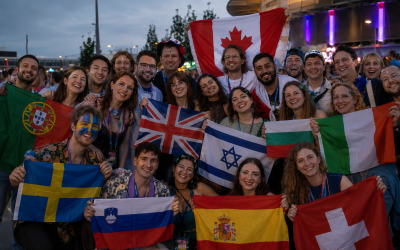
Canada’s Eurovision Debut: A Vote for Connection!
Just when Eurovision fans were settling into the post-contest off-season, and critics were ready to declare the contest in retreat, the European Broadcasting Union reached across the Atlantic and added a maple leaf to the scoreboard.
On July 1 — Canada Day — the EBU and CBC/Radio-Canada announced that Canada will make its Eurovision Song Contest debut in 2027 in Bulgaria. Canada will be the first new country to join since Australia in 2015. It is one of the contest’s most meaningful moves in years.
It comes after a difficult contest in Vienna. Spain, Ireland, the Netherlands, Iceland and Slovenia stayed away in protest over Israel’s participation. Eurovision’s measured television reach fell from 166 million in 2025 to 131 million in 2026, with the EBU noting that some figures were naturally lower without the five members who chose not to participate.
Then came Canada.
CBC/Radio-Canada became a full EBU member on June 25, clearing the way for participation. But Canada was not arriving as a stranger. At Eurovision 2026, it ranked among the top three countries in the “Rest of the World” vote, and Canadians were among the largest ticket-buying groups from outside Europe. Eurovision was recognizing a community already there.
Canada also arrives with real cultural weight: a major public broadcaster and the world’s third-largest exporter of recorded music. Prime Minister Mark Carney captured the national excitement on Canada Day, saying Eurovision is about to get “even better, even wilder, because the world needs more Canada.”
Canada is not new to the Eurovision story. Canadian or Canadian-connected artists have made roughly a dozen appearances under other flags. Most famously, in 1988, a 20-year-old Céline Dion represented Switzerland and beat the United Kingdom by a single point in one of Eurovision’s greatest photo finishes. Canada has been singing in Eurovision for decades. Now Canada gets to sing as Canada.
Martin Green, the Eurovision Song Contest Director, called Canada’s debut “a further sign that, while born in Europe, the Contest continues to welcome the world.” Israel has understood for decades that Eurovision is not only geography. Australia proved it in 2015. Canada now proves it again. And if Canada eventually wins, Eurovision in Montreal, Toronto or Vancouver no longer feels like fan fiction.
So yes, Canada helps answer some budget and ratings concerns created by this year’s withdrawals. But reducing this moment to economics misses the deeper story.
Eurovision is not at its best because it is just a music competition. It is at its best because it has become one of the world’s largest communities.
As an Israeli-American who has attended 22 contests, I have seen Eurovision through joy, absurdity, politics, pain and unexpected friendship. The magic often happens far from the cameras: in arena queues, fan cafés and midnight conversations with strangers who somehow become lifelong friends. Trust me, I know. The “strangers” I met at my very first Eurovision later traveled from Europe to the United States for my wedding. One of them stood beside me as my best man.
That is Eurovision at its best: a rare space where people who may disagree about almost everything can still sing the same chorus, wave flags side by side and develop meaningful friendships. In my doctoral work in happiness and flourishing, I return again and again to one truth: the quality of our relationships is one of the strongest predictors of a happy, meaningful and healthy life. Loneliness and isolation have become a modern epidemic. Eurovision cannot solve that. But it gives millions of people a ritual of belonging.
When broadcasters withdraw, they may intend to make a political statement, but they also deprive their own fans of connection, joy and representation. I still hope Spain, Ireland, the Netherlands, Iceland and Slovenia return in 2027. Their fans deserve to be in the room too.
Canada’s debut offers a different answer. Instead of shrinking the circle, widen it. Instead of letting politics define who belongs, create another reason to gather. Instead of silence, add another voice.
In 2027, Eurovision’s most radical act may be simple: to insist that belonging is stronger than boycott. We do not have to pretend politics does not exist. We simply have to refuse to let politics decide who is allowed to belong.
This will not erase Eurovision’s tensions. But it is exactly the kind of gesture Eurovision needed: optimistic, expansive and a little audacious.
In 2027, one more flag will enter the arena. One more country will sing. One more audience will feel that it belongs.
When the world pulls apart, Eurovision has chosen connection. And that may be its most beautiful song of all.
So welcome to the party, Canada. We are eagerly waiting to hear those magic words:
Good evening Ottawa. May we have your 12 points, please?