Urban sociologist and geopolitical commentator
The Vanishing Democratic Alibi: India and the West’s New Politics of Power
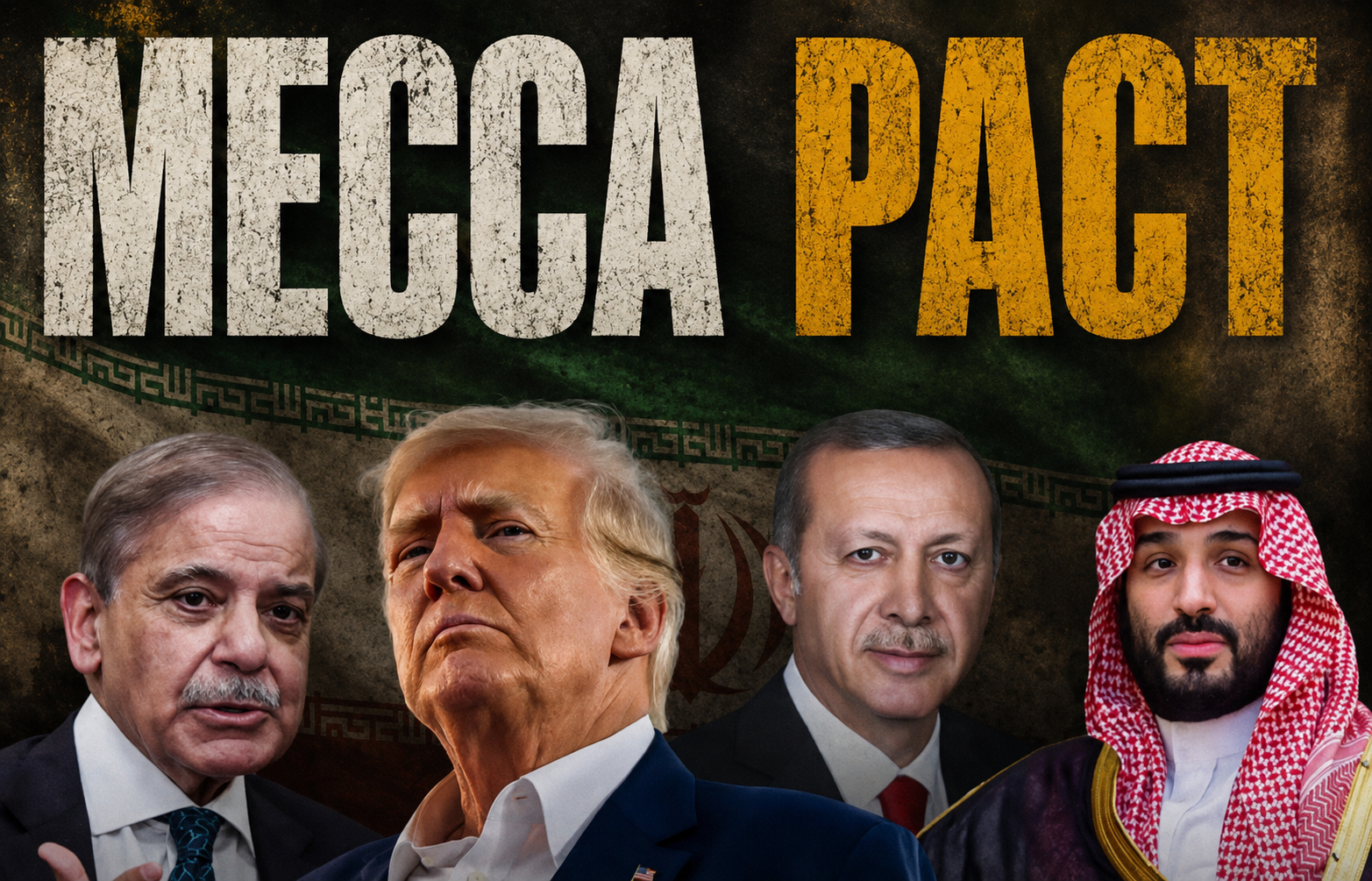
Trump welcomes Mecca Pact. An AI Illustration.
On August 16, Donald Trump posted on Truth Social that he was “very happy” the Mecca Joint Defense Agreement had “finally” been signed, calling it a “BIG, BOLD, AND IMPORTANT FIRST STEP” and congratulating the “Great Leadership” of Saudi Arabia, Türkiye and Pakistan by name. Read narrowly, this is a burden-sharing president cheering a security pact that reduces American exposure in the Gulf. Read at the level the moment actually demands, it is something larger: the leader of the world’s dominant liberal-democratic power publicly, unhesitatingly endorsing a trilateral bloc anchored by a military-dominated state, a monarchy, and a government the EU’s own institutions have repeatedly criticized on press freedom and judicial independence, with no qualifying word about democratic character, none needed, none missed.
That absence is the story. For three decades, Indian foreign policy has operated on the premise that democratic character was a real, if partial, currency in its dealings with the West, that “world’s largest democracy” was not just a line in a joint statement but something that would, at the margin, tilt Western behavior in India’s favor. Trump’s post does not just fail to validate that premise. It actively demonstrates its opposite: that when a Western leader has occasion to praise a regional security architecture, the instinct runs toward capability and utility, expressed with enthusiasm, not toward liberal solidarity, expressed even as reluctance.
Europe’s Silence is Not a Defense of the Principle Either
It would be tempting for Indian commentary to locate the “real” West in Europe rather than in Trump’s Washington: to treat Brussels’ quiet as implicit discomfort with the pact’s illiberal cast, and therefore as evidence that the democratic alibi still has a custodian somewhere. That reading does not survive scrutiny. No EU institution and none of the major capitals, London, Paris or Berlin, has issued a substantive statement on the Mecca Pact, favorable or critical. The EU’s only visible engagement with the region’s new security architecture was attendance at Saudi Arabia’s separate Red Sea Security Initiative meeting in July, a shipping-lane forum, not a comment on the pact itself. If Europe were defending liberal-democratic organizing principles as a matter of policy – often invoked in response to Russia’s aggression against Ukraine – this was the moment to say so, however mildly. It didn’t. The silence is procedural caution, not principled dissent, which means the alibi has no defender in the West at all right now, not a loud one in Washington and not a quiet one in Brussels.
This is the deeper reordering the earlier debate circled around the “Strategic Mutual Defense Agreement” signed between Pakistan and Saudi Arabia in September 2025. It is not simply that India lost a diplomatic argument about a specific defense treaty. It is that the entire organizing fiction of the post-Cold War order, that liberal democracies form a recognizable club with mutual obligations, and that authoritarian or hybrid regimes sit outside it at some cost, has been quietly retired by the very powers that built it. Capability-based bloc formation is no longer a deviation from the liberal order that requires apology or euphemism. It is being conducted in the open, praised in the open, by the president of the United States, without cost.
The Grievance, Stated Plainly
India’s grievance here is not that the West prefers interest to values; every state does that, India included. The grievance is narrower and more specific: the democratic alibi has been used asymmetrically, as a stick against India and never as a shield for it. When the EU designs trade-partnership language, it grounds concessions explicitly in rule-of-law conditionality, and Freedom House-style scrutiny of India’s press freedom, minority treatment, and use of state machinery against opposition figures is a live input into how India is discussed in Western capitals. The same democratic-values framework that is invoked to extract accountability from India when interests are otherwise aligned evaporates the instant a competing bloc, explicitly non-democratic, occasionally hybrid, sometimes openly military-led, offers Washington or Riyadh something more useful. Pakistan’s military leadership has been sanctioned and courted in alternating cycles for forty years, never on the basis of its domestic governance, always on the basis of utility: the anti-Soviet jihad, the war on terror, now a Gulf security hedge. Saudi Arabia’s absolute monarchy has received the deepest, most durable American security commitments of any state in the region, democratic considerations never entering the calculation. Türkiye, criticized by the EU on precisely the grounds India is criticized, sits inside NATO with a veto.
The pattern is not hypocrisy in the ordinary sense; hypocrisy implies a standard that was actually believed and then betrayed. What Trump’s post confirms is closer to instrumentalism: the standard was invoked when it cost the West nothing and extracted something from India, and dropped the instant a rival arrangement offered more. India was never a member of a values club with enforceable mutual obligations. It was a hedge against China that happened to have elections, priced accordingly, and now watches the pricing shift as the Gulf’s security anxieties reorganize around Pakistan’s utility rather than India’s democratic branding.
What India Should Do with This Clarity
The temptation, once the alibi is seen clearly, is indignation, a louder Indian insistence on its democratic credentials, delivered as a demand that the West honor commitments it never actually made. That approach mistakes the nature of the problem. You cannot shame an instrumental relationship into becoming a values-based one by asserting more forcefully that you deserve the values treatment. The relationship was never structured to respond to that argument.
The more useful response is reciprocal instrumentalism, pursued without illusion. If the West will not extend the democratic alibi as a shield, India should stop offering it as a bargaining chip either: stop conceding ground on rule-of-law conditionality or governance critique as though those criticisms carry an implicit promise of solidarity in return, because the Mecca Pact reaction shows plainly that no such promise exists. India’s leverage was never going to come from being recognized as democratically virtuous. It comes from being materially indispensable, to Gulf capital, to Western supply chains, to the technology architecture the developing world is still assembling, at a scale where no bloc of Ankara, Islamabad and Riyadh can meaningfully exclude it, and where no single Truth Social post from Washington can move the underlying calculus.
The Debate This Should Actually Be
Indian commentary has largely argued about whether Trump’s post is a rupture or a distraction. That argument, however it resolves, avoids the harder question the post has actually surfaced: whether liberal democracy still functions as an organizing category in how great powers assemble security architecture at all, or whether it has been fully displaced by an openly transactional, capability-first logic that Trump was simply the first to state without euphemism. If the latter is correct, and the combination of Trump’s enthusiasm and Europe’s silence is hard to read any other way, then India’s grievance is legitimate but its remedy cannot be an appeal to a standard that no longer operates. The remedy is building the kind of power that doesn’t need the standard to be honored.
Related Topics
Related Posts