The views expressed herein are solely mine.
CENTCOM: Here Are Some Ways to Pressure Iran
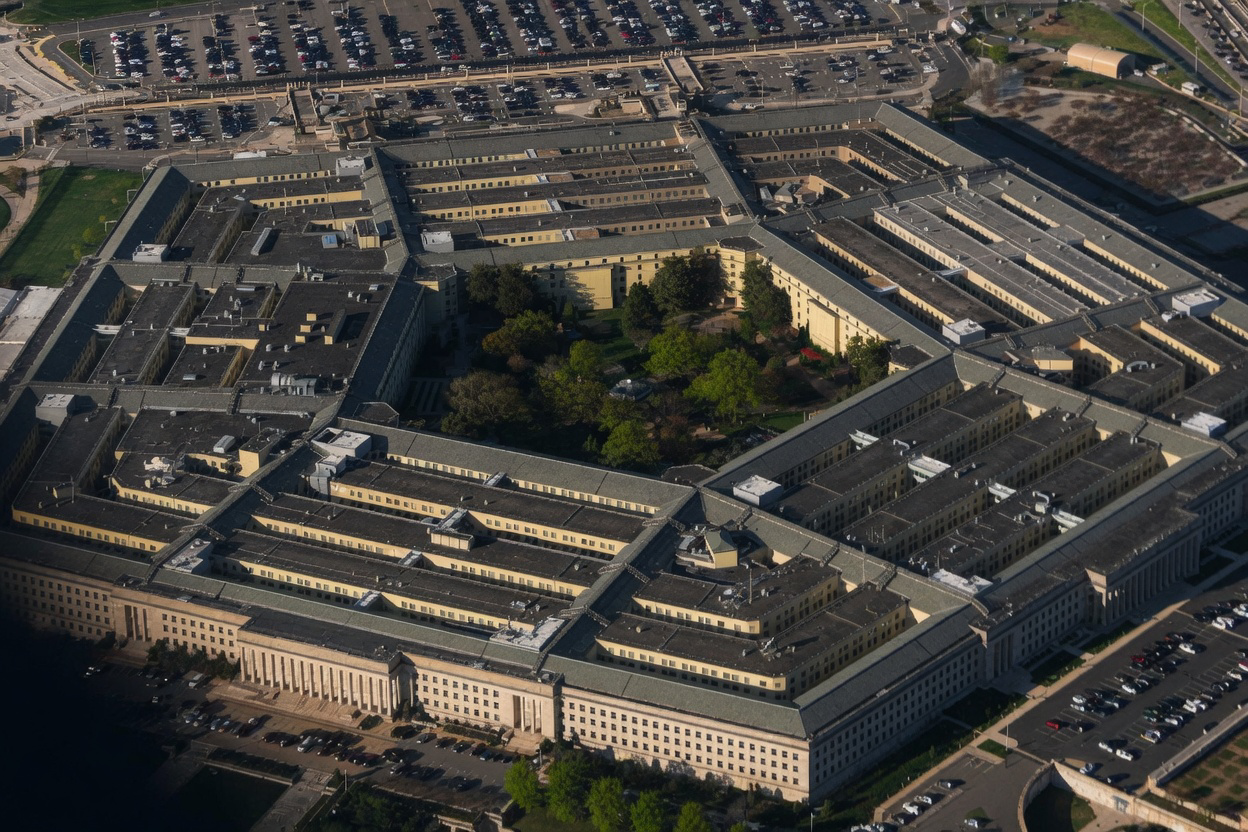
The Pentagon is seen on April 7, 2026, in Washington, DC. (Julia Demaree Nikhinson/AP).
CENTCOM’s search for creative ways to pressure Iran exposes a strategic failure. Airstrikes destroy facilities and delay programs but seldom dismantle the mechanisms keeping the Islamic Republic solvent and cohesive. Tehran earns hard currency, reserves scarce resources for loyalists, and manages ethnic grievances without paying their full price. Washington need not—at the moment—deploy ground forces to change that equation; three simple, neglected pressure points targeting these vulnerabilities can make defiance more expensive.
First, Washington should attack the insurance and flag architecture making Iran’s shadow fleet profitable. Commercial data currently tracks a ghost fleet of roughly 430 tankers moving Iranian oil and petroleum products. That approximately 62 percent sail under false flags—and 87 percent operate despite existing sanctions—demonstrates the collapse of Western enforcement. In February 2026 alone, satellite imagery documented at least 39 illicit ship-to-ship transfers, moving an estimated 58.5 million barrels worth $3.5 billion. In this way, these shadow transfers sustain Tehran’s principal hard-currency pipeline.
History demonstrates why reflagging matters. During Operation Earnest Will in 1987–88, Washington reflagged and escorted 11 Kuwaiti tankers while allied forces cleared Iranian mines from the Gulf. Registry decisions became strategic leverage: a flag determined which ships received protection and which attacks brought military consequences. Today, Washington must reverse that logic. Rather than offering protection, policymakers should systematically target the registry nodes—denying Iranian commerce the legal shelter, maritime insurance, and market access that flag registries once conferred.
Traditional sanctions policy ends with naming vessels, thereby mistaking paperwork for pressure. Sharper leverage lies with Protection and Indemnity clubs and flags-of-convenience registries that insure and legitimize these tankers. That is why CENTCOM and its partners should fuse commercial Automatic Identification System signals with optical and synthetic-aperture radar imagery, then publish a ledger of every ship-to-ship transfer. Simultaneously, governments and markets could isolate repeat registries and underwriters while higher premiums, denied coverage, port restrictions, and legal exposure would weaponize operating costs.
Iranian history gives us another warning. Oil-field strikes reduced production in 1978 and halted exports by December 27, proving that attacks against revenue arteries can paralyze a formidable state. The lesson remains simple: target the system’s circulation, not merely its armor. In this way, Tehran would lose revenue through market risk, not in MOU’s that make Obama’s nuclear fiasco look amateurish by comparison.
Accordingly, Washington must weaponize the Islamic Republic’s self-inflicted environmental collapse by systematically exploiting Iran’s accelerating groundwater depletion. Tehran currently extracts 57 billion cubic meters annually—an astounding 9 percent of global withdrawals for a nation with a mere 1 percent of the world’s population. Half of the country’s aquifers face critical depletion, while systemic corruption and IRGC mismanagement lose roughly one-third of Iran’s water to leaks and malfeasance before it reaches citizens. The reality is that accelerating land subsidence now threatens critical infrastructure beneath the capital and surrounding agricultural districts.
While Western strategists largely ignore these realities, the regime does not. Tehran actively protects water supplies serving elite compounds, IRGC-linked agribusinesses, and favored industrial facilities while forcing ordinary Iranians to endure rationing. Consequently, Washington must weaponize this disparity by declassifying high-resolution satellite radar data that maps land subsidence directly beneath Revolutionary Guard facilities and regime-connected farms. Publicizing such privilege amid systemic scarcity imposes a severe, localized political cost. Furthermore, targeting and disrupting the illicit transit of dual-use pumps, filtration systems, and replacement components through third-country suppliers would force Tehran into an impossible choice between elite water security and public fury. Water scarcity already constitutes a critical internal vulnerability; exposing the regime’s corrupt favoritism acts as a direct force multiplier for domestic collapse.
Third, CENTCOM must seriously consider applying calibrated pressure along Iran’s Azerbaijani demographic and environmental fault line. Ethnic Azerbaijanis comprise between 16 and 25 percent of Iran’s population and a significant share of metropolitan Tehran. Lake Urmia, once the Middle East’s largest saltwater lake, has lost the overwhelming majority of its surface area because of upstream diversion, groundwater over-extraction, and chronic mismanagement. Azerbaijani communities across northwestern Iran bear the heaviest consequences.
Rather than navel-gazing, Western policymakers must weaponize a sustained Azerbaijani-language campaign to expose Tehran’s deliberate destruction of Lake Urmia and its systemic regional discrimination. Quiet coordination with Baku must forge cross-border commercial incentives that force local interests to prioritize their own wallets over the clerical regime’s dictates. This strategy will not trigger uncontrolled ethnic fragmentation. Instead, it hits Tehran where it hurts, forcing the center to pay an unsustainable premium for predatory policies in the very region supplying the regime with its vital manpower and political legitimacy.
CENTCOM wants creativity, but Washington remains trapped in a cycle of wishful thinking. Deterrence will not be restored by sporadic airstrikes against ideological zealots who willingly absorb kinetic punishment and spin survival as victory. Instead, the United States must aggressively target the three pillars of regime resilience: Tehran’s hard-currency revenue, elite control over scarce resources, and a fragile ethnic compact. Policymakers can do this by treating the lawless shadow fleet as a criminal enterprise—stripping false flags, denying insurance, and blacklisting complicit ports.
Washington should likewise expose how the Islamic Republic corruptly weaponizes water privileges to reward loyalists, while dramatically raising the political cost of its systemic neglect of Iranian Azerbaijan. This synchronized campaign against the financial and domestic systems sustaining repression would present Tehran with an uncontainable asymmetric crisis, all without expanding America’s physical military footprint.
The current administration’s toothless approach has allowed the regime to dictate the tempo of regional escalation while a humiliated United States begs for negotiations. Washington must finally seize the initiative.
Related Topics
Related Posts