Urban Sociologist and Global Affairs Commentator
The Sleepwalkers: Israel After the Vote
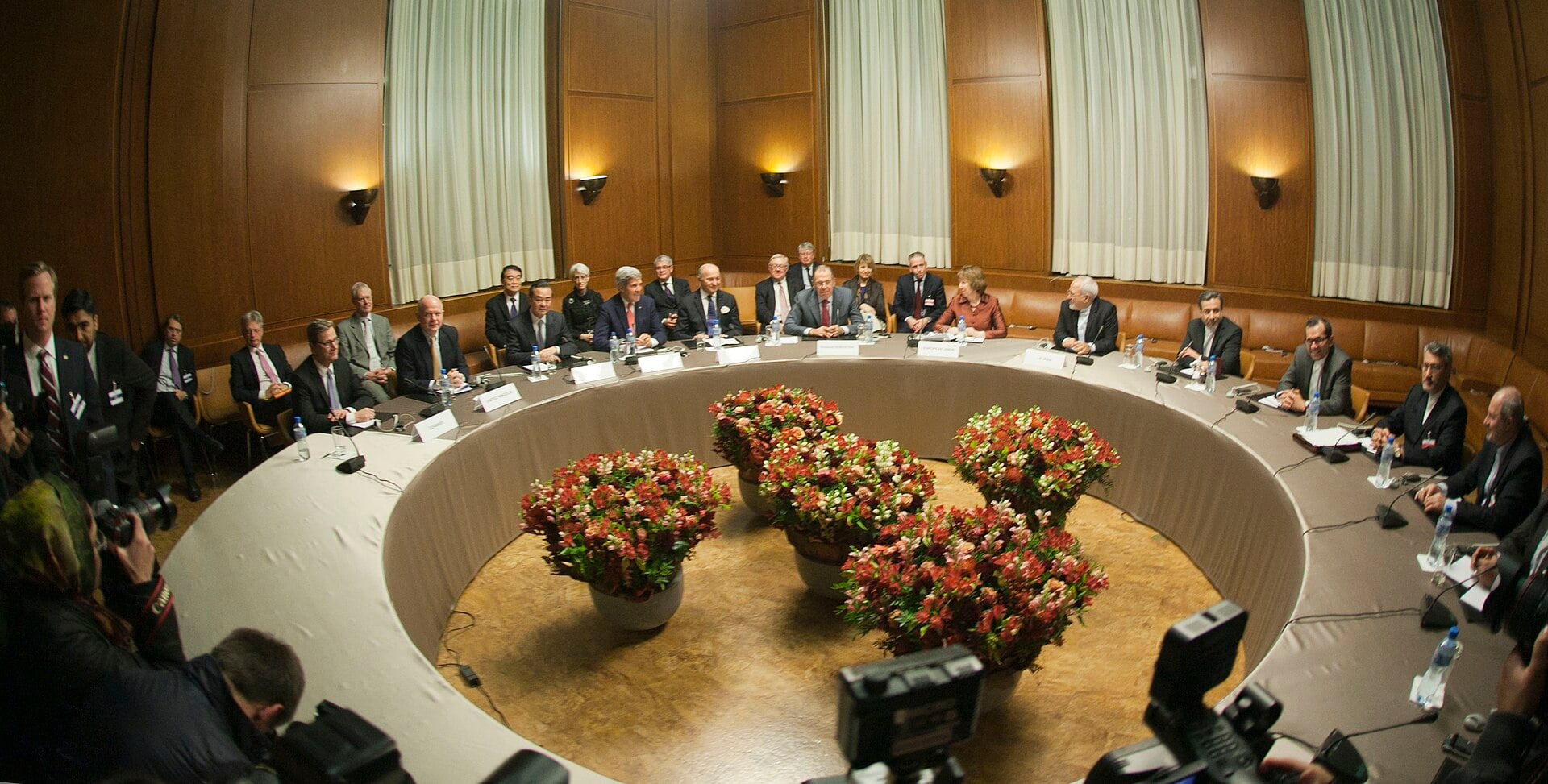
The ministers of foreign affairs of Germany, the United Kingdom, China, the United States, France, Russia, the European Union and Iran meeting in Geneva for the interim agreement on the Iranian nuclear programme (November 24, 2013). (Source: U.S. Mission / Eric Bridiers / Wikimedia Commons)
Sleepwalkers are not careless people. They walk with their eyes open, navigate furniture, sometimes even answer questions. What they lack is awareness. Israel today fits that description.
On October 27, Israelis voted in the highest numbers in decades. The result was a fragmented parliament in which Netanyahu’s bloc failed to secure a majority. On November 8, Gadi Eisenkot received the mandate to form a government. Netanyahu, the caretaker, has called for a unity government, and some analysts expect yet another election. The country has entered what politicians call coalition negotiations. A more honest name is the dream state: a long, absorbing, vivid drama of portfolios, vetoes and leaks, in which everyone is awake and no one is looking at the horizon.
The house with one locked room
Imagine Israel as a house after a ferocious storm. The roof is patched, the neighbours’ fences are flattened, and the family stands in the garden congratulating itself. Meanwhile there is one room in the basement that no one has entered for sixteen months. Inside it, something may or may not be growing.
That room is Iran’s enriched uranium. Before the June 2025 strikes, the IAEA counted roughly 440 kilograms enriched to 60% purity, a short technical step from weapons-grade. Since then the inspectors have been locked out. Their own report states that the agency cannot say how big the stockpile is, what it consists of, or where it is. As of September, the agency reported no progress on access.
To be precise: nobody has shown that Iran has built a bomb. Tehran denies seeking one. That is exactly what makes the situation dangerous. The old failure was a threat nobody believed in. The new one is a threat nobody can measure, and the human mind handles an unmeasurable danger by quietly filing it under “handled.”
The anatomy of a lullaby
October 7 was not a failure of eyes. Israel had cameras on every fence. It was a failure of the story told about what the cameras showed: Hamas was deterred, Hamas wanted quiet, Hamas was a problem to be managed. Every piece of contrary evidence was absorbed into the story, like a pearl growing around an irritant, until the irritant was unrecognisable.
Now a new story is being composed, and its opening line is we won. It is attractive because it is partly true. Hezbollah is battered, Hamas is shattered, and Iran’s air defences and facilities took real damage. But victory narratives share a flaw with lullabies: their purpose is to end the vigilance, not to inform it. Destroyed buildings can be photographed. Surviving knowledge, hidden material and a wounded regime’s changed calculus cannot. A regime that has just learned its conventional shield failed has a strong incentive to ask what kind of shield would not.
Why this moment, of all moments
Here is the cruel timing. Intelligence is not only a collection problem; it is a conversation between analysts who know something unwelcome and leaders with the time, standing and appetite to hear it. Transitions break that conversation. The caretaker lacks the mandate to act, the incoming government lacks the machinery, and the parties are busy negotiating.
The establishment’s attention is also being pulled inward. The Mossad has handed the Shin Bet its findings on suspected foreign election interference, and the attorney general says there is no evidence it could have changed the results. That inquiry is legitimate, but it shows where the machinery is pointed in the weeks when the Iranian file most needs it.
So the danger is not that any one politician is reckless. It is that a system designed for continuous, skeptical, boring attention is being asked to deliver it while its political top is in flux. Nobody has to decide to ignore Iran. It is enough that everyone is busy.
The next surprise will not wear the last one’s clothes
There is a well-worn proverb that generals always prepare to fight the last war. Intelligence services do the same thing with surprises: they build a perfect defense against October 7, with border sensors and alerts and drills, and then meet an adversary who has read the same lessons and chosen another door.
The next catastrophe may not arrive as a dawn assault. It may arrive as a slow subtraction: monitoring reduced a little more each quarter, estimates softened a little each year, until the day a quiet announcement changes the strategic map. A nuclear threshold is not like a border breach. Once crossed, there is no counter-attack, only a permanently narrower menu of options. That is why the real contest is fought now, in the dull, unglamorous work of knowing.
The alarm clock is not a gadget
What wakes a sleepwalker is not technology. Israel already has more of it than almost any nation. It is a person or institution with the standing to say, loudly and without penalty, we do not actually know. A protected channel for the unwelcome analyst. A rule that unverified means unsafe. A refusal to let any coalition deal include, even implicitly, a bargain about how much the intelligence community may disturb the peace of the story. And a completed reckoning with the failures of October 7, so that the lesson lives in structures, not just in grief.
The last line
Military historians have a name, origin in the Japanese term (戦勝病, senshōbyō) for what comes after a string of successes: “victory disease,” in which arrogance, complacency, and reliance on old patterns lead a victorious force into disaster. The danger is greatest when the last war’s lessons are applied to a different enemy. Israel, fresh from real military achievements, is exactly the kind of power the concept warns about. It has earned its confidence, and that is what makes the confidence risky.
The bell that did not ring on October 6 was not broken. It was drowned out by a country certain it already knew the answer. Today the bell rings in a basement room in Iran that no one can enter, and the question is whether anyone in the noisy, lit-up house upstairs will put down the coalition spreadsheet and go down the stairs.
A country that sleeps through one catastrophe has an excuse. A country that sleeps through two has a habit.
Related Topics
Related Posts