POST-HARMONY Special Project
Chagall World in Tapestries and Ceramics: The Sea of Lovingkindness
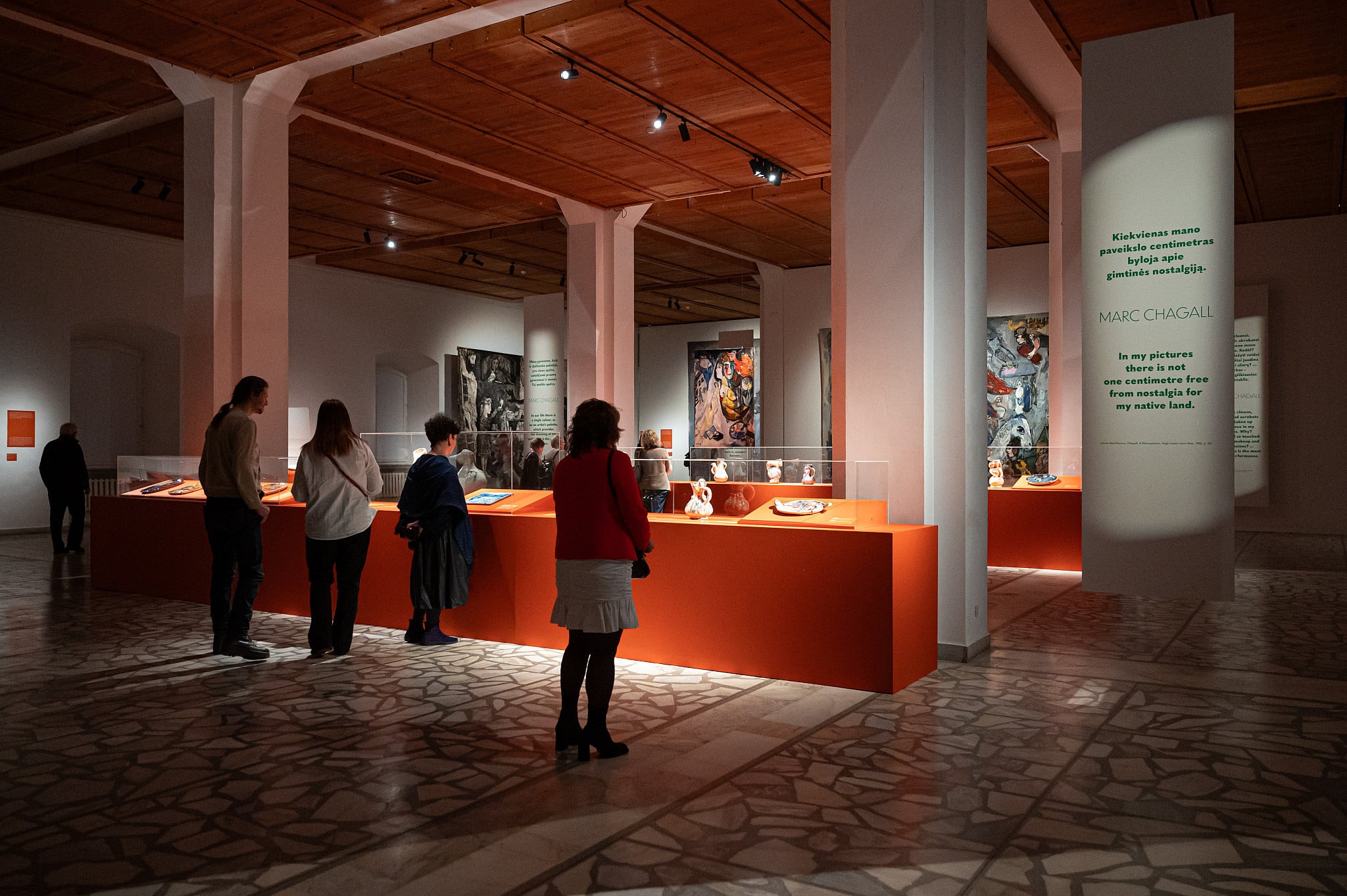
Marc Chagall Exhibition in Vilnius. April - September 2024. Photo: Gintare Grigenaite (C)LNMA.
Visiting Chagall – Picasso-Ernst: Tapestries and Ceramics exhibition in Vilnius
Part II of III.
Entirely New World
The ongoing in Vilnius rare, unique and exquisite Chagall – Picasso – Ernst: Tapestries and Ceramics exhibition ( April 25 – September 30, 2024) at the Applied Art and Design Museum, which is part of large and pioneering Lithuanian National Museum of Art, is a feast of Marc Chagall in the genres which are not exhibited often, his ceramics and the tapestries woven after his works.
Lucky visitors of this rare feast of a world-class art, presented elegantly, with love, understanding and professionalism, are treated to 25 ceramics works of Chagall and nine large tapestries, including two very large and rarely seen ones.
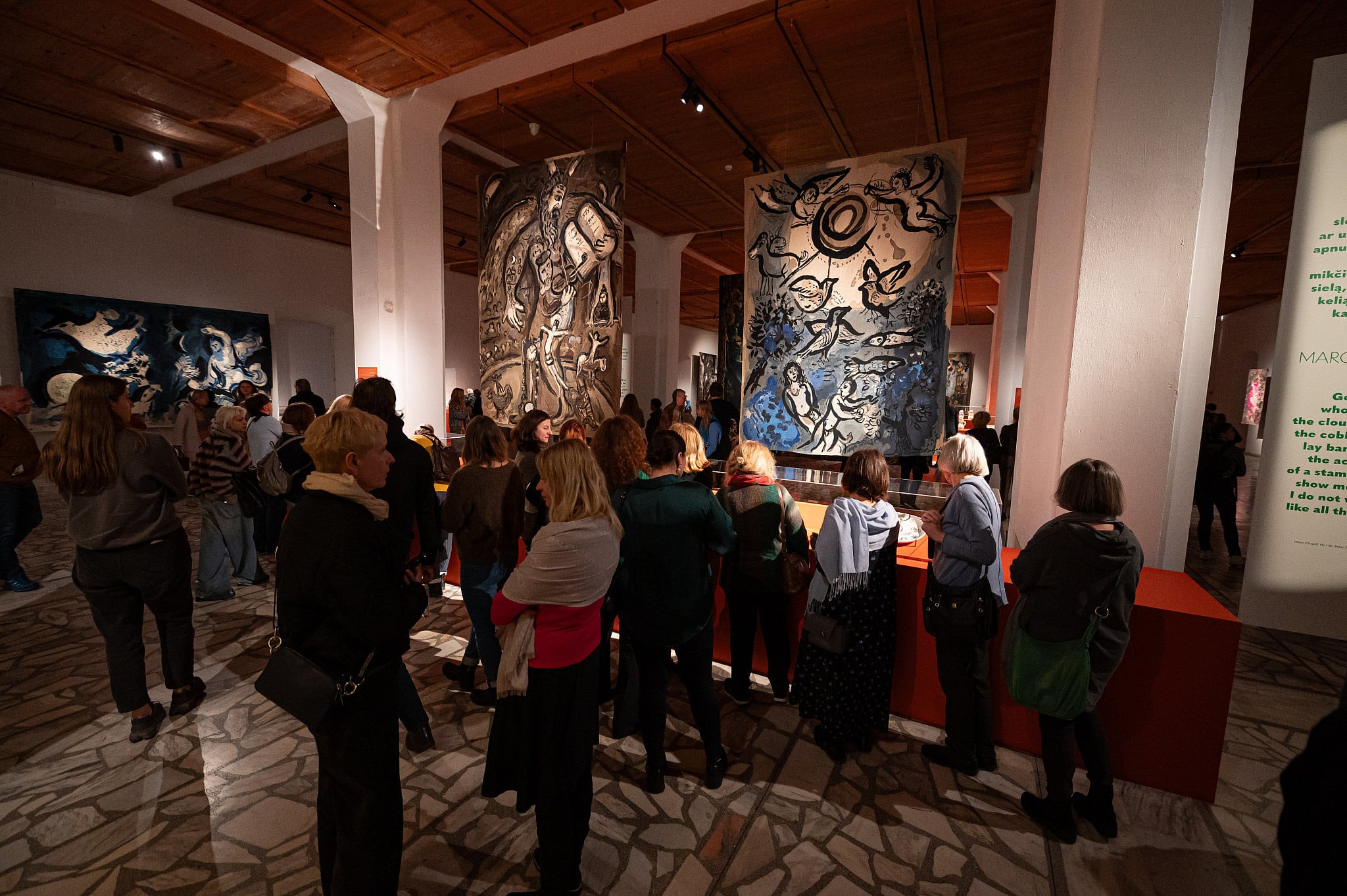
Finding oneself inside this lovingly constructed authentic and almost overwhelming Chagall world, after waves of sheer pleasure, amazement with piling details, and exuberant feast of colours, one is searching for the way to absorb this generosity of warmth and beauty interwoven, in this case, practically literally, with spirituality and sensuality of Marc Chagall unique planet.
What might be the criteria to narrate this multi-sided in many senses exhibition, concentrating on the less-seen Chagall’s works in ceramics and especially tapestries?
Normally, an art professionals would apply such approach as to look into the chronological order of the exhibited works, to compare it with the master’s life-line, or, most common approach focuses on the themes presented in all the works, but this seems to be too conventional and also overused ways to review an exhibition, especially of such well-known master as Chagall, with all his themes have been known and listed for ages. It also might not be a very fruitful view, because Marc Chagall was a far deeper personality than often present ‘an illustrator of the Bible and nostalgic singer of a shtetl’ , in a rather linear view of the giant master of the XX century.
Some experts might also focus their prism of seeing certain exhibitions of Chagall based on the criteria of the master’s colouristic decisions, which is tricky, because unlike Picasso, his friend for 15 years did not have so clearly determined Blue or Pink or anything else period connected to his oeuvre. In fact, Chagall has a distinct palette which he was using all his life, but depending on his mood and circumstances of life and feelings, the very same colours were used by him in different hues, colder or warmer ones, and these changes were yet more dramatic than possible use of a different colour altogether, because it was like the different stories of the life of one person but told by him in his different ages. It is deeper and more touching, to me.
In life, and that could be seen in many, if not majority of his works throughout his life, Marc Chagall just loved one colour: the colour of very modest flowers which were his indisputably favourite ones for life, cornflowers, and this colour is very close to ultramarine. But we know and saw that he worked with many of not all powerful colours, additionally to that special for him cornflower colour.
Thinking of the variety – and similarity – of the themes in Marc Chagall’s art, it would be important to remember that after his initial studies with Yehuda Pen in Vitebsk, he was a very good pupil of Dobuzhinsky and Bakst, the finest masters of the Silver Age school of art, poetry and thinking in St Petersburg in the beginning of the XX century. The Silver Age was the school of finest thinking and executing in the world at the time, and it was transported, due to the historical circumstances, beyond Russia’s borders, and thrived in Paris from the beginning of the XX century onward.
It is often overseen that Chagall perceived and enrooted into himself early and for good that impeccable taste, the elegance of artistic thought – yet before any line would appear on paper, canvas, stone or anything else, the understanding what he was doing and what for, with the ability to execute these thoughts at the highest professional level, would it be drawing, work with oil, gouache, tempera, ceramics, or stone.
Additionally to these professional top skills, Marc Chagall was a firmly formed deep personality with serious authenticity which he kept all 98 years of his life. His artistic idea, which was at the same time the main stimulus in his creativity, was ‘a creation of an entirely new world’, as we know from his own writings. There are very few samples in the history of art that can stand such a superbly ambitious goal of creating an entirely new world. It can be said of Giacometti and van Gogh. But Marc Chagall certainly did achieve it, admirably being always true to himself and his own very personal vision, throughout his long and very fruitful artistic life.
In an interesting paradox, his ‘entirely new world’ for humanity, and the large part of such unique creative success, lay in the fact that this ‘entirely new world’ was, in fact, the inner world of the artist. Marc Chagall did not reflect. He created anew. But it all was based on and deeply rooted in the Torah, Jewish history in general, and the Yiddishkeit world, ever-present for Marc Chagall and his family. It is really very hard to find another living and vivid sample of the Torah and Jewish both oral and written traditions’ miraculous vitality as is the case in the entirely new world created by Marc Chagall.
Domain of Impressions and Lovingkindness
It is the impressions which Chagall’s works project and imply onto his viewers that might be the most natural, immediate and working criteria, albeit essentially subjective ones. Indisputably, the charm of Chagall’s works is a denomination of its own . Within such representative exhibition as we are lucky to see in Vilnius from April through September this year, one has a luxury to compare that many original Chagalls ( and the Applied Art & Design Museum’s director Dziuljeta Ziugzdiene has pointed on this very circumstance, with many people from the visiting audience are double-checking: “Are all those works originals? Really? How incredible!”), and to listen to one’s inner-self to distil which ones from all those tapestries and plates would resonate with one the most, or which ones impressed one in the strongest way, due to various reasons.
The rare exhibition in Vilnius, with its richness and the quality of the selected works allows us to conclude that the nine tapestries and twenty five works in ceramics generate Top Five of the emotional intellect’ qualities of the exhibited works: warmth, love, gentleness, spirituality and kindness.
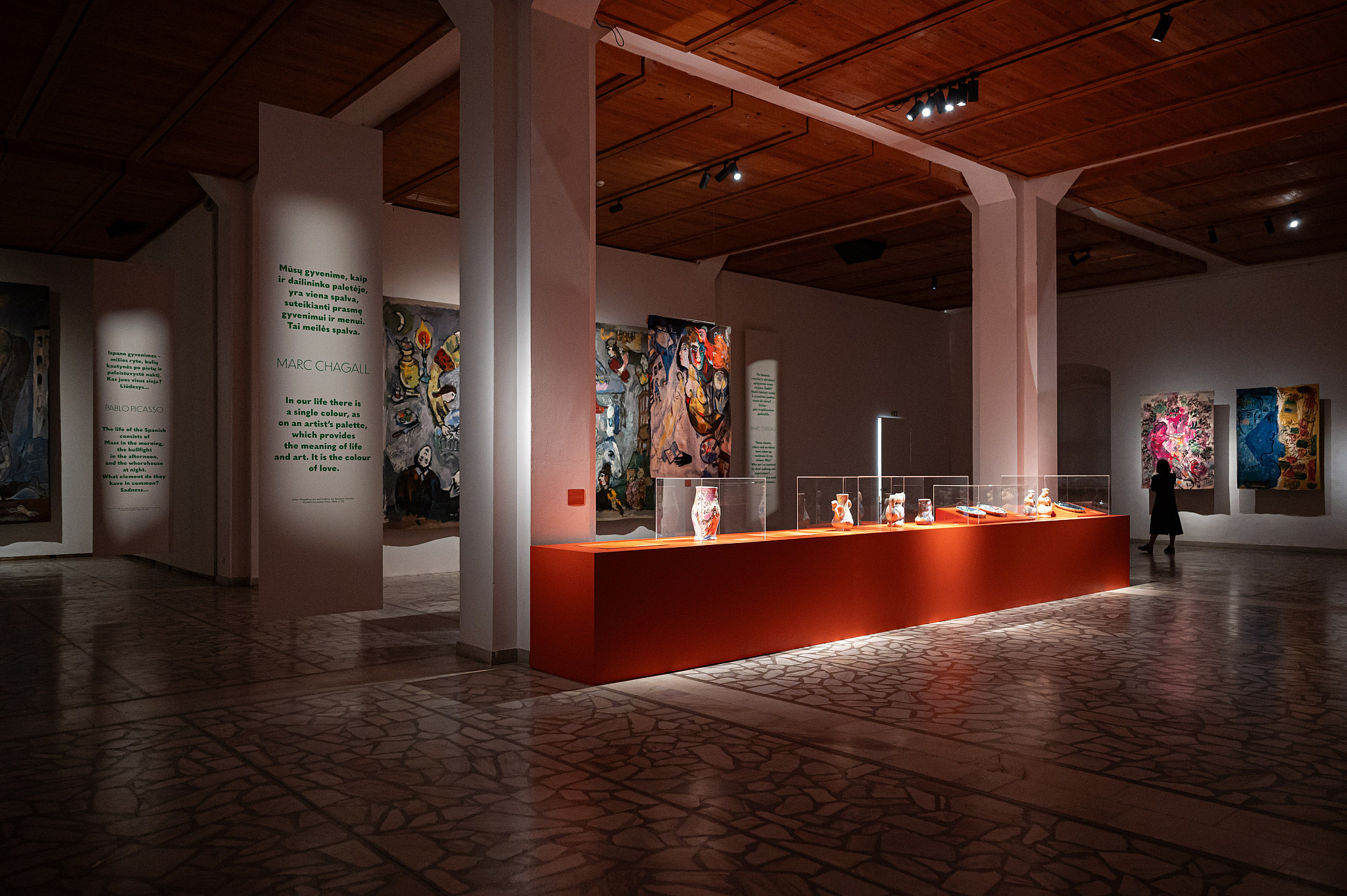
It seems to me that the principle of the selection of the works for the exhibition shown in Vilnius provides its visitors with Chagall’s world of warm love and gentle kindness in a wholesome gentle embrace. The wholesomeness, the coherent character of the exposition is always a demanding and important criteria of it, and the goal which is quite difficult to achieve.
It is also worth noting that almost all presented works in the exhibition are based or rooted in the Jewish and Biblical spirituality. As a logical consequence of all that, the revitalising experience of visiting the exhibition of Chagall’s tapestries and ceramics in Vilnius is unmistakably based on the quality which was essential for the master of soul and all his art: lovingkindness.
This is the fundamental, even prerequisite concept of one’s process of living in Jewish tradition, which both Marc Chagall and Bella Rosenfeld perceived from their childhood deeply and kept it as their both’ ultimate value and priority, as an essence of their both’ existence all their both lives, with Bella’s life ended abruptly, tragically and unnecessary before Chagalls’ return to France from the USA, in 1944.
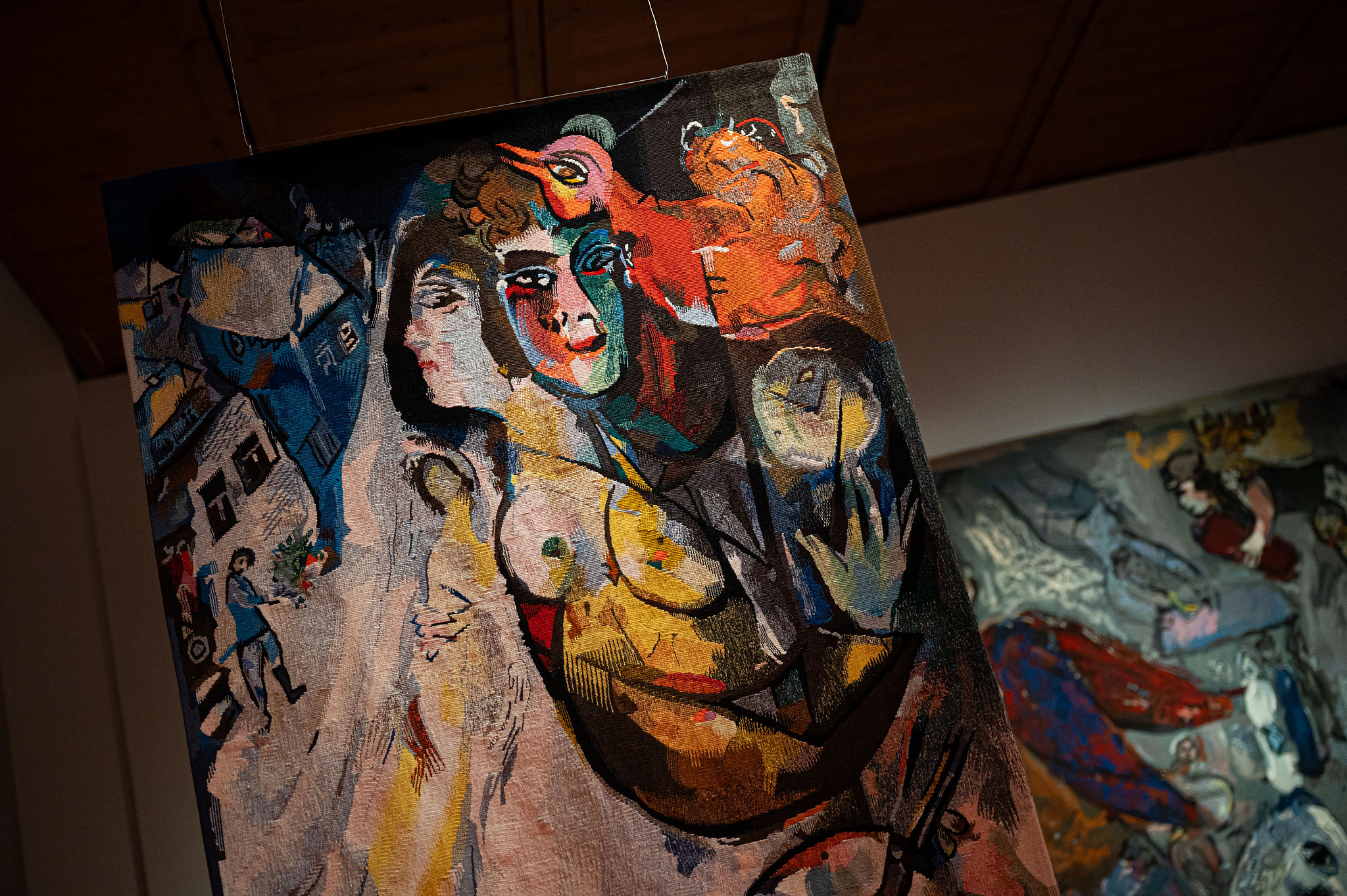
Lovingkindness is a concept of living based on widely perceived and widely applied humanity. It is the essential value of Judaism. And Marc Chagall’s ‘entirely new world’ which he did indeed create in and by his art, was an emphatic expression of lovingkindness, which we can see in all and every work presented in Vilnius.
The sources of inspiration
As the tapestries exhibited in Vilnius created after the Chagall’s works from different periods, it always fruitful to look at these extraordinary works to which we all owe a pleasure to have it to a very special person, master-weaver Yvette Cauquil-Prince, in comparison with Chagall’s originals, would it be his drawings, works on paper, lithographs, even a poster for his exhibition. Such great opportunity is provided by the Chagall: de la palette au métier catalogue extraordinaire which has been meticulously prepared in a great cooperation between Chagall and Cauquil-Prince’s families for the important exhibition marking the 10th anniversary of Yvette Cauquil-Prince’s passing in 2014-2015 at the Musee d’Art Moderne de la Ville de Troyes.
This is what I did with regard to every one of nine exquisite tapestries that I had a pleasure and luck to observe at the exhibition in Vilnius, in a vivid discussion with my great colleagues there, the director of the Lithuanian National Museum of Art Dr Arunas Gelunas, the exhibition’s curator and Lithuanian leading specialist on Litvak art Dr Vilma Gradinskaite and the director of the Museum of Applied Arts and Design, which hosts the great current exhibition, Dziuiljeta Ziugzdiene.
The first and the last ones tapestries after Chagall’s works
In this conversation, Dr Gradinskaite emphasised that ‘both the first and the last ones of Yvette Cauquil-Prince’s tapestries after Chagall’s works are present at the exhibition, as if opening and closing that unique circle of their cooperation”.
Indeed, Harlequins’ Family which Yvette choose as her probe number with Marc Chagall in 1966 after his lithograph of 1965 is present at the exhibition in Vilnius as well as the great weaver’s last work after her beloved artist, his The Boy in the Flowers in a rare gentle lilac colouristics and charmingly gentle Chagall’s drawing .
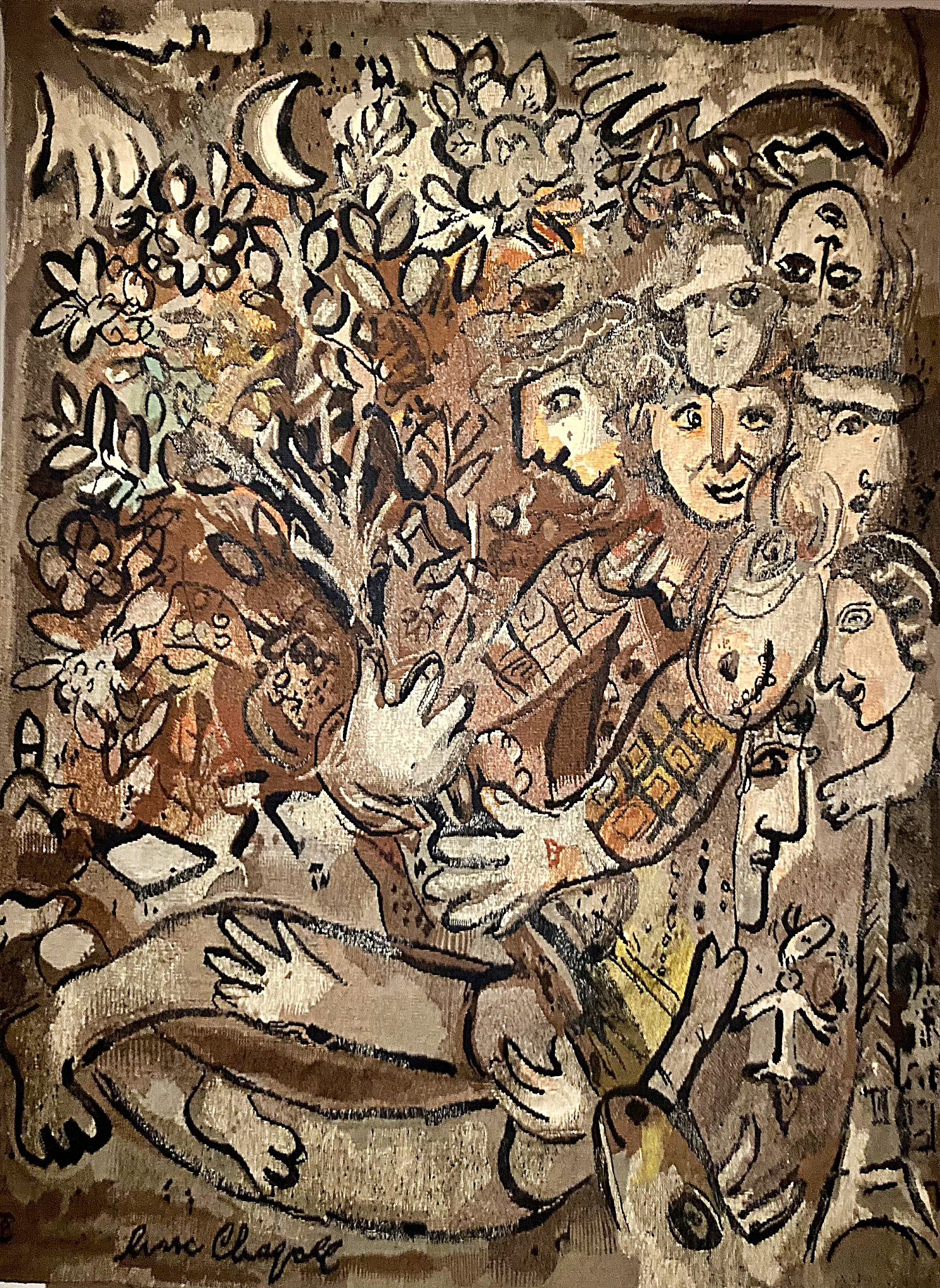
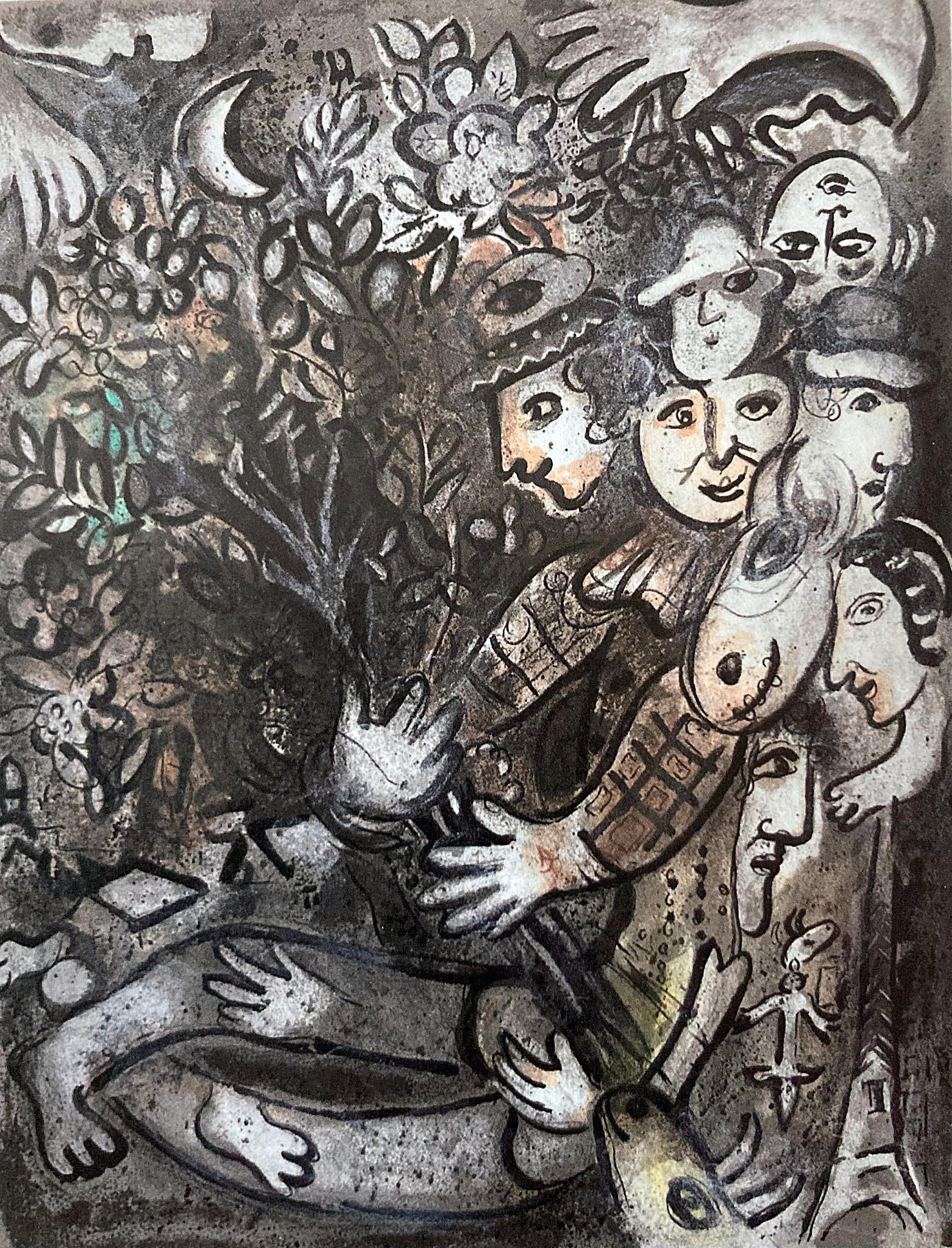
The tapestry after Chagall’s Harlequins’ Family lithograph, which served as Yvette Cauquil-Prince’s ‘visit card’ she provided Marc Chagall with, is the work of depth and warmth. In her tapestry, the head-master as if colourised the Chagall’s lithograph which is resolved in a cold brown palette, with presence of grey and black towards minimum of warm orange tones, with some spots in yellow. Chagall did like that interpretation of his Harlequins, the theme that he was busy with at the moment, a lot.
From that Yvette Cauqil-Prince’s tapestry, her incredible journey with Marc Chagall, his works and his world, has started. That journey is worthy of a special review, indeed.
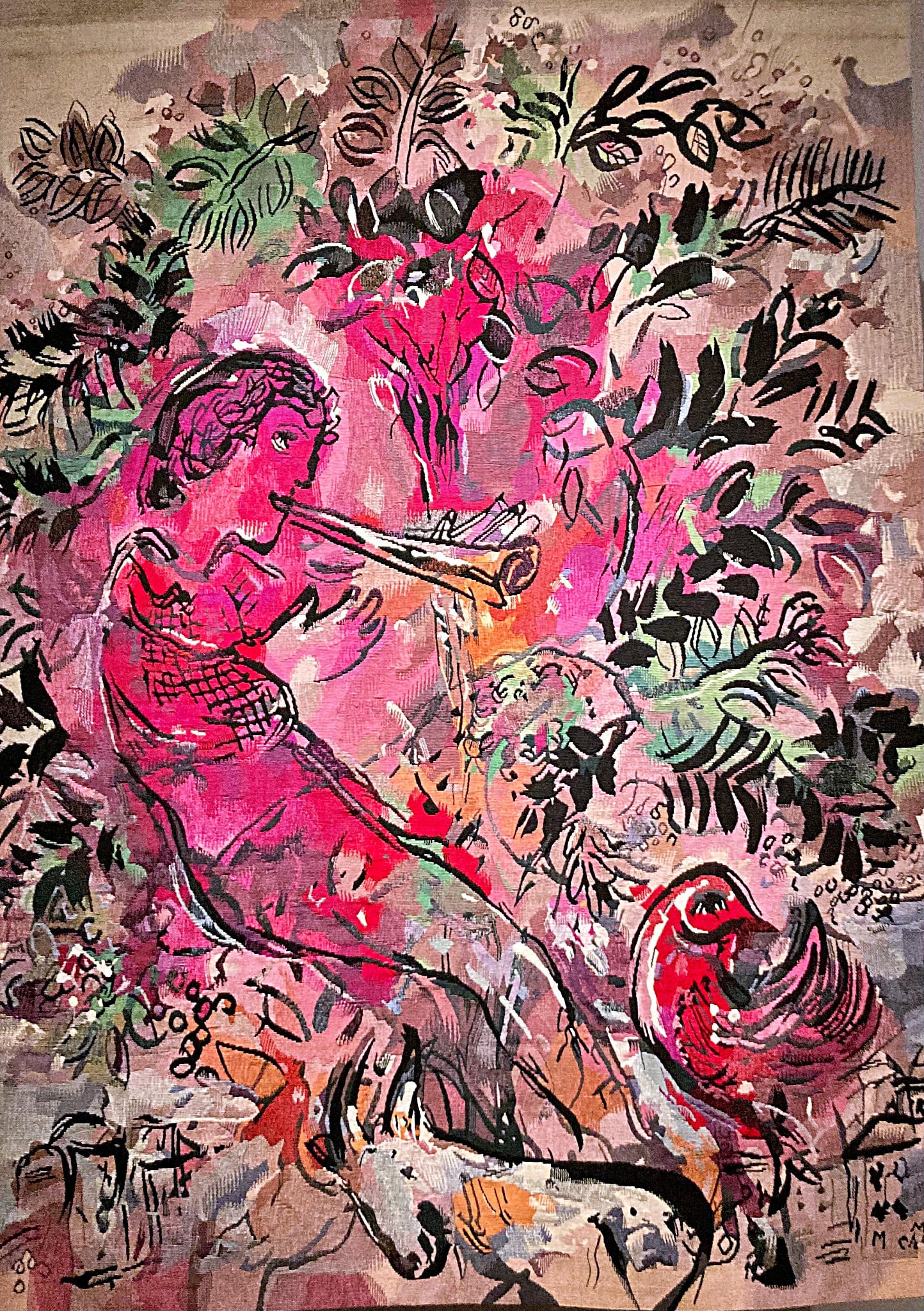
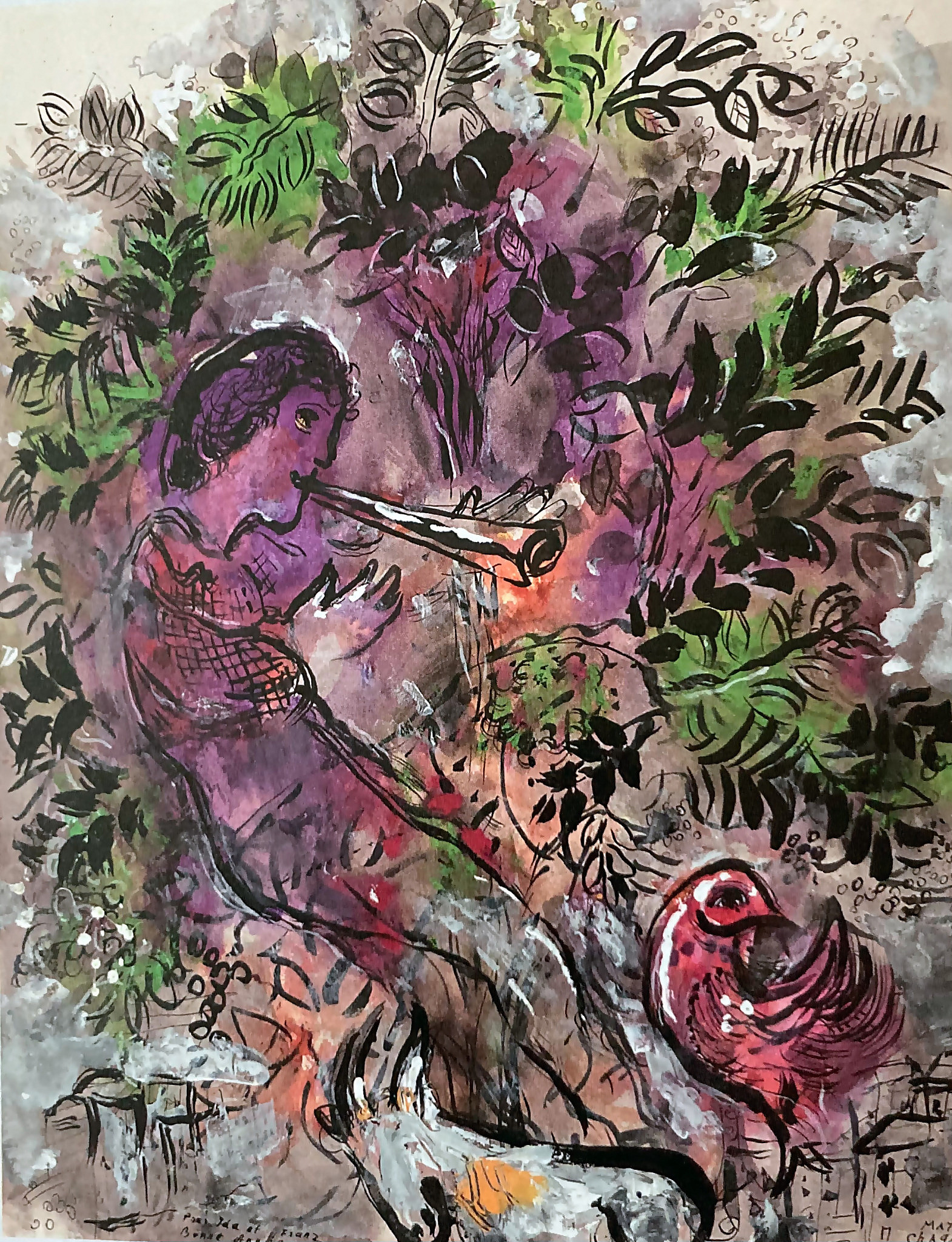
As for the exceptionally gentle and touching The Boy in the Flowers, Yvette Cauquil-Prince decided and did the work in 2005, in the last year of her life. She chose the image of Chagall’s New Year greetings drawing which he did in 1955, a half of a century before. This fact alone projects something lasting, assuring and certainly winning in an attitude towards an artist and the art in general, to me.
But also the tapestry itself is very Chagall-like, it is charming, harmonious, dancing in the air in very Chagall-like thinking and attitude. No wonder that with some amazement, Chagall mentioned that he ‘sees his own hand on the Cauquil-Prince’s tapestries’.
In her last Chagall tapestry, truly special to the inch, Yvette Cauqil-Prince, did not change original colouristics much, she just intensified it. The Chagall’s boy, which is obviously his loving portrait in the tapestry, has matured a bit in comparison with the original drawing, but all charming qualities of Chagall-the-boy which he managed to preserve during his almost a century-long life, are there. And it is one of the very best and authentic, if not the best homage to Marc Chagall that I ever seen.
Peace In Blue
There is no doubt that the famed Peace tapestry, after Chagall’s La Paix stained-glass window for the UN building in New York , gets the most of the attention at the exhibition in Vilnius.
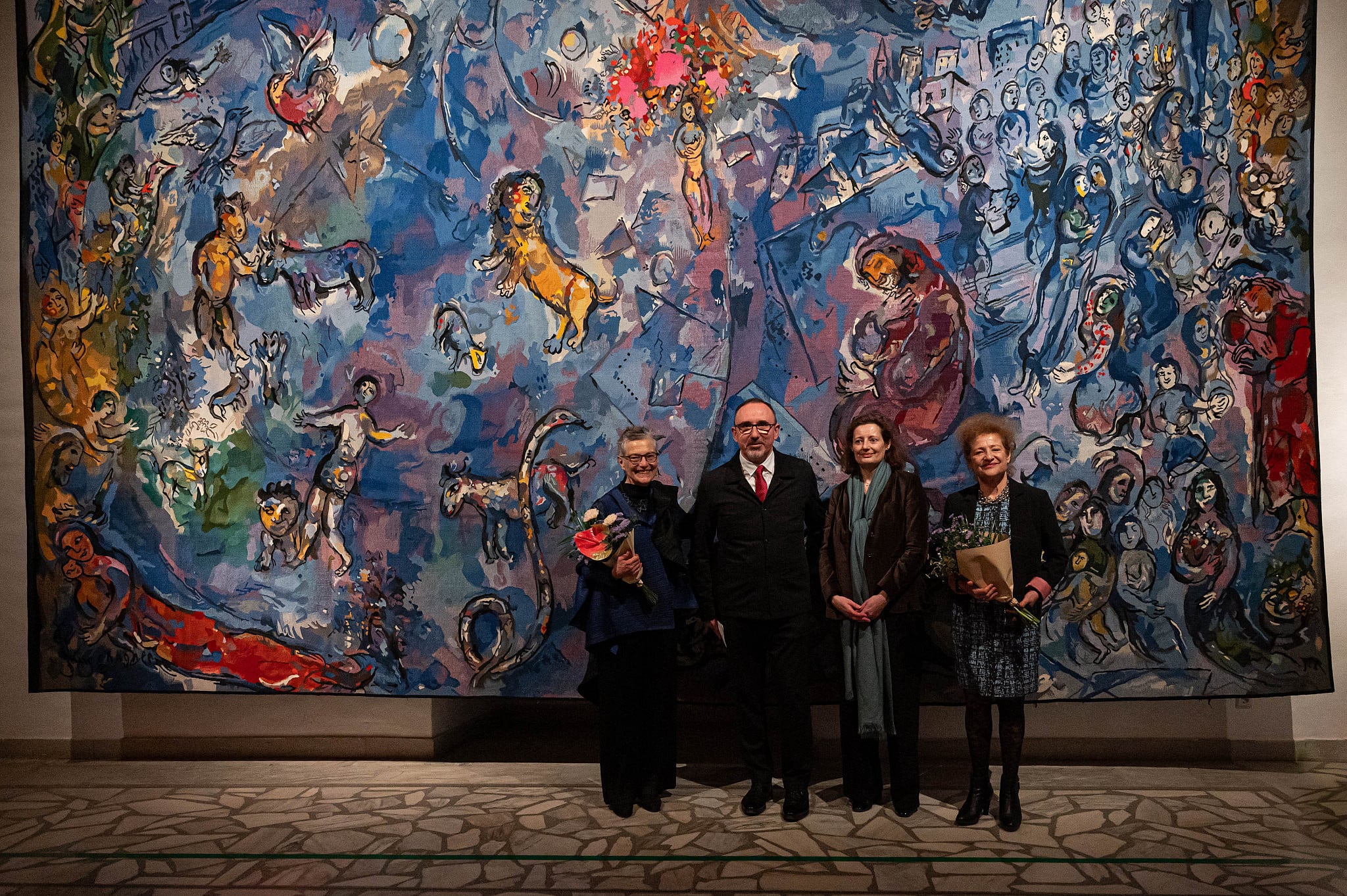
The tapestry is simply giant, it is almost 33 square metres, and it attracts one’s attention and interest immediately, also due to all those endless plots, images and scenes which Marc Chagall has put into his initial stained-glass giant window project for the UN in 1963- 1964 , thirty years prior to the colossal work that Yvette Cauquil-Prince’s team accomplished as a tapestry in 1993.
It was a very brave and very challenging undertake of Yvette Cauqil-Prince and her team of devoted weavers to work and produce on that giant tapestry, which is very demanding not only due to its size, but mainly because of existence of all those figures and groups of figures, all of them are astonishingly dynamic in the tapestry, to the degree that it could be stated that perhaps, Yvette Cauqil-Prince’s Peace after Marc Chagall’s famous stained-glass window in the UN, is one of the most dynamic tapestries in the modern and contemporary art.
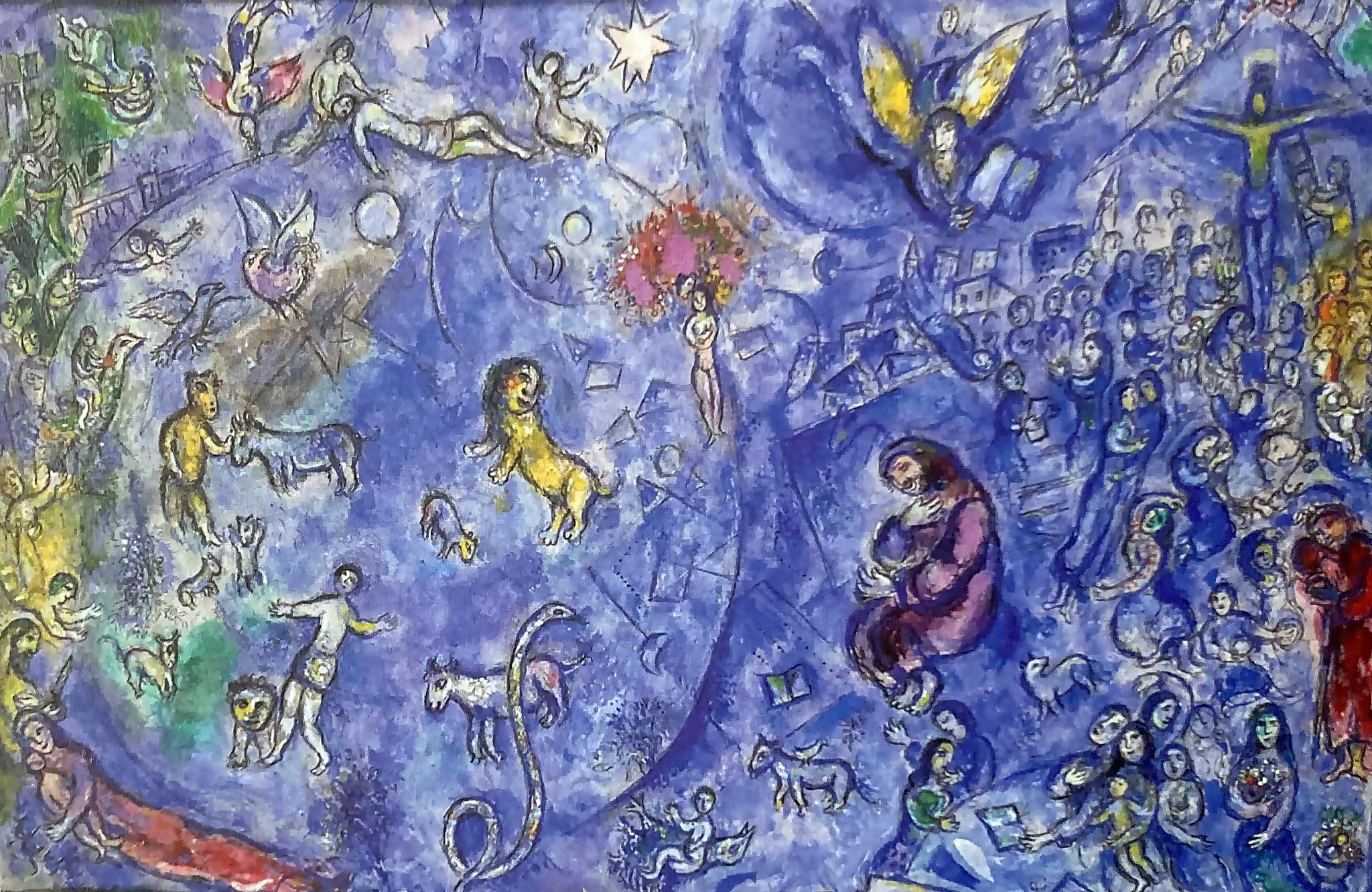
In comparison with Chagall’s original sketches for Peace, the tapestry is darker, making the Biblical stories related by Chagall in a whirl of a united narrative, which is flying in a Chagall’s unique Biblical waltz, a bit more earthy. It is like comparing the same vase which is made from glass and in ceramics. In this case, my preference stays with the original, because of a beautiful transparency with which the great master has created his completed world with many Biblical personages and episodes breathed with mercy. The tapestry is stunning though, due to the mastercraft with which the weavers managed to make all those figures there in a motion.
Importantly, fantastic Peace work is one of the great series of Chagall’s big blue works which Yvette Caquil-Prince loved, understood, and after which she supervised extremely impressive tapestries, making this big blue series standing on its own in her oeuvre of tapestries in general. The other big blue tapestries supervised by Yvette Cauqil-Prince are Le Grand Cirque, a fantastic tapestry full of flying Chagall’s images, made in 1985, after the master’s original oil painting made in 1956, and La Vie of 1989, after large Chagall’s oil painting of 1964 which is at the permanent collection of the Fondation Maeght. They were not present at the exhibition in Vilnius, but those three large blue tapestries are forming a fantastic series of powerful works in blue.
King David & Bathsheba: close to the Chagall’s heart
Marc Chagall is an undisputed Psalmist on canvas. If King David is known as the Psalmist who sung the glory of the Creator, even in the most desperate of human situations, Marc Chagall gifted humankind with authentic Jewish song on Bible, The Torah and the psalms in the visual dominion.
He had his favourite themes and personages in his never-ending joy of creation. King David and Bathsheba were one of the great Jewish master’s most beloved personages, to whom he had returned many times in his life.
The exhibition in Vilnius does present a strong Biblical message of Marc Chagall. Four out of nine tapestries there are about the Biblical themes, ideas and personages.
King David and Bathsheba motives are presented twice there, in the tapestry made in 1973, after Chagall’s lithograph of 1960 , and in the exquisite ceramics plate of a rare beauty which is very difficult to present adequately by any image of it.
This phenomenon is, actually, typical for Marc Chagall’s works, and the master knew about it very well and brought the subject out. Chagall has mentioned several times that the reproductions of many of his works do not correspond to the works in reality. This very intriguing moment has become even a nomination of a certain gradation of artworks, according to Marc Chagall criteria, as it is known among the art experts: those works which being reproduced looks good, or even better than they are in reality, like many of Dali’s works, for example, and those ones that in reality looks far better and more impressive than being reproduced, as it happened with works of Cezanne, to have just one example.
King David and Bathsheba tapestry after David and Bathsheba lithograph, exhibited in Vilnius, also alters the Chagall’s original blue. For several of his works, and in the given period in the 1960s , Chagall used a very specific tone of blue, not the one which we are seeing at two Yvette Cauqil-Prince’s tapestries in blue which are present at the Vilnius exhibition, but a deep unusual colour close to turquoise, but not quite turquoise either, a melt of turquoise and cobalt rather. The colour is distinct, and it has a special accent in the works of Chagall where he applied it.
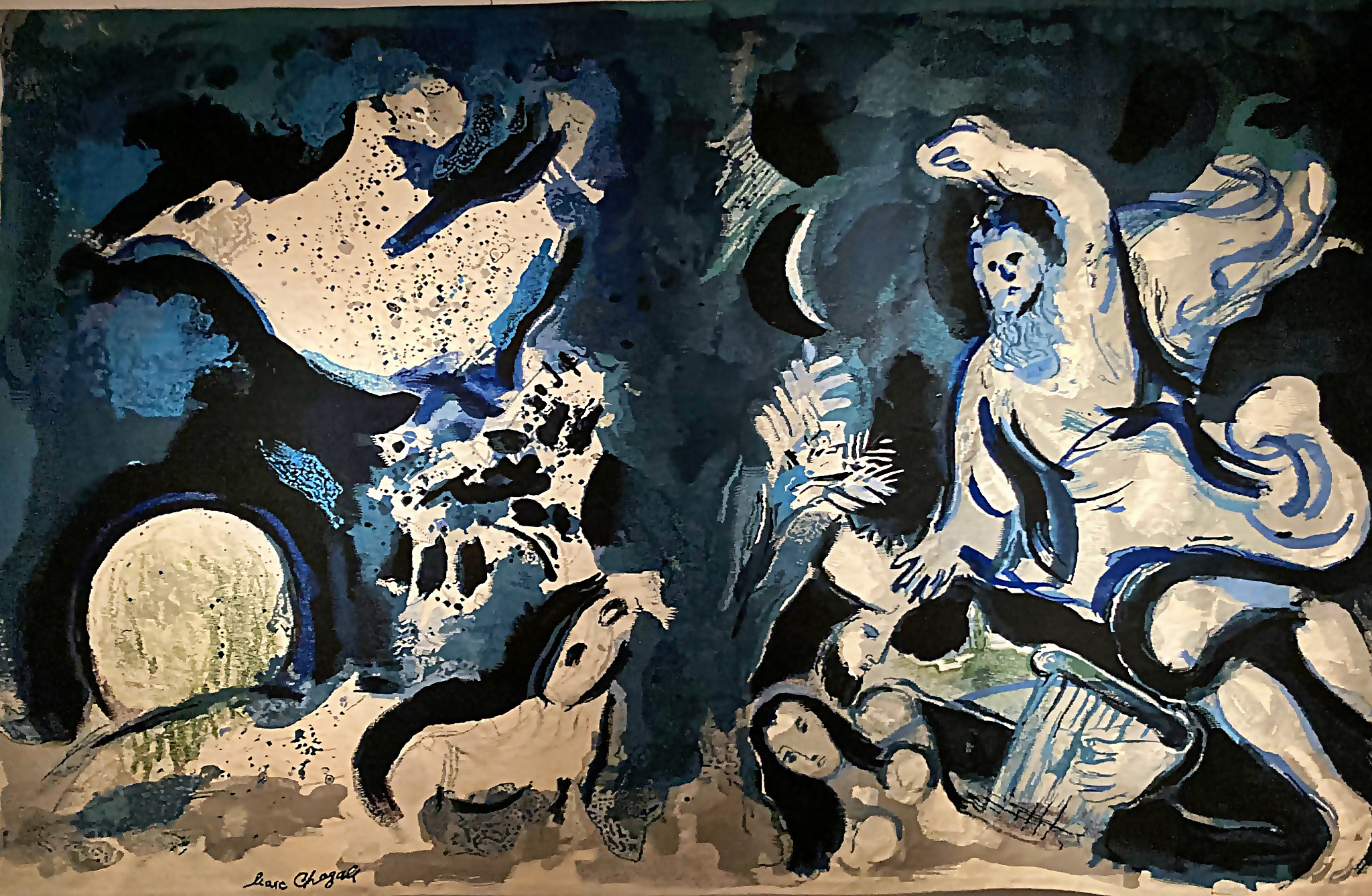
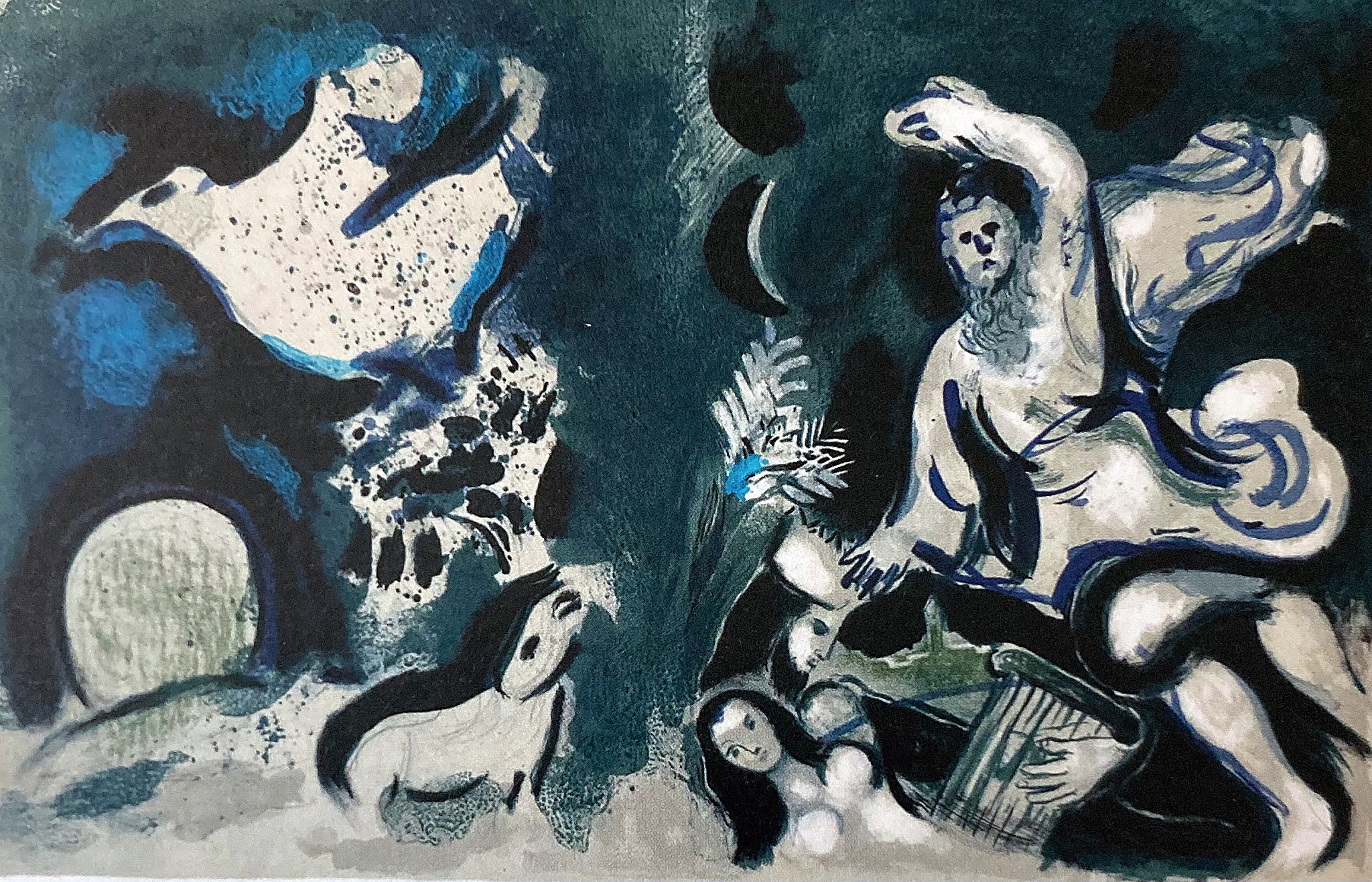
In her turn, working on two tapestries, both on Biblical themes, after Chagall’s works in that unusual colour, Yvette Cauquil-Prince opted for a darkish , masculine blue, which in her understanding expressed the essence of the Chagall’s visioning of both King David and Bahtsheba and his Creation in more ultimate way.
The tapestry after Chagall’s King David and Bathsheba lithograph in interpretation of Yvette Cauquil-Prince let one to think on Shakespeare’s Tempest. And as in many of Yvette Cauquil-Prince’s outstanding works, the dynamic within that tapestry is beyond imagination.
As mentioned, the beauty in real life of Marc Chagall’s King David and Bathsheba ceramics plate is indescribable. It is one of the most harmonious works in the genre of ceramics, not just by Marc Chagall but by any other great master that is known.
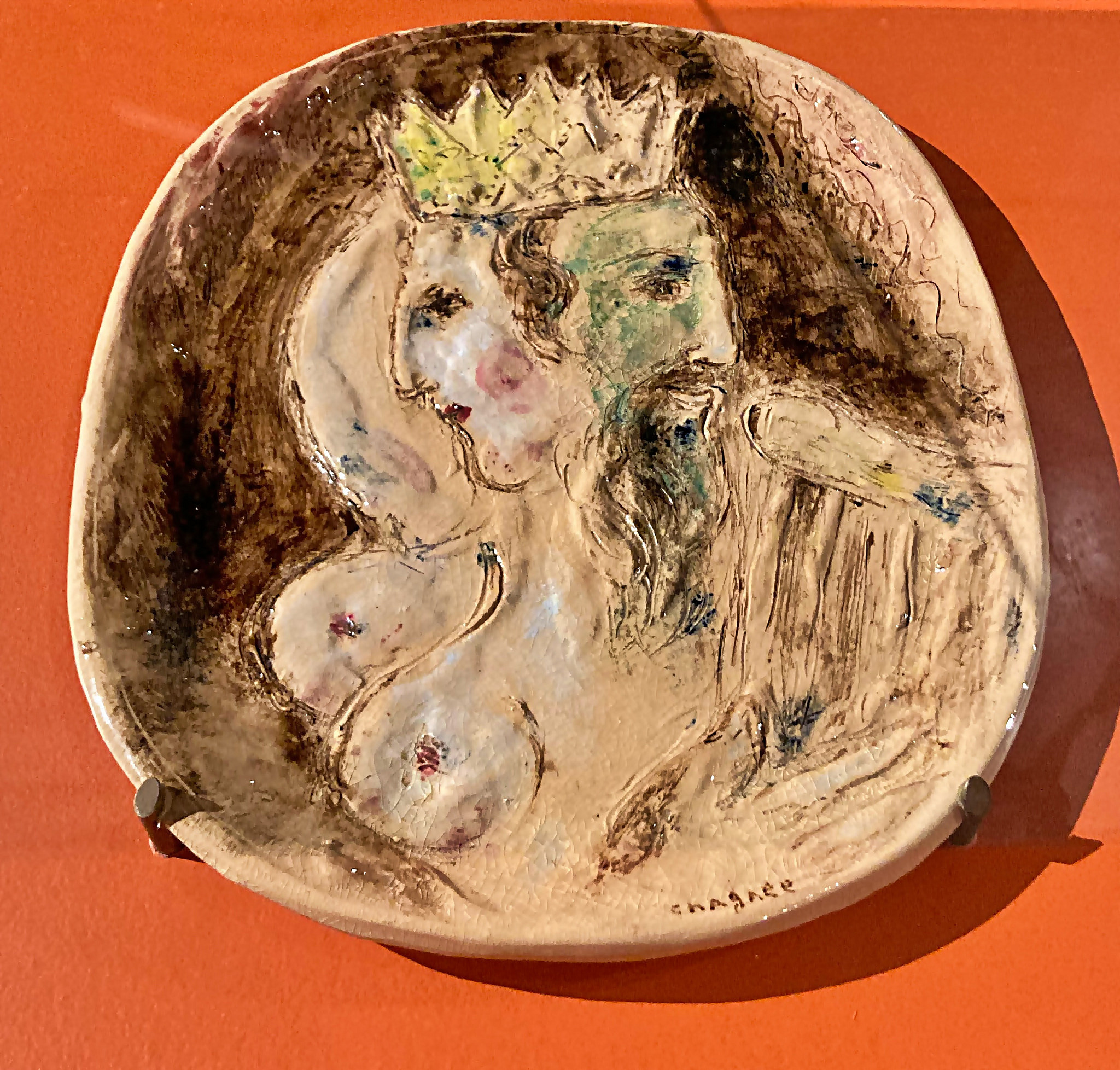
It is a surprising, refreshing and instantly appealing work of pure beauty which transpires love in every millimetre of it. Something definitely which would stay in mind and memory for a long time after the exhibition.
The world of Joy: Chagall’s Ceramics
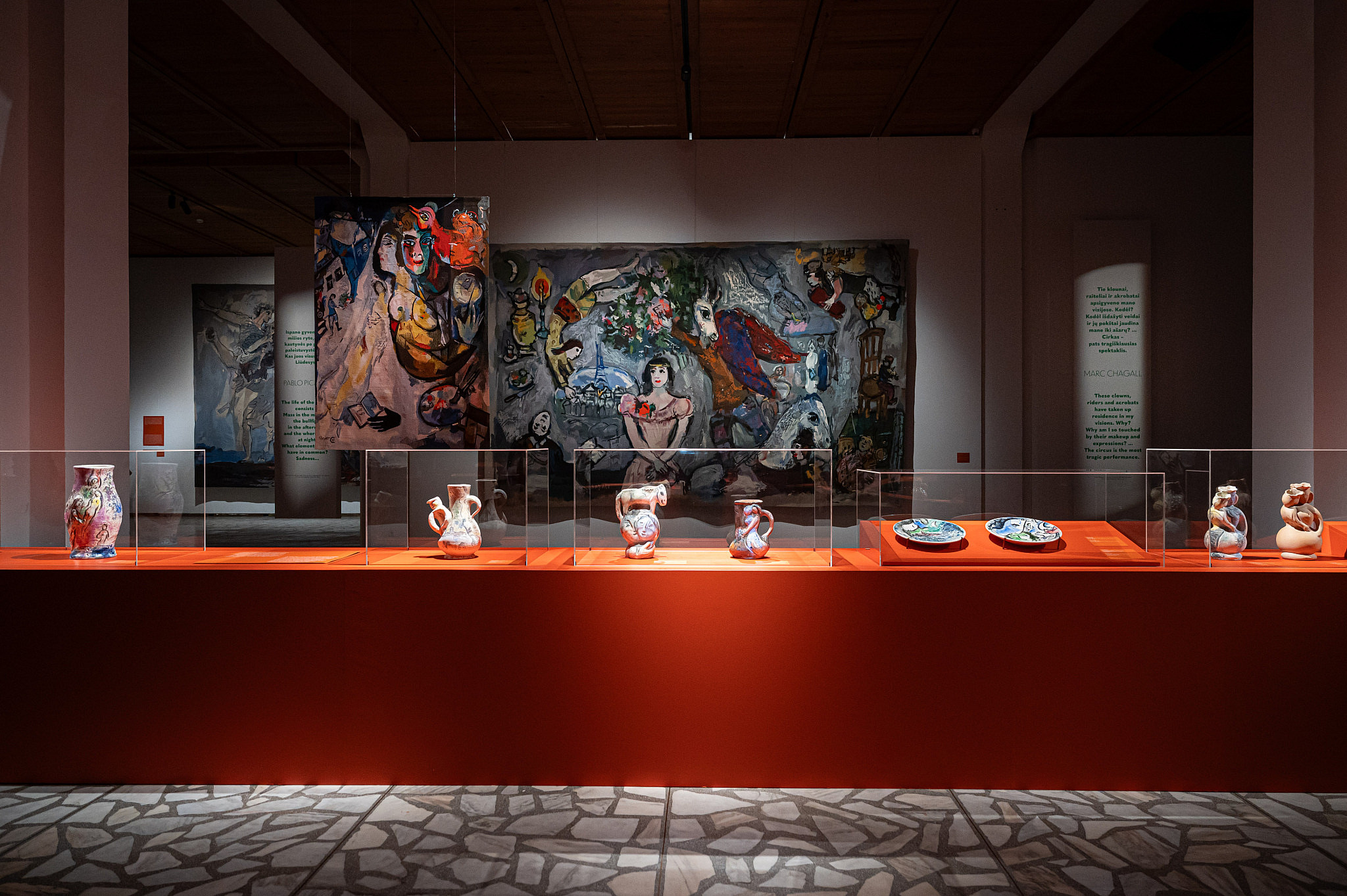
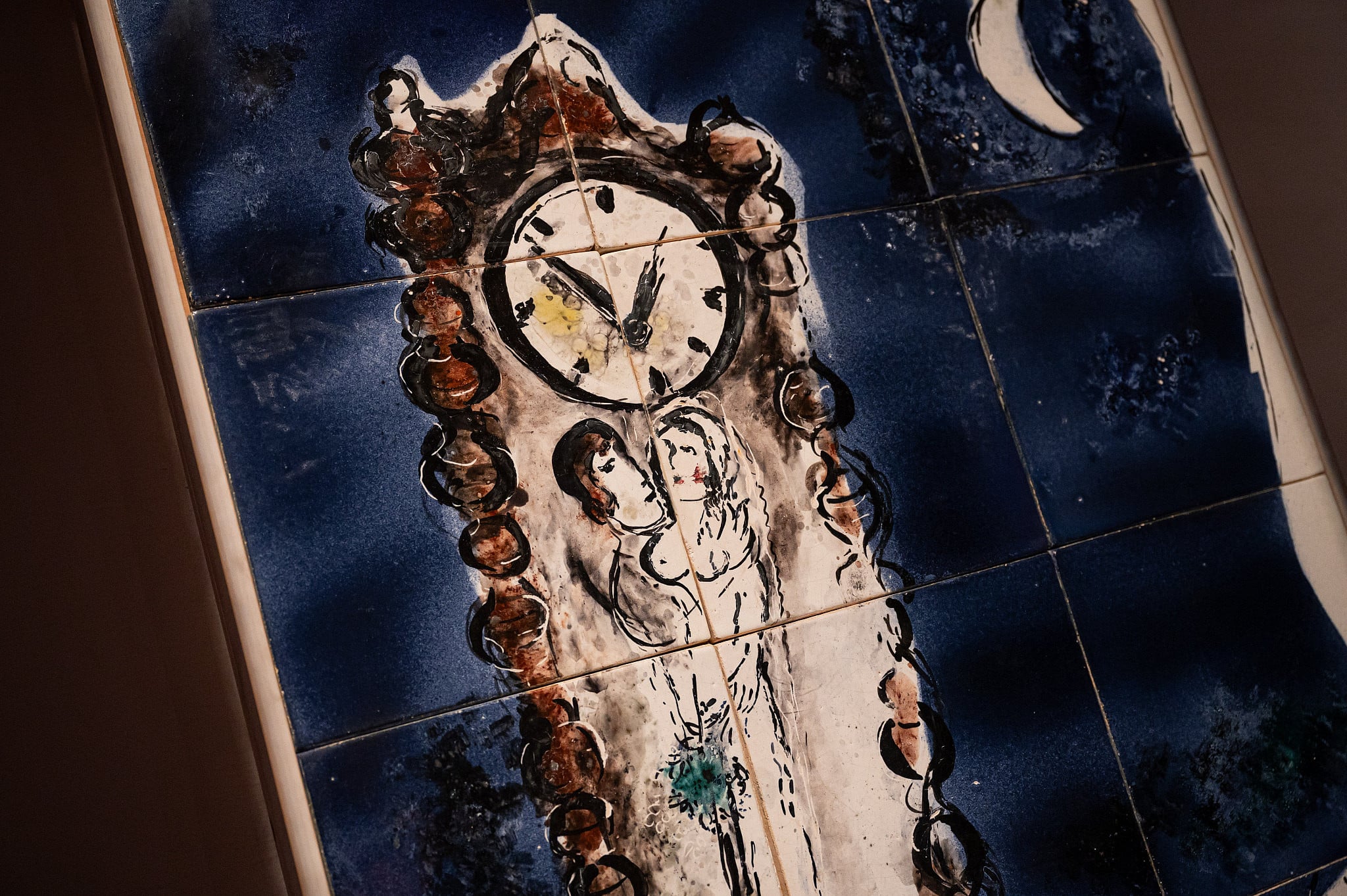
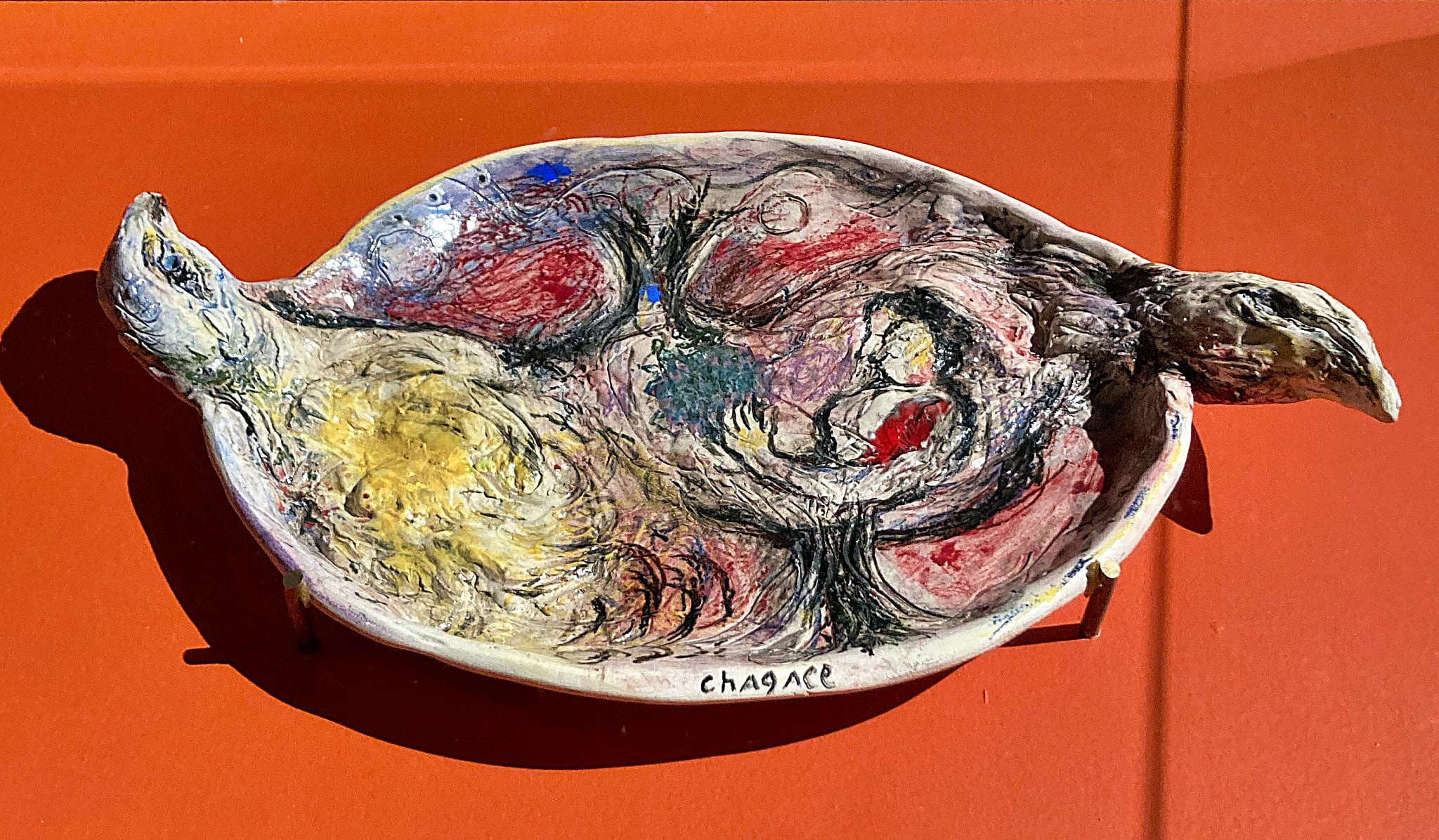
There are 24 ceramic works by Marc Chagall exhibited in Vilnius, including one large superb Lovers in the Clock ceramic art panel, 15 various delightful plates and eight inventive pitchers. It is quite a harmonious selection, representative of something like one tenth of Chagall’s works in ceramics.
The master was enthusiastic about the medium of ceramics for the decade between early- 1950s and early 1960s, in a friendly competition with neighbouring Pablo Picasso, whose one but exquisite plate portraying Don Quichotte is also exhibited in Vilnius.
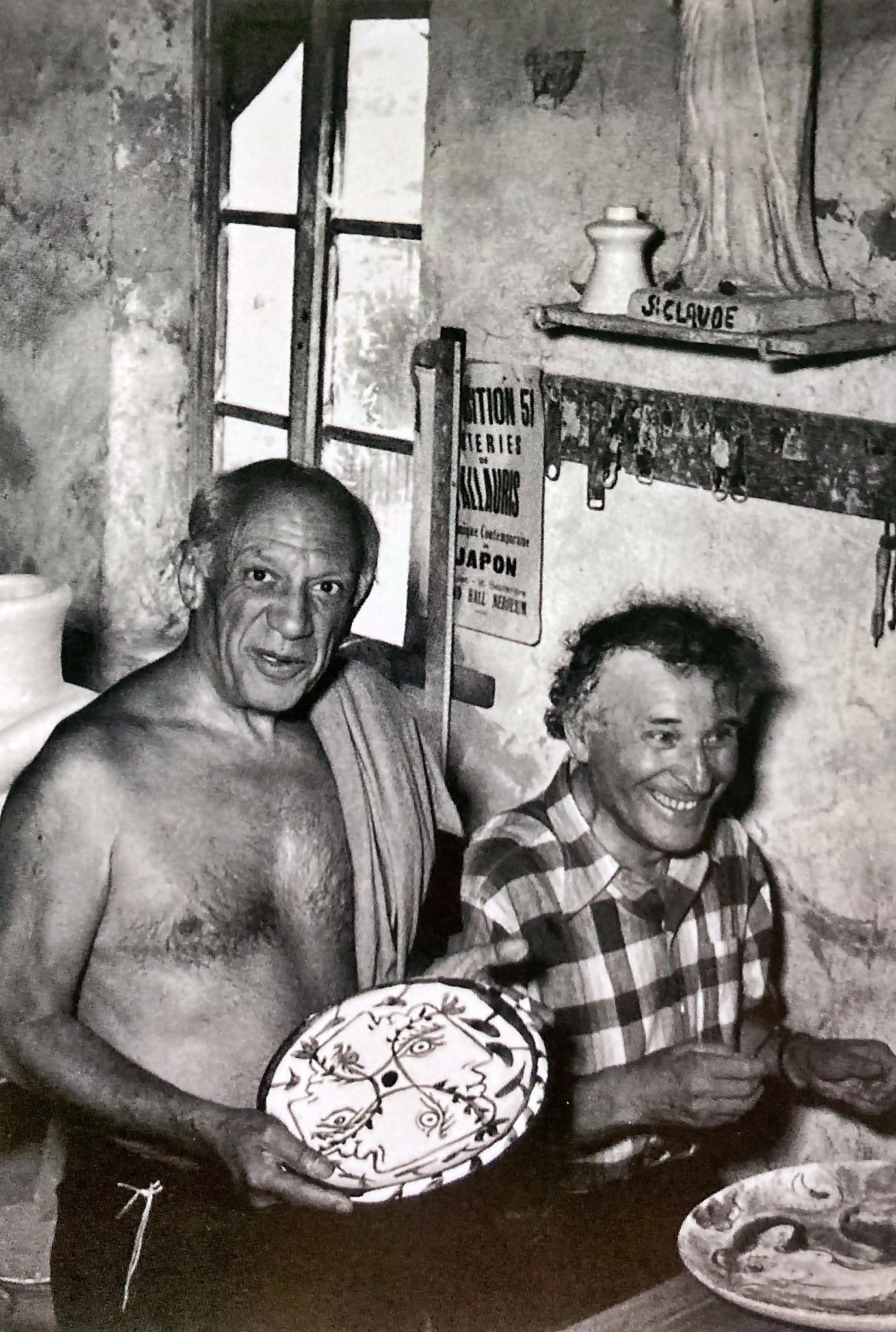
Marc Chagall was known for being genuinely interested in practically any other medium of visual arts additionally to conventional drawings and paintings, and his experience with ceramics was very successful indeed, although less known than his stained-glass windows, due to an objective reasons: the windows are of such size and visibility that it is simply impossible to oversee it.
His keen interest in ceramics resulted in over 200 various objects of art, between 220 and 250, and his interest faded in parallel with the end of his cordial relations with Picasso in 1964, after the previous fifteen years of a cordial relationship, due to Picasso’s inappropriate remarks.
In Vilnius, visitors are observing with a genuine interest Chagall’s warm and engaging works in ceramics in various qualities and forms: some people are interested in Chagall’s unusual and full of fantasy pitchers, some others enjoying his various plates in a very representative collection of them at this exhibition, in form, shapes, plots and colours. One can really see that Marc Chagall was happy and engaged while creating his various talented ceramic works.
Additionally to the described above, unique in its beauty King David and Bathsheba plate, the piece of superb art, Chagall’s Two Birds of 1961 spoke to me in particular due to its originality, masterly feeling of the material and a truly original form.
In both, the tapestry and ceramics, visitors are treated with a loving, beautiful, inventive and soulful fairy-word created by Marc Chagall in the unique way in which every single detail of that feast of memory and lovingkindness, the main concept in Judaism, underlying behaviour and various paths of life, is real and coming from real life of real people in real place and real time.
In the secret of Chagall’s artistic miracle, all these elements together, thanks to artist’s talent, infused by his Jewish heart, vision, and phenomenal artistic intuition, has transformed into an individual lullaby for everyone seeing his works, especially those of us who are lucky to see it in originals, as at the rare and truly special exhibition in Vilnius throughout the summer 2024.
Chagall – Picasso-Ernst: Tapestries and Ceramics, at the Museum of Applied Art and Design, The Lithuanian National Museum, Vilnius, April 25 – September 30, 2024.
Part I of the review of the exhibition can be read here.
Part III will conclude the mini-series of the exhibition’s review.
Vilnius
May – June 2024
Related Topics
Related Posts