Challenging Israel’s Government, Embracing Its People
Many liberal Zionist Jews around the world who love Israel are finding it increasingly difficult to identify with the country in recent months. The Israeli government’s continuation of the war in Gaza, apparently driven by political considerations, along with its ongoing efforts to weaken the judiciary, politicize key institutions, and centralize power, raise serious concerns. These developments challenge the claim that Israel remains a genuine democracy acting solely to protect its citizens. The inclusion of far-right and ultra-nationalist figures in leadership—some of whom openly call for the destruction of Gaza and make blatantly racist, misogynistic, anti-Arab, and anti-LGBTQ+ statements—further alienates even supportive Jews and casts Israel in a deeply troubling light.
Many are also outraged by what they perceive as the government’s de-prioritization of the Israeli hostages still held in Gaza. The pain of their families is often dismissed or politicized, an approach many view as morally reprehensible.
For liberal Zionists, Israel’s democratic foundations are not just a political preference -they are essential to the country’s moral legitimacy and central to its Jewish character. Watching those values erode has created a sense of alienation and shaken their confidence in the long-term viability of the Jewish democratic state.
Internationally, Israel’s standing is deteriorating. Longtime allies such as the United States, France, and Germany have voiced sharp criticism. As support weakens globally, many Jews in the Diaspora feel the pressure of dual responsibility: defending Israel’s right to exist while also upholding their commitment to democracy and human rights.
Jews outside Israel are often told they shouldn’t comment on Israeli politics because they don’t live there. But this dismisses the reality that many Diaspora Jews feel deeply invested—emotionally, financially, spiritually—and have close family ties to the country. Increasingly, they feel their legitimate concerns about democracy and human rights are labeled as disloyal, naïve, or even treasonous.
When good-faith criticism of Israeli government policy is branded antisemitic or anti-Israel, it dilutes the fight against real antisemitism and alienates those who care deeply about both Israel and Jewish values. Silencing dissent, especially in times of crisis, undermines Jewish tradition, which has always valued moral debate and ethical introspection.
Many Israeli government officials have called for national unity during wartime, urging critics to remain silent. But for many Israelis and Diaspora Jews alike, true unity means standing firmly behind the Jewish people’s right to a homeland and their right to defend it, while also reserving the right to question and challenge the government’s actions. Unity does not mean unconditional support for every policy or decision; it means holding Israel to its highest ideals, even in times of crisis.
Liberal Zionists who love Israel but strongly disagree with its current government face a painful dilemma. How can they continue to support the Jewish state that has been central to their identity and pride, while opposing policies they find indefensible?
There are three common responses to this tension:
Some choose to support Israel no matter what, avoiding criticism out of fear it could fuel antisemitism or be used by Israel’s enemies. While this approach emphasizes loyalty, it often comes at the expense of credibility, particularly among audiences who are critical of Israel but open to hearing its perspective when it is presented with honesty and moral clarity.
Others choose to disengage, avoid conversations about Israel, hide their Jewish identity, or remain silent even when criticism of Israel is unfair. This may provide short-term emotional or social relief but often leads to a loss of connection with both Israel and Jewish communal life.
A third approach separates the Israeli people, culture, and democratic ideals from the policies of the current government. It allows Jews to support Israeli civil society, stand with pro-democracy movements, and engage with Israel through shared values of justice, pluralism, and equality.
This approach of critical engagement is more complex, but also the most honest and constructive. It insists that love for Israel and critique of its government are not mutually exclusive. It allows Jews to remain emotionally and morally connected while also fighting for a better, more just Israel.
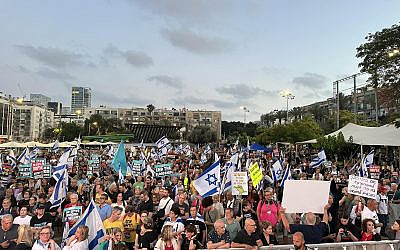
Many liberal Israelis are already living this model. They protested the government’s judicial overhaul, and when war broke out on October 7, they were among the first to step up – organizing aid convoys, housing evacuees, and manning civil aid centers. Though they resumed protesting afterward, they continued to serve in the military and maintain civic order. Their posters read: “We are not our government” and “This government does not represent us.” Their actions show that critical engagement is not a form of abandonment—it is an expression of deep commitment.
Similarly, Diaspora Jews can proudly say: “We support Israel, but not this government.” They are not abandoning Israel; they are rejecting a version of it that feels increasingly distant from the democratic and ethical values they hold dear. Their criticism is a form of love, not disloyalty.
One powerful display of this ongoing connection is participation in the World Zionist Organization (WZO) elections, now taking place globally. These elections give Diaspora Jews a rare and critical opportunity to shape the future of the Zionist movement and help allocate more than US$1 billion annually through institutions such as the Jewish Agency and Keren Kayemet LeYisrael–Jewish National Fund.
For many liberal Jews, voting in the WZO elections is a way to reaffirm their commitment to a democratic, pluralistic, and inclusive vision of Israel. This becomes more critical than ever, as they wrestle with deep concerns over Israel’s current government policies. It is a peaceful yet impactful form of civic engagement that bridges ideological divides and channels concern into constructive action.
In Canada, online voting for the WZO will run from June 5–15. Of the nine Canadian slates, only one – Hatikvah Canada – is unaffiliated with a religious denomination and advocates for a democratic, inclusive, and pluralistic Israel. Hatikvah’s platform affirms the rule of law, judicial independence, press freedom, and civil society resilience -principles that align with the majority of Canadian Jews and most Israelis.
A recent 2025 national survey of Canadian Jewish voters, conducted by Leger and commissioned by JSpaceCanada, found that 55.9% support the Israeli protest movement and oppose the government’s handling of the Gaza war and hostage crisis – more than double the percentage who oppose the protests (24%). The survey also found that 58.5% want the Canadian government to put more pressure on both Israeli and Palestinian leadership to pursue a peace process (vs. only 20.2% who oppose); and 55.9% support joint Israeli Palestinian civil society initiatives (vs. 18.8% who oppose). These findings confirm that most of Hatikvah’s core principles align with the views of the majority of Canadian Jews.
Now is not the time to retreat in despair or disengage out of frustration. It is time to double down on our values, use the tools available to us, and reaffirm our stake in Israel’s future. Voting for Hatikvah-Canada is a meaningful way to say: We believe in a better Israel, and we are committed to helping her.