CFO | Empower Society for Good I Author
Chanukah After Sydney: When Naming Evil Becomes a Moral Test
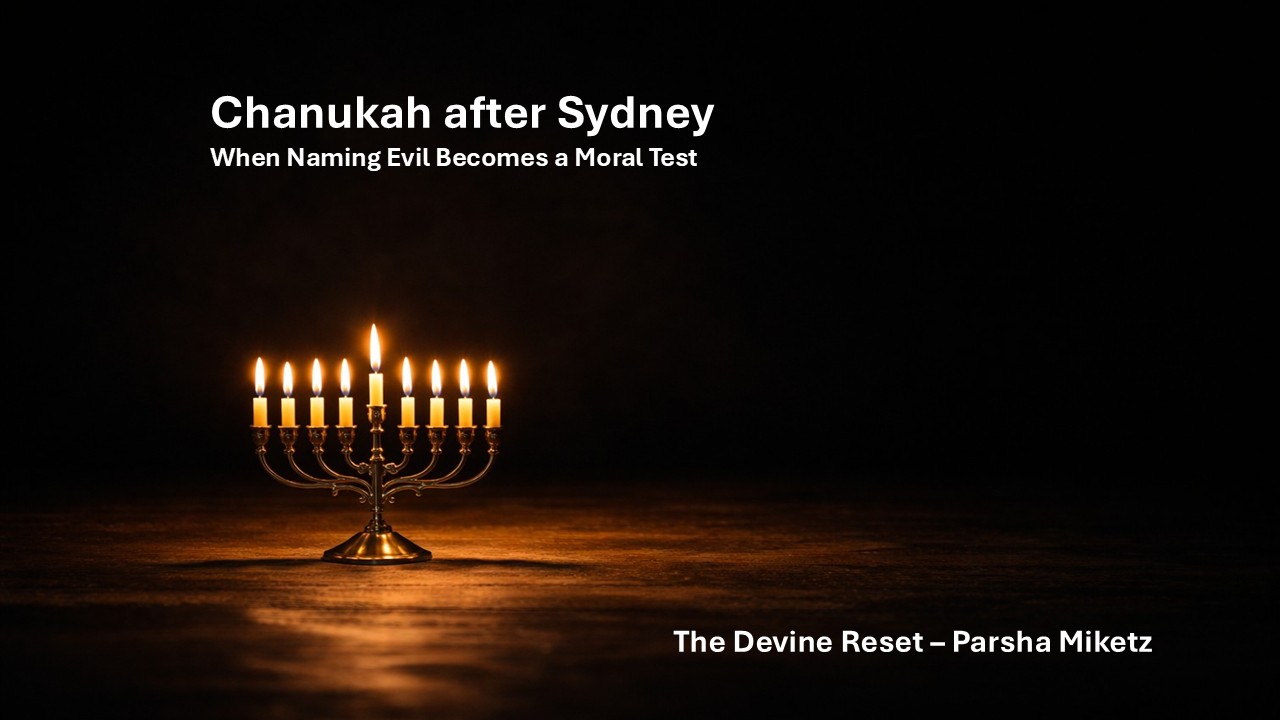
Last year, I wrote a Chanukah blog, which I decided not to publish, titled “Light in the Darkness – Chanukah Amidst Global Turmoil,” a reflection on Chanukah, current events, and the weight of living in a world shadowed by darkness yet still lit by flickers of hope.
This year feels different. I’m less hopeful.
After the murder of Jews in Sydney this week—Jews attacked while celebrating a Jewish holiday—the gringe has stolen Chanukah. Not sadness alone. Not only fear. But a deep moral recoil. A sense that something has gone fundamentally wrong, not only in the world, but also in how the world now speaks about Israel and for Jews being randomly attacked or killed for being Jewish.
Are there no safe places for Jews anymore?
My enthusiasm has dropped. I feel shaken, despondent, and unsettled. And yet, if I am honest, I should not be shocked. Not after the marches. Not after the chants. Not after watching antisemitism normalize itself under the language of justice, resistance, and human rights.
People now say: This is what ‘Globalise the Intifada’ looks like.
Jews attacked everywhere.
And still, leaders hesitate to name it. Fail to recognise the threat of radical Islam and Jihad. Come first for the Saturday people, then the Sunday people.
Lives Snuffed Out
Before ideology, before politics, before analysis, we must stop and look at the lives that were taken.
These were not symbols.
They were not proxies.
They were not combatants in anyone’s imagined struggle.
They were people trying to live Jewish lives—quietly, openly, faithfully. People celebrating Chanukah. People bringing light, meaning, and goodness into the world in the most ordinary and human way possible.
They had families, friendships, routines, futures. Their lives were snuffed out not because of something they did, but because of who they were.
That matters.
These were Jews.
They were targeted.
Their lives mattered.
A Chabad-Organised Chanukah Event in Sydney
The attack took place at a Chanukah event organised by Chabad in Sydney—a gathering created to celebrate Jewish life, faith, and continuity.
Among those murdered was the Rabbi who devoted his life to building that community. He built a beautiful Chabad House that served as a shul, a community centre, and a home for Jewish life—open, welcoming, and grounded in warmth and responsibility. His mission was simple and unwavering: to bring light, belonging, and meaning to Jews of every background.
He was killed together with fourteen others, innocent people who had come to celebrate Chanukah.
This was terror.
It was terrorism.
Not an “incident.”
Not random violence.
Not a tragic misunderstanding.
It was a deliberate act of terror directed at Jews gathering openly to celebrate their faith.
Even as investigations continue, this much is already clear: Jewish life was targeted. To say anything less is to erase both the victims and the truth.
The Crime — and the Cowardice of Language
What followed was almost as disturbing as the attack itself.
Leaders avoided the words “Jews were targeted.”
This was not accidental.
To say Jews were targeted would require moral clarity. It would force leaders to acknowledge that Jewish identity itself—not geopolitics, not policy, not context—was the motive. By avoiding the word Jews, leaders engaged in a blatant whitewashing of Jewish murder, laundering a targeted antisemitic terror attack into generalized violence.
When leaders cannot say the word Jew in the context of murder, they are not neutral. They are complicit in the erosion of truth.
ISIS and the Convenient Lie
That same pattern continued when leaders suggested the attack was “motivated by Islamic State ideology.”
This is not clarity.
It is deflection.
ISIS is a Salafi-jihadist terrorist organisation seeking a global caliphate through religious absolutism and organised terror. It is universally condemned.
But there is no evidence that ISIS planned or directed it. Maybe these Terrorists were inspired by the Muslim Brotherhood, ISIS, or Palestinianism.
Invoking ISIS is politically convenient. ISIS is safe to blame. Palestinianism is not.
Blaming ISIS allows leaders to condemn terror without confronting antisemitism embedded in movements widely portrayed as moral, progressive, and just. It avoids acknowledging that hatred of Jews has moved from the fringes into the mainstream—chanted in the streets, tolerated by institutions, and excused as political expression.
Mislabeling is not a technical error. It is a moral choice.
Palestinianism: The Great Deception
Palestinianism is not a classical national liberation movement. It is not fundamentally about borders, governance, or building a viable society. If it were, we would see sustained efforts toward institutions, justice systems, economic development, and coexistence.
We do not.
Palestinianism is an ideology whose core impulse is:
- To rewrite history
- To cast Jews as foreign colonizers
- To erase Jewish indigeneity
- To delegitimize Jewish existence itself
“From the river to the sea” is not rhetoric. It is a blueprint. It does not imagine two peoples living side by side. It imagines one people removed.
This is the real deception of our time: an ideology of negation rebranded as justice, embraced by leaders unwilling to confront the consequences of their words.
Complicity Through Legitimization
This whitewashing does not occur in isolation. It sits within a broader pattern of moral abdication.
These same leaders have allowed the marches, legitimizing chants that openly call for Jewish eradication under the guise of protest. They have rushed to recognize a Palestinian state, not as the outcome of peace, responsibility, or coexistence, but as a symbolic political gesture divorced from reality. And they have lent credibility—through silence, ambiguity, or endorsement—to the lie of “genocide,” a blood libel recycled for the modern age.
Words create moral frameworks.
When leaders validate false accusations of war crimes and genocide, they invert the victim and aggressor. Jewish self-defense becomes criminal. Jewish survival becomes something that must be explained, justified, or apologized for.
This is not neutrality.
This is complicity.
“Globalize the Intifada”: Exporting Violence
“Globalize the intifada” is not a metaphor. Historically, an intifada is a campaign of violence—stabbings, shootings, bombings, and attacks on civilians.
To globalize it is to export that terror.
It collapses the distinction between Israeli policy and Jewish identity and reframes attacks on Jews as political acts rather than antisemitic crimes.
This is why Jews are attacked and killed in Sydney, Paris, Manchester, New York and Washington, etal, not because they are political actors, but because they are Jewish.
Let’s explore two ideas from this week’s Parsha (reading) that shed light on this.
Miketz: Power Without Moral Recognition
This week’s Parasha Miketz speaks directly to this moment.
Joseph rises to power in Egypt not because Egypt undergoes a moral awakening, but because Pharaoh recognizes truth when it serves survival. Joseph interprets dreams accurately. He offers solutions. He becomes indispensable.
But Joseph is valued for his utility, not his identity.
This is a recurring Jewish pattern throughout history.
Jews are tolerated when useful.
Protected when convenient.
Abandoned when morally inconvenient.
Joseph saves Egypt from famine—yet Egypt will later enslave his descendants. Power without moral recognition proves fragile. Acceptance without truth proves temporary.
Miketz teaches that political legitimacy divorced from moral clarity is unstable. A society can admire Jewish brilliance, benefit from Jewish contribution, and still turn on Jews when the moral narrative shifts.
Joseph is inside the palace.
But the truth about Jews remains outside the moral framework.
Miketz: Blindness and Moral Suspense
Miketz deliberately leaves us in suspense.
Joseph’s brothers stand before him—their own brother, flesh of their flesh—and yet they fail to recognize him. Their blindness, whether born of guilt, fear, denial, or arrogance, prevents them from grasping the truth that is right in front of them.
In many ways, we are no different.
The story of Joseph mirrors our own struggle with perception. The signs are there. The patterns repeat themselves. And yet we hesitate, rationalize, or look away.
How will the brothers’ story play out?
And more importantly—how will ours?
It calls to mind the children’s Book – The Emperor Has No Clothes. The truth is visible, even obvious, yet everyone pretends not to see it.
That blindness has a name.
It is Palestinianism—the refusal to see Jews as a people with history, identity, and moral legitimacy.
Chanukah Was Never Just About Candles
Perhaps Parasha Miketz is read on Chanukkah for a reason.
Miketz is about survival through integration. Joseph learns to live within Egyptian society. He speaks its language, understands its culture, and rises to the highest levels of power. Yet even as he succeeds, his identity remains unresolved—unrecognized by his own brothers and only conditionally accepted by those around him.
Chanukah, by contrast, is about what happens when integration crosses the line into erasure.
As Rabbi Jonathan Sacks reminds us, the miracle of oil does not appear in the book Maccabees. The original Chanukah story is not primarily about candles; it is about a physical and spiritual war against forced assimilation and religious eradication.
The Greeks did not initially seek to kill Jews. They sought something more insidious: to erase Judaism. Jews could live—so long as Judaism did not. Jewish identity could survive as culture, philosophy, or ethnicity, but not as covenant, commandment, or sacred difference.
Rabbi Sacks explains that Chanukah was a reaction to the Hellenistic cultural assault on Jewish worship. Greek civilization prized universality, aesthetics, and human reason. Judaism insisted on particularity, holiness, and obedience to a higher moral law. The clash was not accidental—it was inevitable.
That is why the Sages later emphasized the miracle of the oil. The oil symbolized more than survival. It represented the inner light of Jewish faith, the refusal to surrender religious distinctiveness, and the right to live differently in a world that demanded conformity.
In Jerusalem, the struggle was about religious freedom—the freedom to worship in the Temple, to live by Jewish law, and to maintain a covenantal way of life.
That clash is not ancient history.
It is happening again—now.
Today, Jews are once more told that they may exist, but only on certain terms. Judaism is tolerated when it is private, symbolic, or stripped of meaning. Jewish identity is acceptable when detached from peoplehood, land, and responsibility. Jewish sovereignty is framed as an offense. Jewish distinctiveness is treated as a moral problem.
And when Jews refuse to erase themselves—when they gather openly, worship publicly, or affirm their connection to Israel—the response is no longer debate, but hostility.
That is why what happened in Sydney matters so deeply.
Jews were not targeted because of a policy, a border, or a political stance. They were targeted because Judaism is inseparable from Jewish identity, community, peoplehood, and the historic connection to Israel and Zionism. The attack was directed not only at individuals, but at Judaism itself—at the right of Jews to live their faith openly and without apology.
Chanukah, therefore, is not only about the Temple of the past. It is about the right to build Jewish life in the present—shuls, communities, learning, ritual, and faith lived confidently in the public square. It is about the right of a sovereign Israel in its greater ancestral homeland, in peace with itself and its neighbours.
The threat Chanukah confronted has returned.
It has been modernized.
It has been globalized.
And it has been morally inverted.
Today, ideologies that claim to speak in the name of justice demand Jewish erasure. Israel Judenrein. Movements that claim moral superiority excuse violence, terror against Jews. And societies that pride themselves on tolerance struggle to tolerate Jews.
Chanukah reminds us that the battle was never just about oil or candles.
It was—and remains—about resisting assimilation and about defending the right of the Jewish people to live their faith. To live freely in their Land.
Ideas sourced from: Rabbi Sacks on Chanukah
https://www.youtube.com/watch?v=UwMdq0RU8uk&t=618s
Lighting Candles Without Illusion
So where is Chanukah now?
Chanukah does not promise that darkness disappears.
It teaches us that light is lit anyway.
Even when the gringe remains.
Even when leaders fail.
Even when the cost is high.
That is not naïve optimism.
That is Jewish defiance.
Related Topics