Chanukah in a Time of Darkness: Choosing Light After Australia
As we celebrate Chanukah, a cloud hangs over us.
The recent terror attack in Australia has shaken the Jewish world, casting a shadow over a season meant for joy. Yet Chanukah was never meant to deny darkness. It was meant to confront it—with light, with mitzvot, and with moral clarity.
That was the focus at Chabad of White Plains this Chanukah: bringing the community together to celebrate, to honor those who have fallen, and to insist—publicly and unapologetically—that Jewish light will not be extinguished.
Photo Courtesy: Aaron Herman
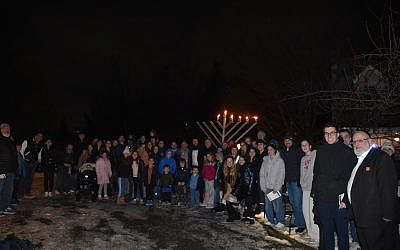
Why the Menorah Was Never Meant to Stay Inside
Rabbi Zalmy Plotke, Rabbi of Chabad of White Plains, reminded the community that public Chanukah lightings are a relatively recent—but intentional—development.
“Years ago, the Chanukah menorah stayed inside the home,” he explained.
“It was a private mitzvah, shared with family and maybe close friends—but not beyond that.”
That changed with a bold reframing.
“The Rebbe saw the menorah as an opportunity,” Rabbi Plotke said.
“The entire idea of Chanukah is to bring light into the world. The Jewish people’s mission is to be a light unto the nations—and the menorah symbolizes that mission. Why keep it to ourselves? Why not spread it to the world?”
Public menorah lightings were born—not as spectacle, but as purpose.
Light That Multiplies
“Fire represents the neshama—the soul,” Rabbi Plotke said.
“It flickers upward toward Hashem. And when that soul is ignited, it expands. It brings more light, and more light, and more light.”
Photo Courtesy: Aaron Herman
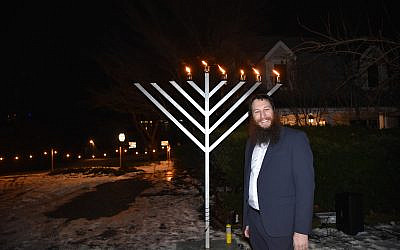
“Something unique about fire is that when one flame gives to another, it doesn’t lose anything. It remains just as strong. And when two flames come together, they become even bigger. That is Chanukah—and that is the Jewish response to tragedy.”
“When someone tries to blow out a Jewish flame,” he added,
“the response is not retreat. The response is to make the flame stronger than before. Jews are fiery on the inside. We just need to let that fire out.”
Igniting the Soul
Rabbi Alter Shmuel Greenberg of Young Israel of White Plains focused inward.
“The essence of the lights of Chanukah is that ‘the candle of Hashem is the soul of man,’” he said.
“When we light the candles, we are igniting the light of our own souls. Once that light is lit, we are empowered to do the work of Hashem—bringing light into the world.”
History, he reminded us, bears this truth out:
“After all these years, after all these tragedies—we are still here. And we are still growing stronger.”
Remembering the Fallen
The joy of Chanukah does not erase grief.
“Fifteen people were murdered,” Rabbi Greenberg said quietly.
“They leave behind parents, siblings, loved ones, families. It is an unimaginable void.”
He shared the story of Rabbi Eli, who was killed while acting as a human shield to save another person. Weeks earlier, he had taken his nieces to lunch—not just to treat them, but to learn how to be a better father.
“That’s the kind of person he was,” Rabbi Greenberg said.
Choosing to Show Up
Rabbi Greenberg quoted the Lubavitcher Rebbe:
“When tragedy strikes, a Jew doesn’t ask, ‘Why did this happen?’ We ask, ‘What do we do about it?’”
The answer was clear:
“We don’t fight hate with hate. We fight hate with light.”
Before the menorah was lit, the community paused in prayer—for the injured, for the families, and for the holy souls taken simply for being Jewish. Then the flames were lit. More light was added to the world.
Light Is the Answer
Rabbi Zalmy Plotke returned to the core idea: Chanukah is actionable.
“Chanukah is about bringing light into the world—real light,” he said.
“Not hiding. Not retreating. Not waiting for things to feel safe. When darkness shows itself openly, light has to show itself openly too.”
“A Jew does not respond to darkness by becoming smaller. We respond by becoming brighter.”
“Light isn’t just something you see—it’s something you do. Every mitzvah is another candle. Every act of goodness adds another flame. You can’t argue with light. You can’t shout it down. All you can do is add more of it.”
Rabbi Greenberg echoed the charge:
“A Jew does not ask, ‘Why did this happen?’ We ask, ‘What do we do now?’ The answer is unwavering: we fight hate with light.”
The Final Word
Chanukah does not promise the absence of darkness. It demands a response.
As Rabbi Zalmy Plotke put it:
“If there is darkness, it means there is work to do. And the work of a Jew is always the same—add light.”
That is how Chanukah was marked in White Plains.
With candles.
With community.
With mitzvot.
With memory.
And with an unshakable declaration to the world: the light is not going anywhere.