
POST-HARMONY Special Project
Chapeau to France: Farewell to Charles Aznavour
All my life I am wondering: why on earth we are always belated in expressing our appreciation to outstanding people? Why it is almost always posthumous? Charles Krauthaummer tried to change this insensitive habit of our society by announcing publicly on his imminent passing a week before it had happened. But it did not change the existing way of handling saying goodbye. Nobody dared to talk about a person who was still living in the way we are used to pour our memories and appreciation to those who had left us. After the failed last Charles’s experiment – I knew him and understood what he was up to – I actually had been reversing my life-long conviction that we are usually doing it wrong saying our goodbye to the person who cannot hear it. I started to seeing it in a slightly different way. As it happened, in the case of Krauthammer recently, it is just impossible to say goodbye to a living person – it is merciless, said my husband, and I do agree with him.
But there are different ways to say goodbye as we know it. There is a senseless it its vanity way of massive and forced artificial mourning as it was the case with late Senator McCain; and it is exquisite in its sensitivity and tact farewell to Charles Aznavour on the first weekend of October 2018.
Following the family’s request, France refrained from a pompous ceremony, but every detail, every step and every sigh of the country’s farewell to Aznavour on October 5th, 2018 was exquisite. It was modest and elegant; it was attentive and tactful; it was dignified and loving. And it was unique in the France’s state recognition of the Armenian essence and belonging of its most cordial chansonnier.

The huge inner court of Les Invalides was almost empty. Two hundreds people inside, the Aznavour’s family, the French government and some dignitaries, the close friends and colleagues like Jean-Paul Belmondo, the representatives of the diplomatic corps did emphasised anti-pompous character of the ceremony called Hommage National a Charles Aznavour. Just one Aznavour’s reward was on display from so very many that he had earned for his long life of 94 years and his extra-ordinary career of 72 of them.
Some 500 members of public were allowed to the ceremony on the first-come basis. But anyone could follow it from a giant screens on the outside side of Les Invalides, and from a live broadcasts. What a normal, not abusive, respectful way of the most difficult from our ceremonies.
Just two speeches, of the Prime Minister of Armenia and President Macron. “ In France, poet does not die” – said Macron in the end of his speech. I forgot that this France that we used to love and admire, and to be nourished by its multi-sided culture, existed.
Throughout the ceremony I was thinking that every detail that we were seeing it was something that we did not see in France for quite a long time. That tact, that fine way of everything, that love expressed deeply and sincerely.
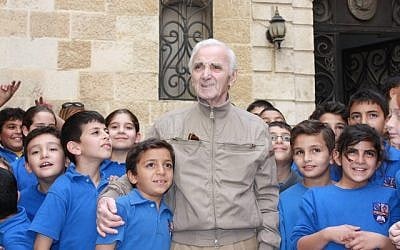
- Charles Aznavour visiting Armenian Patriarchy in Jerusalem during his visit to Israel in 2017.
The measure of the recognition of the Armenian essence of Charles Aznavour in his country’s farewell to him was dignified in a full measure. His coffin draped in the French national tricolour made of rich textile, had been carried on to the farewell ceremony by the French National Guard accompanied by a melancholic melody of Dle Yaman played on duduk, Armenian national instrument close to clarinet. Just one instrument. But the melody itself was essentially indicative. Dle Yaman is the most important Armenian national song of mourning; it had been created after the Turkish genocide against Armenians in early XX century. From my Armenian friends, I know that Dle Yaman is regarded as both most beloved and most important national melody by the Armenian people. To play it to accompany the Charles Aznavour’s coffin into the still court of Les Invalides in Paris was exceptional.
But how exceptional beautiful, simply unforgettable, was another song performed at the ceremony by just three soloists of the French Republican Guard orchestra. That piano, violin and voice rendition of Armenian Waltz was just extraordinary expression of love. Sung in Armenian by the French soloist, the song reflected the feelings of all people, in France, Armenia and everywhere else who loved Aznavour for so many years. Not those, of course, who came there to pose smiling and laughing and showing themselves, as the Sarkozy-Bruni couple together with Hollande did. But there are always something like that , and actually it is good that the world saw and noticed it.
Armenian Waltz, a song authored by the well-known French-Armenian band Bratsch in mid-1990s, is the one of the best compositions of the musicians. But in none of many of their own renditions they did not come anywhere close to that extraordinary performance-by-heart that the three French musicians from the Republican Guard Orchestra did. They did it to Charles Aznavour directly, and it had been felt at any second of their saying goodbye from all of us.
The link to that most beautiful performance is here
As it happened, people in Armenia did not know much about that beautiful song before the ceremony. Now, all Armenia is singing and listening to that melody of love. Melody of ongoing love to the man who infused love, in so many of its ways and forms, during so many years into so many of us.
It was France of its best at the solemn, but so very enlightened farewell to the man who was the pride of the French culture and whom France did recognise in a full measure for who Aznavour was: devoted Armenian.
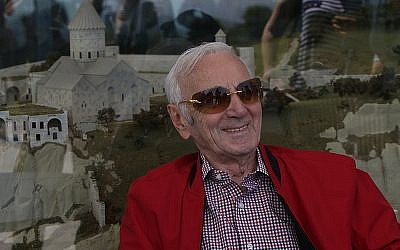
- Charles Aznavour during his recent visit to Armenia. (C) Armenian News Agency.
Chapeau to France for such understanding and such way of expressing it. Farewell to a great singer was in fact unique moment of Humanism. With a big H.
October 2018
Related Topics
Related Posts