
Charlie Kirk’s Murder: Democracy’s Test Is Law—Not Mob Blame
Charlie Kirk’s murder has sparked a storm of reaction. Some say he didn’t deserve empathy because of his rhetoric. Others are rushing to pin the blame on Democrats, or “the left” as a whole. Both reactions miss the real point: what safeguards democracy is not empathy, and it is not blame. It is tolerance and a commitment to law over vengeance.
Empathy is Optional, Tolerance is Not
British-Iranian human rights lawyer Elica LeBon put it bluntly:
“Every time I speak about these killings—such as the healthcare CEO Brian Thompson and now Charlie Kirk—I always get the same response, ‘why should I have empathy for such and such a person?’ I’ve realized that people are asking the wrong question.
The question is not why you should have empathy. The question is why you should have tolerance… What safeguards democracy is not empathy, but tolerance. … Once the killing matrix is opened, it is open to all. Under the laws of street justice, everybody is fair game.” — Elica LeBon
Empathy comes and goes, she says. We naturally feel it for people we relate to, but struggle to extend it across divides. Tolerance, however, is the baseline — the line that says we do not kill or silence each other for disagreement. That line is the foundation of democracy itself.
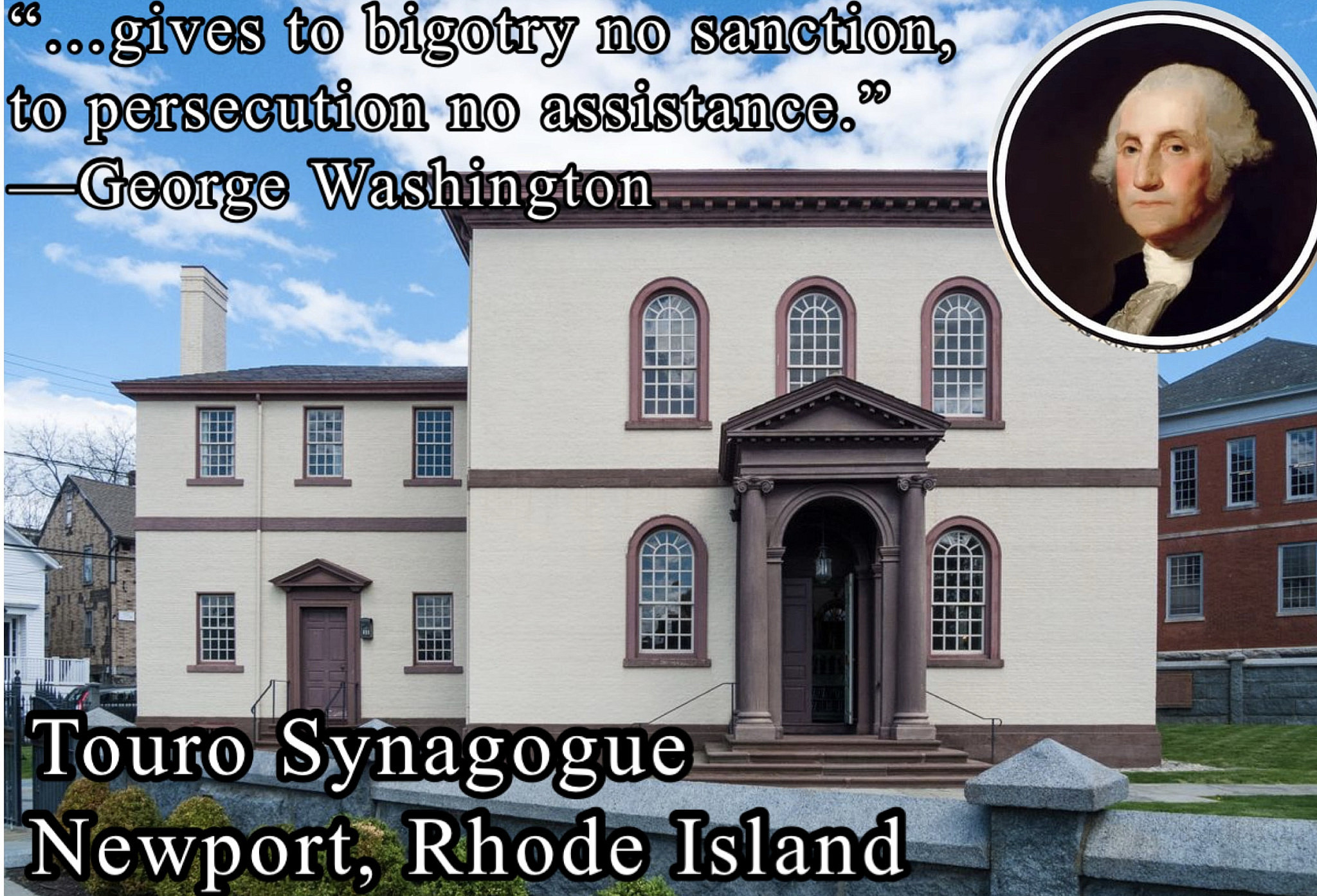
Washington’s Promise at Newport
The Founders understood this. George Washington made the promise not in theory but in person — in his 1790 letter to the Hebrew Congregation at Newport’s Touro Synagogue:
“The Government of the United States… gives to bigotry no sanction, to persecution no assistance. … Everyone shall sit in safety under his own vine and fig tree, and there shall be none to make him afraid.” — George Washington
Washington didn’t demand love or empathy. He demanded safety, rooted in tolerance.
The Danger of Scapegoating
The other temptation now is to scapegoat. Already, people are pointing fingers at Democrats — or entire swaths of the political left. That is not justice; it’s a shortcut to chaos. Scripture gives a timeless reminder:
“For there is not a righteous man upon earth, that does good, and sins not.” (Ecclesiastes 7:20)
No party, no movement, no person is without fault. To turn one individual’s crime into the guilt of an entire group is hypocrisy, not justice.
Law Over Vengeance
This was understood by the Founders as well. John Adams warned that America must never let passion overrule principle:
“We are a government of laws, not of men.” — John Adams
Adams’ warning is as relevant now as it was in 1774:
• Justice can’t be built on mob passion.
• No one is above the law, but no group should be condemned outside it.
• Democracy survives only when the law, not vengeance, has the final word.
And, Benjamin Franklin captured it best when he said truth must be tested openly, not by silencing or scapegoating:
“When men clash in opinion, both sides ought equally to have the advantage of being heard by the public; and when truth and error have fair play, the former is always an overmatch for the latter.” — Benjamin Franklin
The Real Test of Democracy
No one is asking you not to be angry. No one is asking you not to grieve. Those responses are human. But grief must not harden into collective blame. Anger must not mutate into scapegoating.
Lincoln’s murder didn’t make every Southerner a killer. JFK’s assassination wasn’t the fault of every political opponent. To abandon restraint now is to unravel justice itself.
Charlie Kirk’s death is an absolute tragedy. But, the greater tragedy would be if we abandon the very values that safeguard democracy in its aftermath.
Tolerance over hate.
Accountability over scapegoating.
Law over vengeance.
That is the test before us.
—————————-
Sources
Elica LeBon, British-Iranian Human Rights Lawyer. Quotation on empathy vs. tolerance, September 2025.
The Holy Scriptures: Ecclesiastes 7:20.
George Washington, Letter to the Hebrew Congregation of Newport (Touro Synagogue), August 18, 1790. National Archives.
John Adams, Novanglus Essays (1774); later enshrined in the Massachusetts Constitution, 1780.
Benjamin Franklin, Apology for Printers (1731), defending the right of open clashes in opinion.