
This Way Up: Spiritual Means to Psychological Ends
‘Check Mate’: Chess, Judaism, and Chinese Wisdom on Masculine and Feminine
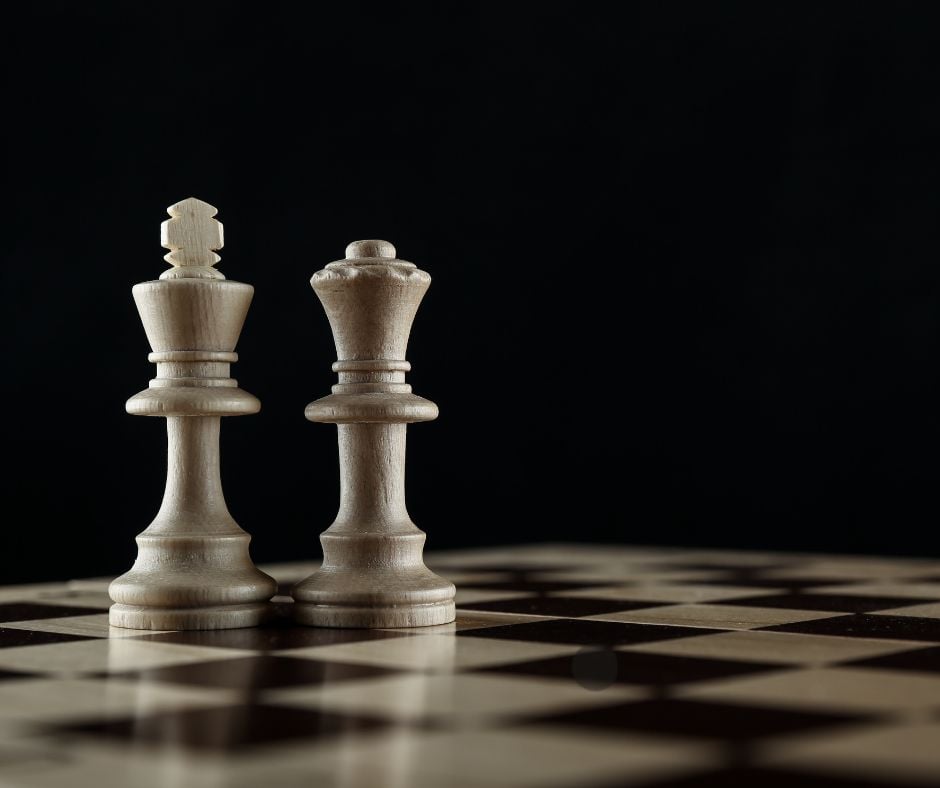
Image courtesy of Canva.com
In both Jewish and Chinese traditions, the concept of polarity—Heaven and Earth, masculine and feminine, giver and receiver—is central to understanding the fabric of reality. While modern culture often debates gender roles as social constructs, these ancient systems assert that masculinity and femininity are spiritual energies, each with distinct qualities, both essential and requiring balance. Importantly, these dynamics play out not only between men and women but also within each person, as the conscious and unconscious selves engage in a dance of polarity.
Yin and Yang, Zachar and Nekeva
In Traditional Chinese Medicine (TCM), Yang is associated with Heaven: upward-moving, active, assertive, and expansive—the spark, the initiator, the energizer. Yin, by contrast, is the energy of Earth: receptive, grounding, nourishing, and containing. When these forces harmonize, life flourishes. When they compete or become estranged, imbalance and disintegration follow.
Judaism echoes this principle. Masculinity (zachar) implies memory, projection, and directionality. Femininity (nekevah) implies receptivity, form, and containment. Their union is not merely biological, it is cosmic. Genesis portrays creation as a series of divisions: light and dark, land and sea, man and woman. But creation’s goal is not division; it is reunion. Ideally, the masculine turns back to the feminine.
After the first transgression in Eden, a pivotal moment occurs: Adam names Eve, and then names himself. The sages interpret this to mean that a man comes to know himself by knowing the feminine. Psychologically, the conscious self (masculine) encounters the unconscious (feminine), and only through this meeting does self-knowledge transpire. Notably, after this moment, the Creator softens, providing garments for the couple. The message: when the masculine engages the feminine, they are met with grace, and they are both now better equipped to move forward.
Biology and Resistance: Why We Struggle to Yield
Yet there are barriers to the attainment of this inner and outer harmony. Pride resists influence, and this resistance shows up both biologically and psychologically.
Biologically, we see it most vividly in male development. In utero, a surge of androgens is required to override what would otherwise become a female anatomy under the sway of maternal estrogens. As writer Sukie Colegrave observes, “male development can be seen as an ongoing struggle for independence from the influence of the feminine.” Even post-differentiation, male embryos continue to resist estrogen, while females are readily masculinized by even minor androgen exposure. This is one way biology dramatizes a resistance to yielding.
Psychologically, however, the same drama is universal. What biology reveals in male development, every ego experiences: the pride that resists correction, the drive to be autonomous, the reluctance to yield to another’s influence—whether that other is a partner, a mentor, or the unconscious depths of one’s own being.
To elevate the feminine, then, is to move against this instinct. But that is precisely what spiritual traditions demand: to rise above nature in the service of higher order.
The Crown Above: A Poetic Ideal
One of the most poetic expressions of this principle is found in Proverbs 12:4: “A woman of valor is the crown of her husband.”
This is more than metaphor. A crown sits above the head, symbolizing reverence, honor, and moral authority. Psychologically, it suggests that a man must not only love his wife—he must allow himself to be shaped by her. To make one’s wife a crown is to place her insight, presence, and wisdom in a position of leadership within the relationship.
Modern research affirms this ancient view. At the University of Washington’s “Love Lab,” psychologist John Gottman and his team studied thousands of couples over decades to understand what made marriages last. A striking finding: men in stable, happy marriages consistently accept influence from their wives as in, “I do what my wife tells me to do.”
In The Seven Principles for Making Marriage Work, Gottman notes that in 81% of marriages that ultimately failed, the husband had refused his wife’s influence. Resistance to shared authority and emotional responsiveness was a key predictor of breakdown.
In this light, Proverbs was offering not just poetry, but prophecy: a wise man makes his wife his crown. Yet this principle transcends marriage. The polarity of masculine and feminine also unfolds in the psyche itself: the active, conscious self must learn to yield to the receptive depths of the unconscious. Whether in relationship or within, wisdom comes when masculine energy honors its feminine counterpart.
Chess as a Living Parable
Even the game of chess encodes this wisdom. Archetypically, we might expect the masculine to wield the greatest powers of movement and scope. Yet chess reverses the script: the King is limited to a single step, while the Queen commands extraordinary reach—moving freely in every direction.
This inversion is not weakness but rectification. The King’s restraint empowers the Queen. Masculinity steps back from total dominance and, in so doing, crowns the feminine. She, then, devotes herself to the cause of the King.
Chess thus becomes a parable of sacred polarity: when masculinity willingly limits itself to empower the feminine, both are elevated. The King’s survival depends on her strength; her brilliance depends on his centrality. The game embodies the desired state that Jewish and Chinese wisdom alike envision—true balance, born of mutual empowerment.¹
The Cost of Resistance: Spiritual and Social
Both Jewish and Chinese wisdom affirm that masculinity must be tempered and channeled to become whole. In fact, there is research which supports this injunction.
In his influential book Men and Marriage (1986), social theorist George Gilder analyzed criminological data and found a consistent pattern: the demographic group most strongly associated with criminality is single men.
Gilder argued that, left untethered from relational commitment, men often lack the internal structures that promote responsibility, community, and direction. Marriage, he proposed, civilizes men. It invites them to accept limits, contribute beyond themselves, and temper destructive impulses. Without this structure, Yang becomes volatile, energetic but unanchored.
Gottman’s research reinforces this. The male capacity to accept influence is not only central to marital happiness, it’s a cornerstone of psychological maturity.
Back to the chessboard: a King without his Queen is weak, easily cornered, vulnerable. He cannot thrive without her empowerment. Some might associate to research: Living alone is a risk factor for mortality in men but not women from the general population: a prospective cohort study. The lesson is clear: resistance to the feminine spells fragility.
Jewish law subtly represents this idea. It is the man—not the woman—who is obligated to marry. This legal structure points to a deeper metaphysical truth: it is specifically the masculine that must actively seek containment, correction, and relationship as a path to refinement.
The Wisdom of Balance
In Chinese philosophy, the Doctrine of the Mean expresses this harmony. Song dynasty scholar Zhu Xi writes: “It is only when yin and yang are harmonized that a man has the qualities of the Mean and correctness and becomes a Sage.”
A man who resists the feminine—whether in marriage, society, or within his own psyche—remains inflated, erratic, and spiritually unrooted. A man who welcomes that influence becomes whole. Or in the language of the chessboard: the King who yields scope to the Queen makes for a better game!
Integration, Not Abdication
None of this implies that masculinity is wrong, or that men must shrink themselves. Rather, these ancient teachings insist that power without partnership is distortion. Yang without Yin is chaos.
One modern voice echoing this idea is Dennis Prager, who argues that one of the Bible’s primary aims is to civilize men. In his Rational Bible series and lectures, Prager contends that males are born with a stronger drive toward aggression, sexual impulsivity, and dominance-seeking. If left unchecked, these impulses can destabilize society.
According to Prager, the Bible provides a moral framework that teaches boys to channel their energies constructively: to protect the weak, build families, honor commitments, and pursue justice. “The male has to be taught how to be a good man,” he says. “The female has to be taught how to be a good woman. But the gap between male nature and good man is far greater than the gap between female nature and good woman.”
In this light, to make one’s wife a crown is not weakness; it is wisdom. Chess reminds us: when the King moves slowly, the Queen’s brilliance fills the board. Masculinity finds wholeness not in grasping power, but in sharing it.
Ancient Wisdom for Modern Times
In an era where many struggle to build enduring relationships, these ancient traditions offer practical guidance. Both Judaism and Chinese philosophy teach that relationships are arenas for transformation.
By returning to these teachings, we may rediscover tools to repair the imbalances that pervade modern society. Untamed Yang may, otherwise, never find its way to truths that run counter to its instinct. Masculinity is not inherently toxic, but when unmoored, it can become dangerous. The remedy is the grounded presence of the feminine—whether romantic, maternal, or symbolic.
The lesson of the chessboard is clear, and consistent with at least two systems of ancient wisdom: harmony arrives when the King yields to the Queen. The question for men — indeed for all of us — is whether we can “check” how we are doing with our “mate,” whether that mate is our partner in life or the Yin dimension within. In both cases, the feminine must lead. And when it does, the union bears fruit in a myriad of ways.
¹ Historically, the modern Queen’s sweeping powers of movement in chess only emerged in late medieval Europe, when the older “vizier” piece, conceived as masculine, was transformed into the Queen. Scholars often connect this shift with cultural reverence for powerful queens such as Isabella of Castile, along with widespread devotion to the Virgin Mary. While not originally Jewish or Chinese, the symbolism that resulted still provides a striking parable of empowered femininity and restrained masculinity.
Related Topics
Related Posts