Chevrutah
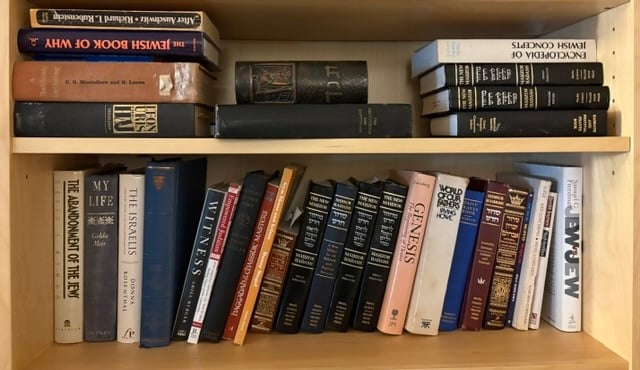

For the last four years, Roger, Mark, and I have been meeting at 9:00 am on Friday mornings for our chevrutah learning. Our shared study has sought to find meaning in an array of texts.
Learning is not an exact word for chevrutah. It is not learning in the sense of mastering a subject like history or biology. Rather, it is a shared effort to plumb text for meaning—more specifically, the meaning that the text offers to our lives. What do these words say to me? How do they frame, shape, or alter my thinking, my values, and my life?
After each of us had experienced losses in our families, we began our journey of learning with the Book of Job. After a year, we moved on to Kohelet – Ecclesiastes and then Shir Shirim – Song of Songs. Expanding the reach of our studies, we explored the Akedah, the Binding of Isaac, through the remarkable writing of Avivah Zornberg in The Murmuring Deep. We then delved into the poetry of Yehuda Amichai. Now we are studying the Book of Hebrews from the New Testament. While this choice may seem odd, it is important to note that while Mark and I are Jewish, and Mark is a rabbi, Roger is a Methodist minister. These two religious thinkers and leaders have shared with me their great gifts of wisdom and thoughtfulness.
I am pleased to share the first in a series of reflections on our shared learning – our Chevrutah.
These Unknowables
3.1415926535897932384626433832795028841971693993751058209749445923078164062862089986280348253421170679
As a mathematical constant defining the ratio between the circumference of a circle and its diameter, Pi will always be an approximation. Advanced computing has calculated Pi to trillions of digits. As the power of computers continues to advance through Moore’s law, the number of digits calculated for Pi will also grow exponentially. But the approximation will always remain.
Similarly, although advances in natural and physical science will continue to grow, the gap between the knowable and the unknowable will always remain. We will never cross the River Styx and return.
For many, this gap is filled by God—an unknowable constant, an ineffable presence that provides comfort and guidance for so many. Along with God, we fill the gap with faith.
But these unknowables, these unanswerable questions, are the foundation of all learning and all human engagement.
That there will always be unanswered questions and unanswerable questions compels us to seek answers. And inasmuch as we do this in the company of others, the foundations of human enterprises are formed. Colleges, think tanks, religious centers of learning such as yeshivot and seminaries are all based on the search for answers—many of which can never be found. But it is the search that can offer such profound meaning for the seekers.