Educator, Mother, Learner, Wife — Guided by Torah
Children Need Normal Heroes
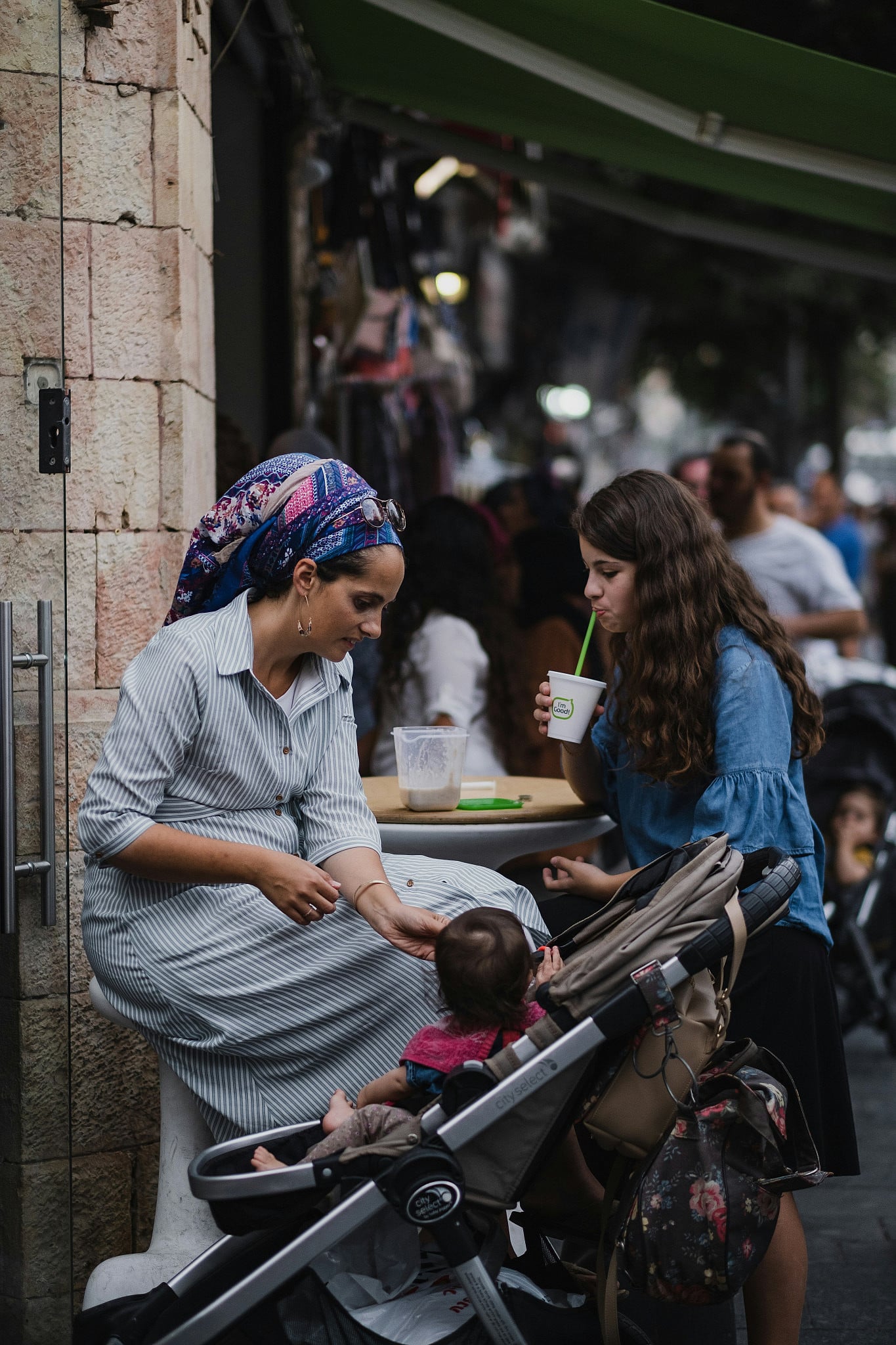
A Jewish mother, daughter, and baby are happily living normally. (Levi Meir Clancy, Unsplash)
From morahs to mothers and bus drivers to bubbes, the heroes worth admiring are not influencers chasing likes.
When people speak of “heroes” today, they usually mean celebrities, athletes, or influencers. For a child, a hero is seen through altogether different eyes. I see it each morning when I walk my daughter into the preschool at our Orthodox shul. The moment she spots her teachers, she squeals “Morah! Morah!” and runs into their arms as though leaping into a spotlight. Later at home, she sings their songs and repeats their stories as if they were epic ballets, rehearsed upon a grand stage. To her, these women are larger than life, and thus she is right. Nevertheless, they are not the only ones. Ordinary heroes dwell amidst us: in kitchens and carpools, in parks and playgrounds, in stairwells and shuls, and at bedtime tables and crowded subways.
That kind of heroism will never trend on social media or bring Hollywood fame, but it is this modest kindness that quietly shapes a soul for the better.
Once Upon a Time: Ordinary Heroes
Not so long ago, children’s heroes were close to home. A fireman who climbed a ladder. A teacher who stayed late to help. A father who worked two jobs to put food on the table. A mother who folded laundry late into the night. A soldier who came home on leave and played ball with neighbourhood kids. A grandmother who could make a single chicken stretch into three meals and still feed unexpected guests. These were the men and women whose quiet strength and sacrifice defined what it meant to be admirable.
Judaism has always understood this. “Who is honoured? He who honours others.” (Pirkei Avos 4:1) “A woman of valour, who can find? For her worth is far beyond pearls.” (Mishlei 31:10) True greatness was never about fame, but about faithfulness.

The Danger: Manufactured Fame
Today, that vision is being stolen from our children. Social media has turned admiration into a market. TikTok and Instagram feed them glossy idols with impeccable and impossible lives, where value is measured in followers, not faith or character. Psychologists call this social comparison — the tendency to measure ourselves against others — and studies show it breeds anxiety. Instagram has turned that into a child’s daily diet. Even stranger corners like Tumblr encourage children to believe that strangeness itself is a virtue — that one must be bizarre, edgy, or self-invented in order to matter.
There is an entire trend of adolescents and young adults who suddenly declare themselves “queer,” not because they are attracted to the same sex or struggling with gender dysphoria. Rather, because they crave a label in a culture that prizes spectacle over substance. The notion that one must adopt a minority identity in order to be compassionate is ludicrous. We do not need to “self-identify” as disabled to care for the disabled, nor do we need to call ourselves refugees to show mercy to strangers. One can be a supportive friend, a loyal ally, and a kind neighbour without rewriting one’s own self into a spectacle.
This culture of spectacle is not confined to labels; it has become a culture of weirdness for its own sake — where boys stretch their ears into ever-larger gauge holes as though deformity were depth, and girls are urged to prove themselves by doing armpit farts or mimicking boys to win approval. As socialite Kim Kardashian once admitted, “I would have done anything to be famous.” What once sounded shocking has become an anthem for a generation raised to think that fame itself is the prize. Children now learn that boundaries, dignity, and even morality are disposable if fame is on the line.
Of course, true illness and hardship deserve our compassion. Yet our children are watching a culture that glamorises endless self-pity, where the loudest prize is to be the most depressed, the most oppressed, the most broken. Strength and healing are pushed aside in favour of performing pain. I do not say this as someone who has never tasted hardship and just wants people to “pull themselves up by the bootstraps.” I grew up poor, the first in my family to graduate high school and then college. When I was fired and outed, made into an international media spectacle, I fell into depression. But I sought help, and slowly, with Hashem’s kindness, I got better. That is why I cannot tell children that despair itself is an identity. Pain is real — I know it well — but healing must remain the goal.
Having endured hardship myself, I also know that life sometimes needs startling voices and bold challenges. Still, that does not mean we must all live a posture of rebellion, forever chasing eccentricity as though it were — in and of itself — a valiant virtue. Amidst such confusion, children lose sight of the dignity of being steady, whole, and proper.
Is it any wonder they are anxious, lonely, and restless? We have asked them to live on a stage when what they need is a home.

The Hope: Ordinary Heroes Are Still Here
Yet the real heroes are still amongst us. They are the teachers who sing the morning songs and brachos with dozens of students, their voices weaving a harmony more powerful than any viral soundtrack. They are the morahs who spot a lonely child at recess and draw her into the circle as tenderly as a mother bird tucking her chicks beneath her wing. They are the mothers who tuck in their children after a weary day of work. They are the grandmothers who steady a stroller down shul steps. They are the bus drivers who greet each child by name.
They are also the janitors who scrub subway platforms before dawn so thousands can pass through with dignity, and the rabbis who linger after davening to notice the congregant whose eyes betray unspoken worry. As the model Linda Evangelista once quipped, “we don’t wake up for less than $10,000 a day.” The world may celebrate such glamour and extravagance, but our Jewish way teaches another measure. The morah who comforts a crying child does not ask for riches or applause. She shows that success is counted in kindness, not in outrage; in devotion, not in spectacle.
These are the figures who will never trend online, yet who quietly stitch together a child’s sense of dignity and security. A morah may never go viral, but she will shape children whose memories of her warmth will outlast every trend. A father who quietly listens to his daughter’s small worries will never grace a magazine cover. Nevertheless, he will build her sense of safety and worth more than any influencer or manufactured “identity” ever could.
Normal heroes give children permission to be normal too — to see it not as an insult, but as a gift. They remind us that life’s deepest meaning lies not in being watched, but in watching over others.

A Call to Honour — and a Mother’s Prayer
What our children need is not another slideshow of “famous people who changed the world,” but living reminders that ordinary people keep the world turning.
Imagine if schools, homes, and shuls alike placed the same spotlight on those who serve quietly as they do on those who publish loudly. Imagine if parents, amidst the Shabbos candles, spoke of the courage it takes to work quietly, love faithfully, and raise children with dignity — not only of kings or warriors. Imagine if our communities gave kavod to the woman who stays late to sweep the shul floor, to the neighbour who checks in on the housebound seniors. Imagine if we lifted up the nurse who tends to patients long after her shift has ended, or the hospital orderly who wheels the sick with gentle hands — with the same enthusiasm we lavish on social media campaigns.
Children learn whom we admire. If we only lift up the loud and the confrontational, they will think loudness is greatness. Still, if we honour the ordinary, they will see that true greatness is often hidden in plain sight — steady, humble, waiting to be noticed.
Thus, I beg — as a Jewish mother, as a woman who knows how fragile children’s hearts can be — let us not hand our little boys and girls to the glittering emptiness of the internet. Let us give them heroes who will hold their hands, not their hashtags. Let us show them that normal is not shameful, that ordinary is not failure, and that faithfulness is worth more than fame.
May our sons and daughters never confuse applause with love, nor spectacle with honour. May they grow up amidst warmth and amongst people who notice them, teach them, and care for them — thus learning that greatness is not performance, but devotion.
When my daughter looks up to her morahs at our Mount Sinai Jewish Center, I glimpse a rare and precious hope. She does not yet know the language of influencers, and I pray she never confuses that noise with greatness. To her, a hero is still someone who notices her, teaches her, and cares for her.
That is the legacy every Jewish mother yearns to leave — a world where children are safe enough to admire what is proper, whole, and good. Let us return to normalcy.

Related Topics
Related Posts