
Notes from home and far away
Childress vs. PASG: Protecting Families from Harm
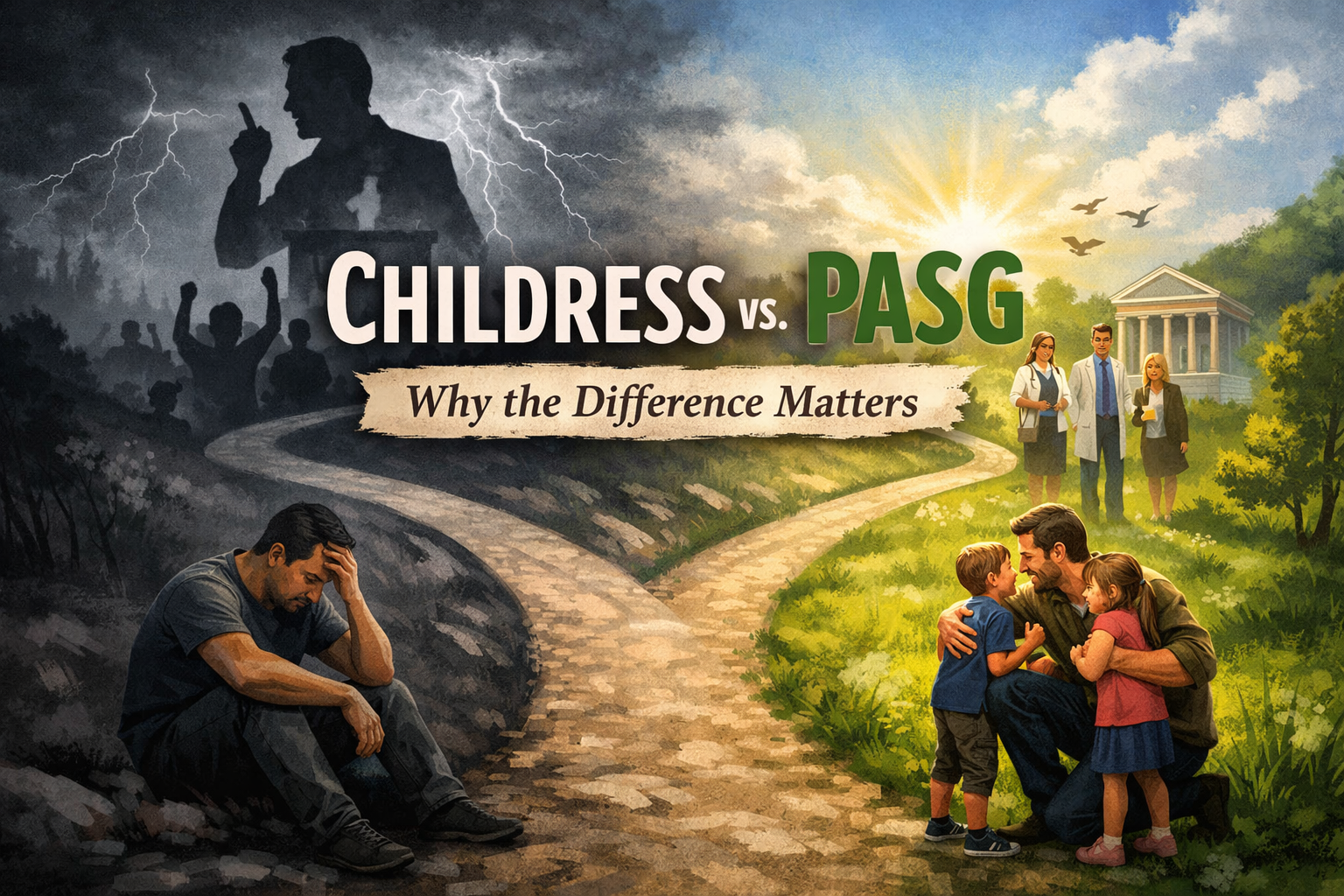
© Monique Dietvorst. AI-generated illustration.
Childress vs. PASG: Why the Difference Matters for Families
Vulnerable Parents, Power, and Responsibility in the Parental Alienation Space
For more than a decade, I have been an advocate for men, children, and families in Canada. I did not begin this work because of ideology, but because of shock.
I started in what was broadly called “men’s rights” advocacy after confronting an uncomfortable reality: an extraordinary number of men were killing themselves in the wake of family court proceedings, separation, and loss of contact with their children. This was not fringe data. It was consistent, measurable, and devastating.
Yet it was almost entirely absent from mainstream media coverage.
Instead, public attention focused narrowly on cherry‑picked narratives of “gendered violence,” while one of the largest sources of preventable death among fathers—post‑separation suicide—remained invisible.
Psychologist Don Dutton captured this imbalance starkly:
The suicide rate of divorced men is approximately 100 times higher than the spousal homicide rate (male and female victims combined).
This is not a rhetorical statistic. It is a warning.
When tens of thousands of fathers are traumatized, isolated, disbelieved, and cut off from their children, they become profoundly vulnerable. In Canada alone, social media groups now contain tens of thousands of targeted parents—overwhelmingly fathers—desperately searching for answers, validation, and hope.
Where there is mass vulnerability and no institutional recourse, there is also risk.
When parental alienation (PA) is denied or minimized in mainstream systems, parents are pushed outside them. In that vacuum, anyone who speaks confidently, forcefully, and offers certainty can become a “guru”—even if their approach ultimately serves themselves more than families or children.
This is the context in which the distinction between Craig Childress’ model and the Parental Alienation Study Group (PASG) truly matters.
This is not a personal attack. It is a necessary discussion about power, ethics, and strategy in a traumatized population.
Understanding Two Very Different Approaches to Parental Alienation
Many parents entering the parental alienation space encounter two very different frameworks. Confusion arises because both use similar language—terms like triangulation, enmeshment, and role reversal—but their foundations, methods, and implications are not the same.
Below is a clear explanation of the difference between PASG and Craig Childress’ attachment‑based model, so families and professionals can make informed decisions.
1. Scholarly Foundation
PASG
PASG explicitly grounds parental alienation in first‑order family systems and relational theories developed between the 1950s and 1970s—the same theories that underpin much of mainstream family psychology:
- Murray Bowen – triangles, multigenerational transmission
- Jay Haley – perverse triangles, cross‑generational coalitions
- Gregory Bateson – the double bind
- Ivan Boszormenyi‑Nagy – role corruption, loyalty conflicts
- Benjamin Garber – parentification, adultification, enmeshment
These theories are clearly cited, peer‑reviewed, and form the historical backbone of parental alienation research. PASG does not present PA as a novel invention, but as a well‑established relational disturbance that has been politically and institutionally suppressed.
Childress
Craig Childress uses many of these same core concepts—triangulation, cross‑generational coalitions, role reversal, and enmeshment.
However, these ideas are frequently presented without clear attribution to their original theorists. For lay readers, this can create the impression that these frameworks are new, proprietary, or uniquely developed by Childress himself.
This matters, because scholarship depends on lineage. When concepts are detached from their academic roots, credibility becomes fragile.
2. Relationship to Institutions
PASG
PASG openly acknowledges the political and institutional barriers surrounding parental alienation:
- Gendered violence ideology
- Family law incentives
- Professional and career risk for clinicians
Rather than denying these realities, PASG works within institutions to restore legitimacy through:
- Peer‑reviewed research
- Consensus statements
- Formal DSM submissions (e.g., Parental Alienation Relational Problem)
The strategy is institutional reform, not institutional warfare.
Childress
Childress argues that existing DSM categories are already sufficient and that the primary obstacle is not systems, but people.
The problem is framed as:
- Professional ignorance
- Moral failure
- Lack of courage by clinicians
The strategy emphasizes exposure, pressure, and confrontation rather than careful institutional navigation. While emotionally satisfying for traumatized parents, this approach often increases professional resistance rather than reducing it.
3. View of Professionals
PASG
PASG views clinicians, evaluators, and judges as constrained actors operating under real systemic pressures.
Its goal is to provide professionals with:
- Clear, defensible diagnostic language
- Established theoretical grounding
- Institutional and scholarly backing
This lowers professional risk and increases the likelihood of adoption.
Childress
Childress frequently portrays professionals as:
- Complicit
- Naïve
- Enablers of abuse
Parents are often encouraged to challenge, confront, or bypass professional consensus. In practice, this can backfire—especially in family court—placing already vulnerable parents at even greater risk.
4. Movement Dynamics and Risk
PASG
PASG emphasizes collective scholarship over personality.
- No single individual is indispensable
- Ideas stand independent of any one figure
- Critique strengthens, rather than threatens, the work
This structure protects the movement from becoming personality‑driven.
Childress
Childress has become a central figure for many deeply traumatized parents.
As a result:
- Strong loyalty dynamics often emerge
- Criticism of ideas is experienced as personal attack
- Emotional dependency can replace evidence‑based evaluation
In populations harmed by family court, these dynamics carry real risk. History shows that traumatized, marginalized groups are especially vulnerable to cult‑like structures—often unintentionally created.
5. Why This Distinction Matters
Parental alienation will not gain lasting legitimacy through:
- Attacking professionals
- Rejecting institutions
- Replacing evidence with loyalty
It will gain legitimacy through:
- Clear scholarly lineage
- Peer‑reviewed research
- Institutional engagement
- Ethical, non‑personality‑driven leadership
PASG provides this pathway.
No single individual is required for parental alienation to be real.
The science already exists.
This is not a personal critique. It is a strategic and scholarly distinction—essential to protecting children, families, and the long‑term credibility of parental alienation research.
Related Topics
Related Posts