The views expressed herein are solely mine.
China’s Caribbean Play: America’s New Front
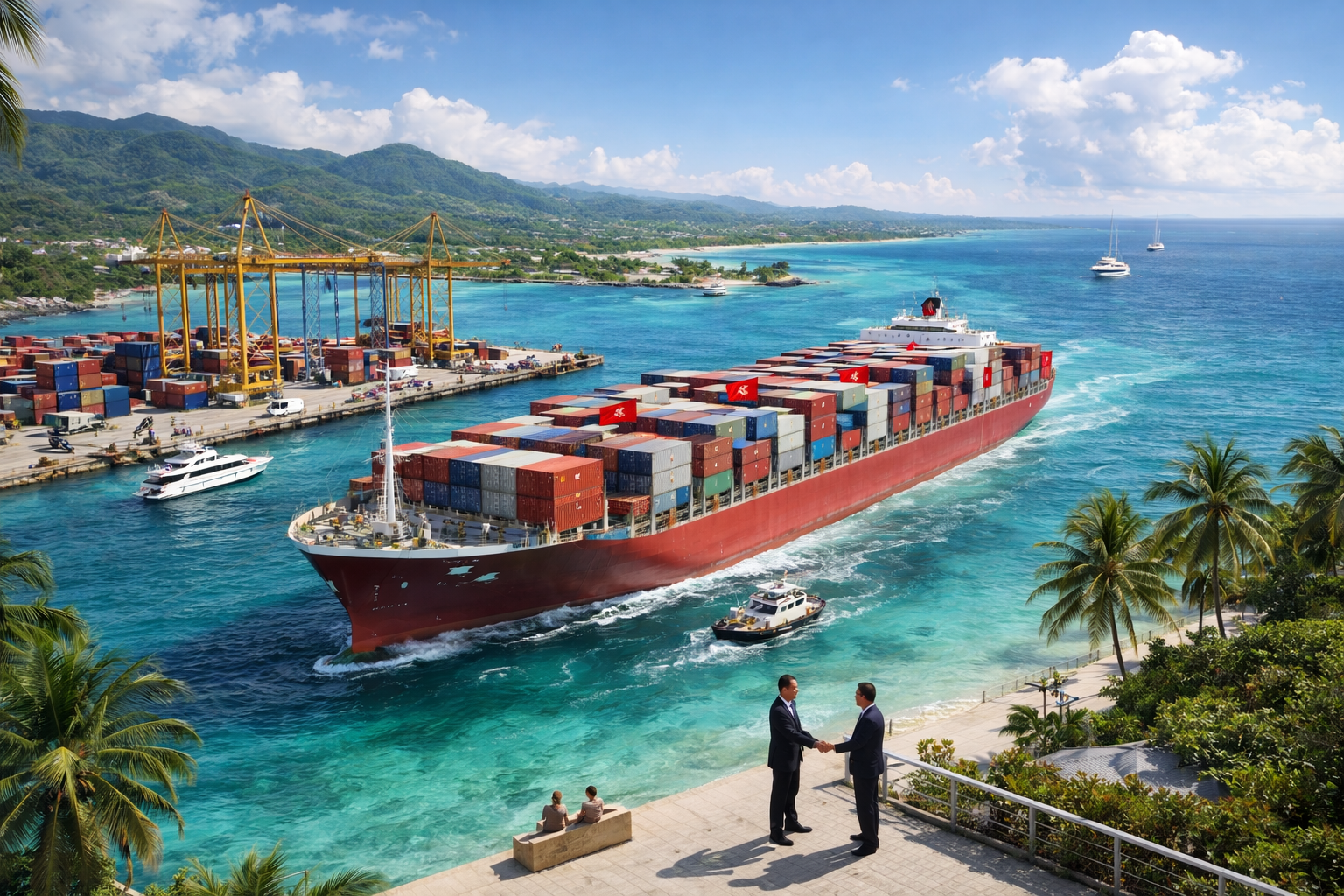
Credits: AI-Generated.
Beijing is not “investing” in the Caribbean the way a normal commercial actor invests. It is building optionality for coercion: logistics access, political leverage, and informational positioning in the United States’ near abroad—close enough to matter, small enough to pressure, and strategically dense enough to complicate U.S. and allied crisis response. This is not about dominance. It is about friction, persistence, and normalization.
In geostrategic terms, the Caribbean is not peripheral; it is a pressure belt. Sea lanes, transshipment hubs, energy routes, ports, telecom backbones, undersea cables, and diplomatic votes converge in a region only hours from the U.S. mainland.
What looks like “development” at the project level functions, at the system level, as perimeter shaping. China’s approach blends geoeconomics with state strategy, embedding itself across ports, power projects, government facilities, and digital infrastructure through firms that are formally commercial but structurally aligned with state objectives.
And this is where securitization matters. Infrastructure becomes a security issue not because it is overtly military, but because it can be reframed as existential under conditions of crisis. Ports determine inspection regimes, queuing priorities, cargo handling, and access to commercial intelligence embedded in manifests, terminal software, and contractor ecosystems.
On the other hand, telecommunications infrastructure shapes data access, surveillance capacity, and legal jurisdiction over information flows. These assets are civilian by label, but dual-use by design. In abnormal times, technical control becomes political leverage.
Across the Caribbean basin, the pattern is consistent.
In the Bahamas, Chinese-linked involvement in major port and infrastructure projects near Freeport embeds Beijing close to U.S. sea lanes, where influence over logistics, modernization standards, and data environments matters more than formal ownership.
In Jamaica, investment in Kingston’s port infrastructure places China inside a major transshipment hub, shaping throughput and long-term operational norms rather than commanding overt control.
In the Dominican Republic, the diplomatic switch from Taiwan to Beijing was followed by accelerated economic engagement, illustrating how political alignment precedes infrastructure leverage rather than the reverse.
In Trinidad and Tobago, Chinese participation in energy and industrial projects intersects with Atlantic energy markets, embedding influence where commercial, strategic, and security interests overlap.
In Suriname, resource-backed financing and construction capacity give Beijing leverage in a small state with limited alternatives, where asymmetry—not predation—is the decisive feature.
Unmistakably, the logic is not confined to individual projects. China extends financing and construction capacity where Western capital is cautious or slow, then accumulates leverage where small states lack bargaining power. Even when terms are not formally exploitative, the asymmetry produces a durable influence. Payment is not always financial. It is often diplomatic recognition, voting behavior, procurement rules, legal posture toward Chinese firms, and silence on issues Beijing cares about—most visibly Taiwan.
Certainly, Venezuela shows the darker edge of the same model. Oil-for-loans arrangements transformed energy wealth into a long-term constraint, servicing obligations through crude shipments and eroding sovereign flexibility. The precise debt figure is less important than the mechanism: short-term liquidity exchanged for years of diminished autonomy. That is not a partnership; it is a managed dependency, and it is instructive for the rest of the basin.
By any reasonable measure, that is why the January 30, 2026 ruling by Panama’s Supreme Court reverberated far beyond Panama itself.
By striking down the concession that allowed a Hong Kong–based firm to operate the two key port terminals at the mouths of the Panama Canal, the court signaled that Chinese-linked control over critical infrastructure is politically and judicially contestable—and that contestation can succeed.
Without a doubt, the canal is not merely a waterway; it is a choke point in Western Hemisphere resilience. Ports at both ends are its hands. Whoever influences port operations influences inspections, queuing, cargo priority, and the commercial intelligence that flows through global supply chains. The strategic advantage lies not in dramatic disruption, but in normalized access—until crisis makes it visible.
Nevertheless, the broader Western failure has been to treat these developments as isolated cases rather than as a coherent perimeter strategy. China does not need to invade the Caribbean to degrade U.S. or allied power. It only needs to introduce uncertainty and friction at critical nodes.
Clearly, the result is deterrence by complication: slower decision-making, constrained freedom of action, less confident allies, and regional governments conditioned to believe that balancing China is costly while accommodating China is rewarded. That dynamic matters not just for the United States, but for NATO and the wider Atlantic system, because logistics, energy flows, undersea cables, and supply chains do not stop at treaty lines.
And this is where the Trump doctrine angle becomes relevant. President Trump intuitively grasped that in an era of dual-use infrastructure, control beats ownership.
By applying political and economic pressure rather than force, Washington nudged the Panama Canal ecosystem back toward U.S.-aligned commercial control without firing a shot. It was transactional, blunt, and effective. Pressure worked where moral lectures failed. In a system defined by leverage, chokepoints, and speed, outcomes are shaped by who can act decisively, not who speaks most convincingly.
Thence, the policy implication is not to lecture the Caribbean or impose ideological purity tests. It is to outcompete—fast—with credible financing, transparent alternatives, and hard security cooperation that treats infrastructure as strategic terrain.
Taken together, Panama demonstrated that the slow-motion capture of critical nodes can be interrupted. The question is whether the United States and its partners treat that moment as a passing headline—or as the opening move in a serious Western Hemisphere strategy. In today’s world, power is leverage, normalization, and access, and nowhere is that reality clearer than in the Caribbean.
Related Topics
Related Posts