Relics from the Responsa Literature
Choose Life: The Moral Price of the Moon
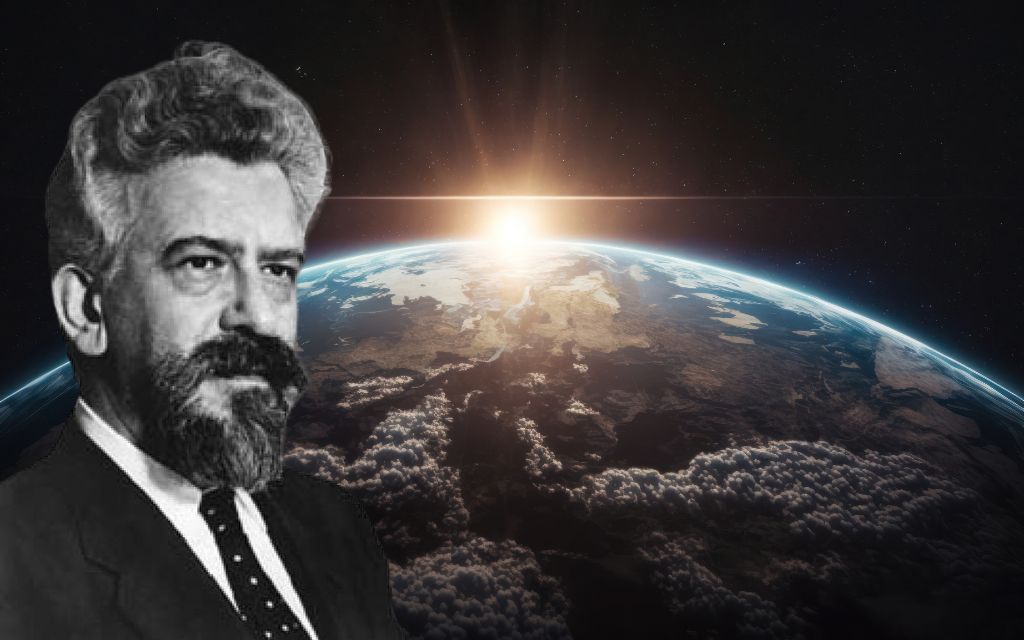
Abraham Joshua Heschel. Photo: Peter1c / Wikimedia Commons, CC BY-SA 4.0; modified from original || Background image licensed via Canva.
With the advent of Space exploration, rabbinic writers debated whether Jewish law permitted a person to leave planet Earth. Possibly the first voice to be heard on this question was that of Rabbi Menachem Mendel Schneerson of Lubavitch (1902-1994). In 1961, he wrote a private responsum in English declaring that Space travel was halakhically permitted.
A year later, Rabbi Nachum Eliezer Rabinovitch (1928-2020) took a different line when he published a short responsum in a Torah journal. There is no indication that Rabinovitch was aware of the Lubavitcher Rebbe’s responsum. According to Rabinovitch, the question was one of motive: Space exploration was not problematic, as long as it was done for the right reasons. While Rabinovitch did not detail what those reasons might be, he was clear about the wrong motive: going to Space out of hubris and a desire for self-deification.
In 1963, a third position was staked out by Rabbi Abraham Joshua Heschel (1907-1972).
****
A Prophetic Voice
Heschel was a theologian, born in Warsaw to a distinguished Hasidic family. After doctoral studies in Berlin, he was deported to Poland in October 1938. With the help of Hebrew Union College (HUC), he left Warsaw for London some six weeks before the German invasion of Poland, reaching the US in 1940. In 1945, after teaching in Cincinnati as part of the HUC faculty for five years, he moved to New York, where he took up a position at the Jewish Theological Seminary of America. Heschel was active in the US civil rights movement, and he played a prominent role in Jewish-Catholic dialogue during the Second Vatican Council.
Heschel’s writing on Space exploration was not presented as the opinion of a jurist; rather, he spoke like a biblical prophet calling for moral behaviour. His essay, “The Moral Dilemma of the Space Age”, was published in a collection titled Space: Its Impact on Man and Society (New York 1965), based on an interview conducted in 1963. The volume was not aimed at a halakhically observant audience or even a Jewish readership. Notwithstanding the general readership, Heschel addressed Jewish law.
****
Permitted, Not Justified
Heschel began his essay by recognising the great scientific and technological advances of his era. But he warned that the Space Age recalled the exhortation expressed by Moses: “I have put before you life and death, blessing and curse. Choose life” (Deuteronomy 30:19). Freedom of choice, explained Heschel, was the greatest of all freedoms, and it needed to be applied to the newest scientific vista:
The deeper meaning of this freedom, applied to our programs in space, compels us to consider their political and social consequences from a moral perspective.
Heschel was unforgiving in his assessment, describing Space exploration as a moral challenge to religion and declaring that the challenge was not being met. At the time, rabbis were debating whether Jewish law permitted Space travel. Heschel argued that this was not the key issue; rather, the moral question was paramount:
This goes beyond the question most often put; namely, whether space exploration is against God’s will.
It is unlikely that Heschel was aware of the Lubavitcher Rebbe’s private letter on Space. He may have known about Rabbi Rabinovitch’s published responsum. Most likely, Heschel was not responding to a particular rabbi but to the religious discourse of the day. As for the halakhic issue, Heschel dismissed the problem:
There is no commandment or prohibition forbidding the exploration of space”
Like Rabinovitch before him, Heschel appears to have relied on the legal maxim that everything which is not forbidden is allowed. Heschel, however, did not see this as a blanket licence for Space exploration, as he quickly qualified his words:
But the fact that an action is not forbidden does not necessarily justify its pursuit. Nor does it make it morally right.
****
Handmaiden of the State
Heschel clarified his apprehension:
It is from this perspective that I question the enthusiasm with which many people rejoice in our scientific and technological achievements in space. Some religious leaders have praised them as a great triumph of the spirit of man. A more realistic appraisal is that the triumph belongs to science and technology, which threatens the enslavement of the spirit of man by inhibiting freedom of choice. For the sheer dynamics of modern scientific and technological developments interfere with the human capacity for decision.
Heschel then turned from technology’s effect on human freedom to the political and military purposes of the Space Race: “This would be true”, wrote Heschel in reference to the problematic nature of Space exploration, “even if our only objective in space was to discover truths about the universe, which it is not.” So, what were the objectives of Space science? Heschel explained:
We are exploring space, not so much to seek scientific truths or because we are motivated by ennobling philosophic insight, but largely because space exploration has political and military value for the state.
While some religious leaders hailed Space travel as an opportunity for theological contemplation and spiritual growth, Heschel saw something else afoot:
In the past, science was subservient to the church. Its emancipation from the church – its freedom from the dominance of religious dogma – was a cause of pride and celebration. Now, for the first time in history, science has become the handmaiden of the state. Now, science must satisfy the demand of the state, and that demand is power.
According to Heschel, Space exploration at its root was a quest for power, and power was fraught with danger:
For power, even if prompted by moral objectives, tends to become self-justifying and creates moral imperatives of its own.
****
Moon or Mankind?
Heschel then rehearsed the official goals of the Space programme:
Our objective in advancing our capability in space is, as stated by our political leaders, to demonstrate power that will assure the security and maintenance of our democratic institutions. On this basis, the conquest of space has been given top priority; and a great portion of the nation’s wealth and talent is dedicated to such programs as manned lunar exploration and the search for extraterrestrial life.
Heschel was quick to point out that he was not troubled by the prospect of such discovery on theological grounds:
On the contrary, if God in creating the universe has created life elsewhere than on our planet earth, this is in perfect harmony with the Judaic understanding of the might and wisdom of God.
Here Heschel’s position was in concert with other rabbis who considered theological implications of Space travel. Nonetheless, Heschel objected to the Space programme on different grounds:
I challenge the high value placed on the search for extraterrestrial life only because it is being made at the expense of life and humanity here on earth. It is on this basis, too, that I object to the high price being paid for manned lunar exploration.
For Heschel, the key issue was priorities. Space exploration was permitted according to Jewish law, but did it justify the vast investment? More importantly, could those funds be better used for other worthy projects?
Is the discovery of some form of life on Mars or Venus or man’s conquest of the moon really as important to humanity as the conquest of poverty, disease, prejudice, and superstition? Of what value will it be to land a few men on the wilderness of the moon if we neglect the needs of millions of men on earth?
****
Earthbound Priorities
Heschel’s rhetorical questions led him to insist that religious authorities raise their voices:
The conflict we face is between the exploration of space and the more basic needs of the human race. In their contributions to its resolution, religious leaders and teachers have an obligation to challenge the dominance of science over human affairs. They must defy the establishment of science as God. It is an instrument of God which we must not permit to be misused.
Other religious leaders sounded a similar call. On 15 July 1969, the eve of the launch of Apollo 11, Reverend Ralph Abernathy (1926-1990) – a close friend of Reverend Dr Martin Luther King Jr (1929-1968) and his successor as head of the Southern Christian Leadership Conference – arrived at Cape Kennedy with a group from the Poor People’s Campaign to protest government allocations for the Space programme. As NASA Administrator Thomas O. Paine (1921-1992) later recorded Abernathy’s argument, money invested in Space exploration should be used “to feed the hungry, clothe the naked, tend the sick, and house the shelterless”.
In 1965, Heschel and Abernathy had marched together with Dr King as part of the third Selma-to-Montgomery march for African American voting rights. Neither religious leader condemned technological advancement. In fact, at the 1969 protest, Abernathy said to Paine:
On the eve of one of man’s noblest ventures, I am profoundly moved by our nation’s scientific achievements in space and by the heroism of the three men who are embarking for the moon.
But Abernathy could not justify “the tragic and inexcusable gulf between America’s technological abilities and our social injustice”, adding: “What we can do for space and exploration we demand that we do for starving people.”
Similarly, Heschel reiterated that there was “no theological prohibition against doing research beyond the confines of this planet”, as he called for a reassessment of priorities and wondered whether Space exploration should eclipse human needs. According to Heschel, the large sums of money that the US government was investing in Space research should be redirected to retraining men and women who were structurally unemployed because of “mushrooming technology”. More funds should be allocated to fight poverty, particularly given his assessment that more than a quarter of the population was “ill-clothed, ill-housed, and ill-fed”.
Referring to US experiments that sent non-human primates into Space, Heschel delivered a damning verdict:
On any moral or ethical basis, when we can overlook the suffering of humanity in our childish delight in our ability to place monkeys and men in orbit around the earth, we are ill-prepared spiritually and morally for the vast accumulation of power which we are achieving through science.
****
Hope, Pray, and Demand
Despite his scathing attack, Heschel expressed faith in humanity’s ability to face the enormous challenge:
[W]e must exert the spiritual will to focus the attention of our minds and hearts on the problems we face. We cannot avoid them by reaching for the moon or grasping for life elsewhere. We must turn our efforts to rediscovering the true value and dignity of man, what man’s life means as a totality in its great dimensions, his great potential for the creative arts, for the advancement of science in the search for peace and understanding, for acts of charity.
The Lubavitcher Rebbe had permitted Space travel and saw it as spiritually and theologically valuable. Rabbi Rabinovitch granted a conditional licence, shifting the focus to motive. Rabbi Abraham Joshua Heschel went further still, calling for a reassessment of priorities: Though Space exploration is halakhically permitted, it is not necessarily a worthy pursuit.
Heschel signed off his essay by questioning what lay ahead:
The choice for man and humanity in this Space Age lies not in the stars but right here on this blessed planet earth. Will mankind fulfill its great destiny? Who can predict? We can only hope, pray, and demand.
Heschel passed away on 23 December 1972 – four days after the splashdown of Apollo 17, the last crewed Moon landing. As Artemis missions again reach for the Moon, Heschel’s questions remain relevant: What are our priorities here on Earth?
Related Topics